
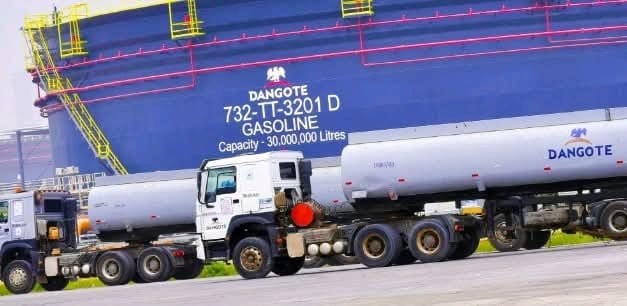
A recent reduction in petrol prices announced by the Dangote Petroleum Refinery was expected to bring immediate relief to millions of Nigerians grappling with soaring living costs. However, days after the adjustment at the wholesale level, the anticipated relief has yet to be fully reflected at filling stations across the country, leaving motorists and businesses still paying as much as ₦1,300 per litre or more for petrol.
The development has reignited concerns about longstanding inefficiencies within Nigeria’s downstream petroleum sector, where price increases are often implemented swiftly while reductions take significantly longer to reach the final consumer. For many Nigerians already struggling with rising transportation costs and inflationary pressures, the delay in passing on the benefits of the refinery’s price cut has become another symbol of the imbalance that frequently characterizes the country’s fuel market.
The Dangote refinery recently lowered its gantry price—the wholesale price at which fuel is sold to marketers—from previous levels by ₦100 per litre, bringing the new price down to ₦1,075 per litre. The adjustment came after a notable drop in international crude oil prices, which typically influence the cost of refined petroleum products worldwide.
Global oil markets had witnessed a decline in the price of Brent Crude, which fell from roughly $110 per barrel to about $92 per barrel. Analysts attributed the drop to easing geopolitical tensions and signals suggesting that confrontations involving the United States, Iran, and Israel might begin to de-escalate.

Ordinarily, such a shift in global oil prices would quickly translate into lower retail fuel prices, especially in a deregulated market environment where pricing is expected to reflect real-time market conditions. Yet across many cities and towns in Nigeria, motorists have reported little or no change at the pump.
DDM News observed that while a handful of filling stations—particularly those affiliated with NNPC Limited—have adjusted their pump prices downward, the majority of independent marketers have maintained existing rates that range between ₦1,300 and ₦1,355 per litre.
In the federal capital, Abuja, some retail outlets operated by NNPC Limited reduced their prices from around ₦1,265 per litre to approximately ₦1,161 per litre. A small number of private fuel retailers followed the adjustment. However, many other marketers have continued selling petrol at much higher prices despite the drop in wholesale costs.
This pattern has become all too familiar in Nigeria’s petroleum market. When global crude prices rise, pump prices often increase almost immediately as marketers adjust to higher supply costs. But when international prices fall, the downward adjustments at retail stations tend to occur slowly, cautiously, and unevenly across the country.
For ordinary Nigerians, this imbalance creates a perception that the system operates in only one direction—quickly passing on higher costs while delaying potential savings. The result is growing frustration among consumers who feel that market forces are not being applied fairly.
DDM News gathered that the persistent gap between depot prices and retail prices has had ripple effects throughout the broader economy. Fuel costs play a central role in Nigeria’s economic structure, influencing transportation fares, food prices, and operational expenses for small and medium-sized businesses.
Transport operators are often the first to react to increases in petrol prices. Bus drivers, taxi operators, and motorcycle riders typically raise fares immediately when fuel becomes more expensive. These increases are then passed on to commuters, who must pay more to travel to work, school, and markets.
However, when fuel prices fall at the wholesale level, transport fares rarely drop at the same pace. This creates a situation where consumers continue to bear the burden of high transportation costs long after the underlying fuel price has decreased.
For commercial transport workers themselves, the situation is equally difficult. Many operate on narrow profit margins and rely heavily on daily fuel purchases. When retail fuel prices remain elevated despite falling crude oil prices, their operating costs remain high while passenger demand weakens due to rising fares.
The situation also affects small businesses across the country. Shop owners, delivery services, farmers transporting produce, and artisans running generators all face higher operating expenses when fuel prices remain elevated. These costs ultimately contribute to broader inflation, pushing up the prices of goods and services throughout the economy.
The launch of the Dangote refinery was widely seen as a potential turning point for Nigeria’s fuel market. As one of the largest refining facilities in the world, the complex has been expected to significantly reduce the country’s dependence on imported petroleum products, a dependency that historically exposed Nigeria to fluctuations in foreign exchange rates and international shipping costs.
Industry analysts estimate that the refinery now supplies a substantial share of Nigeria’s domestic petrol demand, helping conserve billions of dollars previously spent on importing refined fuel. The refinery’s management has also implemented multiple gantry price reductions over the past year in response to changes in global crude oil markets.
These reductions were designed to ensure that local fuel prices reflect international trends while providing greater transparency within Nigeria’s petroleum supply chain. However, the benefits of such adjustments can only be realized if marketers pass them on to consumers at the pump.
This is where regulatory oversight becomes critical. Nigeria’s downstream sector is supervised by the Nigerian Midstream and Downstream Petroleum Regulatory Authority, which is responsible for ensuring transparency and fair competition among market participants.
Although Nigeria’s fuel market has been officially deregulated following the removal of government subsidies, deregulation does not eliminate the need for oversight. Regulators are still expected to ensure that market practices remain transparent and that consumers are protected from potential distortions within the supply chain.
Energy analysts argue that effective monitoring is essential to maintain public confidence in the ongoing reforms within Nigeria’s petroleum sector. If consumers consistently experience price increases without corresponding reductions when costs fall, skepticism about the fairness of the market will inevitably grow.
At the same time, global energy markets remain highly volatile. Developments in the Middle East continue to influence oil prices, particularly tensions surrounding the Strait of Hormuz, through which a significant portion of the world’s oil supply passes.
Recent disruptions linked to regional conflicts have demonstrated how quickly supply chains can be affected, causing oil prices to surge unexpectedly. International organizations such as the International Energy Agency have even taken extraordinary steps, including releasing hundreds of millions of barrels from emergency reserves to stabilize global markets.
Major oil-producing countries like Saudi Arabia and the United Arab Emirates have also explored alternative export routes to bypass potential disruptions in the Strait of Hormuz.
Against this backdrop, Nigeria’s growing domestic refining capacity offers a rare opportunity to shield its economy from some external shocks. However, the success of these reforms ultimately depends on whether the benefits of local production are actually felt by ordinary citizens.
For millions of Nigerians lining up at filling stations every day, the real measure of progress lies not in policy announcements or refinery output statistics but in the price displayed on the fuel pump. Until reductions at the depot consistently translate into lower prices at retail stations, many consumers will continue to feel that the promise of a more efficient and transparent fuel market remains only partially fulfilled.