



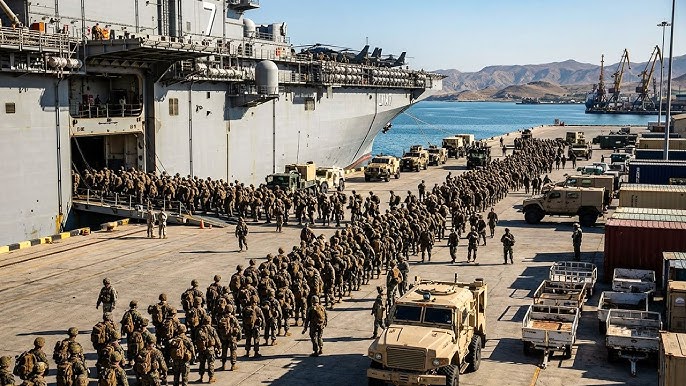
The United States has significantly escalated its military posture in the Middle East by ordering the deployment of the amphibious assault ship USS Tripoli (LHA-7) and elements of the 31st Marine Expeditionary Unit to the region amid intensifying tensions involving Iran, Israel, and several allied powers. The move, approved by the U.S. Department of Defense following a request from U.S. Central Command, signals a major reinforcement of American military presence in the Gulf at a time when the conflict with Iran is widening and threatening critical global energy routes.
According to multiple international reports, the deployment involves roughly 2,200 to 2,500 United States Marines who are being transported aboard a group of U.S. Navy amphibious warships led by the USS Tripoli. These forces are expected to arrive in the Middle East within one to two weeks after departing from their forward operating base in Okinawa, Japan.
Military analysts say the deployment represents one of the most significant reinforcements to the region since the escalation of hostilities between the United States, Israel, and Iran earlier in 2026. The amphibious assault ship USS Tripoli, an America-class warship commissioned in 2020, is capable of carrying helicopters, F-35B fighter jets, landing craft, and hundreds of Marines prepared for rapid amphibious operations.
The arrival of the Tripoli and its accompanying Marine Expeditionary Unit will give American commanders a flexible range of military options, including humanitarian assistance missions, crisis response operations, evacuation of civilians, and, if necessary, amphibious combat operations along hostile coastlines.

DDM News gathered that the decision to send the Marine force was made as the conflict involving Iran and Israel continues to intensify, with U.S. forces increasingly drawn into the confrontation. The United States has already carried out extensive air and naval operations across the region while attempting to protect shipping routes and strategic infrastructure from Iranian attacks.
Reports indicate that the Pentagon approved the deployment after reviewing requests from United States Central Command, which oversees American military operations in the Middle East. Officials believe the additional Marines and amphibious ships will strengthen deterrence and provide the U.S. with the capability to respond quickly to emerging threats across the Persian Gulf.
The 31st Marine Expeditionary Unit, which forms the backbone of the deployment, is a forward-deployed rapid-reaction force permanently stationed in Okinawa, Japan. The unit is specifically designed for crisis response and can conduct a wide range of missions, including amphibious assaults, counterterrorism operations, disaster relief, and military evacuations.
Typically composed of around 2,200 Marines along with aircraft and armored vehicles, the unit operates from a group of amphibious warships known as an Amphibious Ready Group. Together, these ships function as a mobile sea-based military platform capable of launching operations from international waters without relying on foreign bases.
DDM News understands that the decision to send the Tripoli strike group also reflects growing concern within Washington over Iran’s recent actions around the strategically vital Strait of Hormuz. The narrow waterway is one of the world’s most critical energy corridors, with a large portion of global oil shipments passing through it daily.
In recent weeks, Iranian forces have reportedly targeted or threatened commercial shipping and energy infrastructure across the Gulf, raising fears of a broader regional conflict that could disrupt global oil markets. The United States has warned that it will take necessary measures to ensure the freedom of navigation in the region.
Meanwhile, the ongoing conflict has already produced significant casualties and widespread geopolitical consequences. International reports indicate that thousands of sites across Iran have been targeted by joint American and Israeli strikes since the escalation began, while Iranian retaliatory missile and drone attacks have struck several locations across the Middle East.
The situation has prompted growing concern among global leaders about the possibility of a wider regional war involving multiple countries and armed groups. The United States has steadily expanded its military buildup in the Middle East since early 2026, deploying additional aircraft carriers, fighter jets, missile defense systems, and naval assets to the region.
Within military planning circles, the arrival of the USS Tripoli and the Marine Expeditionary Unit could significantly enhance American operational flexibility. Amphibious forces are often used to seize strategic coastal infrastructure, protect vital maritime routes, or establish forward operating positions if ground operations become necessary.
Some analysts have speculated that such forces could theoretically be used in operations targeting Iran’s critical energy facilities along the Persian Gulf coastline, including key oil export terminals. However, U.S. officials have not publicly confirmed any specific operational objectives for the deployment.
Instead, Pentagon officials have emphasized that the deployment is primarily intended to strengthen deterrence and provide additional security options should the regional crisis continue to escalate.
Beyond its military significance, the move underscores the growing complexity of the geopolitical confrontation unfolding in the Middle East. With multiple nations involved and tensions continuing to rise, the arrival of thousands of U.S. Marines and advanced naval assets signals that Washington is preparing for a range of possible scenarios.
For now, the USS Tripoli and its Marine contingent continue their journey toward the Gulf, where their presence is expected to reshape the military balance in one of the world’s most volatile regions. As the crisis between Iran and its adversaries deepens, the deployment marks another critical moment in a rapidly evolving conflict that could have profound implications for global security and energy markets.




