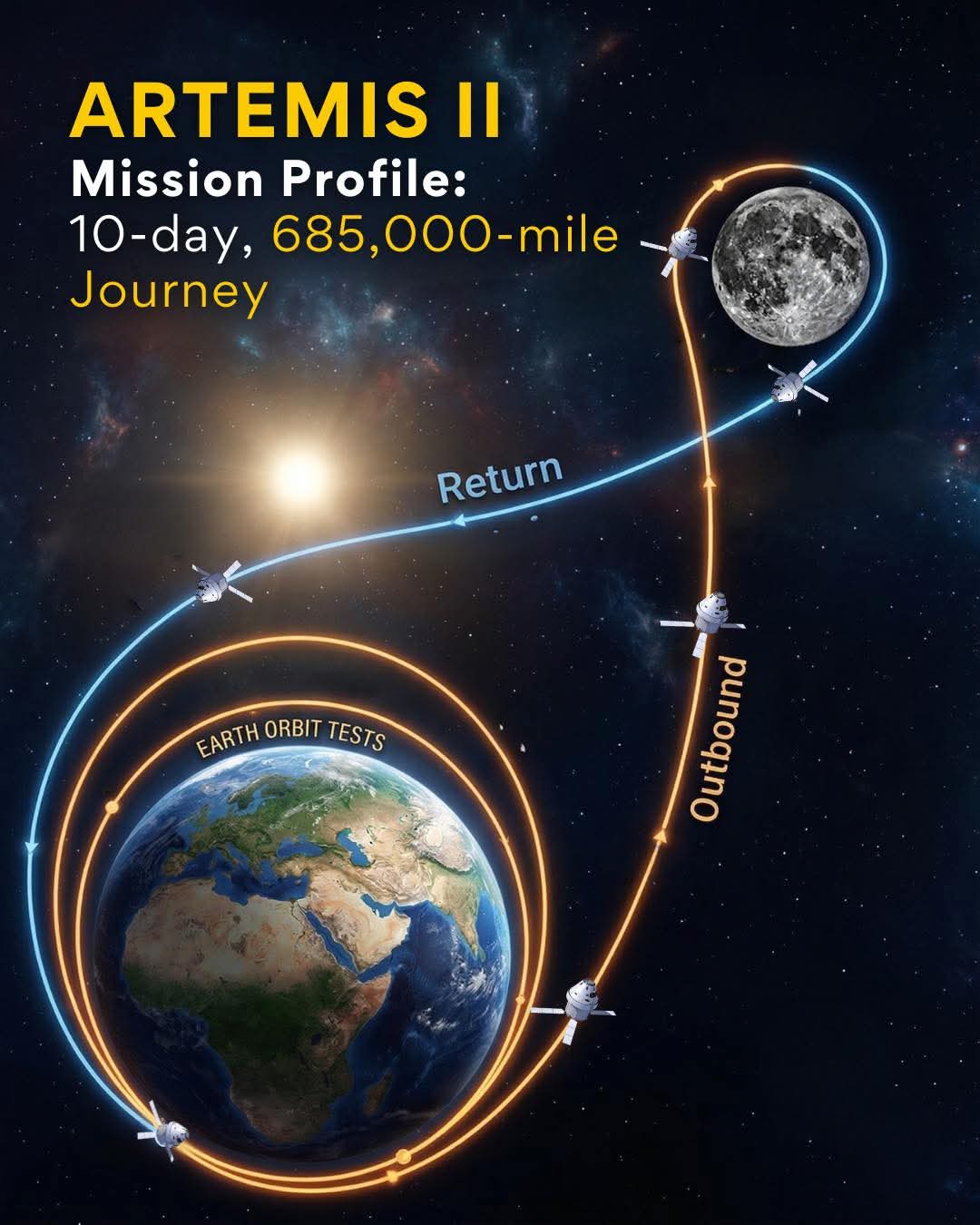
NASA’s Artemis II astronauts are officially looping around the Moon. This 10-day mission marks the first human deep-space flight in over 50 years.
NASA successfully launched the Artemis II mission on April 1, 2026. Currently, four astronauts are travelling beyond low Earth orbit. Specifically, they are flying around the Moon to test critical spacecraft systems. This historic journey will directly pave the way for future lunar landings.
Testing the Artemis II Flight Path
The four-person crew is currently following a precise 10-day mission route. First, the Orion capsule entered high Earth orbit to test life support systems. Following this, the spacecraft fired its engines to push into deep space. As a result, the crew is now travelling on a free-return trajectory. To put it simply, Earth’s gravity will automatically pull the spacecraft back home. Furthermore, the astronauts will safely return without needing extra engine burns.
Meeting the Historic Artemis II Crew
The mission carries a highly skilled team of space explorers. Commander Reid Wiseman safely leads the flight alongside pilot Victor Glover. In addition, mission specialists Christina Koch and Jeremy
https://ddmacademy.net/kidscodingclasses
Hansen round out the crew. Because of this mission, Hansen makes history as the first Canadian near the Moon. Moreover, Koch holds the record for the longest single spaceflight by a woman. Ultimately, Glover recently shared his thoughts on the journey’s emotional significance.
“That’s when we will be closest to the Moon, farthest from the Earth. But it is also a human moment.” Victor Glover, Artemis II Pilot
Pushing the Limits of Deep Space Exploration
This flight marks a massive milestone for human space travel. Specifically, humans have not travelled this far from Earth since 1972. During the trip, the crew will cover roughly 685,000 miles in total. Meanwhile, engineers on the ground are carefully monitoring Orion’s daily performance. Therefore, this real-world testing ensures that the spacecraft can handle longer missions. Also, the team will practise important course changes and long-distance communications.
Preparing for Future Lunar Landings
Artemis II serves as a vital stepping stone for modern science. The current crew will not land on the lunar surface during this flight. However, their rigorous work guarantees safety for the astronauts who follow them. Consequently, NASA plans to actually land humans on the Moon by 2028. Overall, this lunar flyby gives researchers the exact data they need. That is to say, scientists will use this information to build a permanent base.
In summary, the Artemis II mission brings humanity one step closer to the stars. The spacecraft is officially scheduled to splash down in the Pacific Ocean on April 10. Until then, the world eagerly watches as these astronauts make history in deep space. Soon, this successful test flight will open the door to deeper lunar exploration.