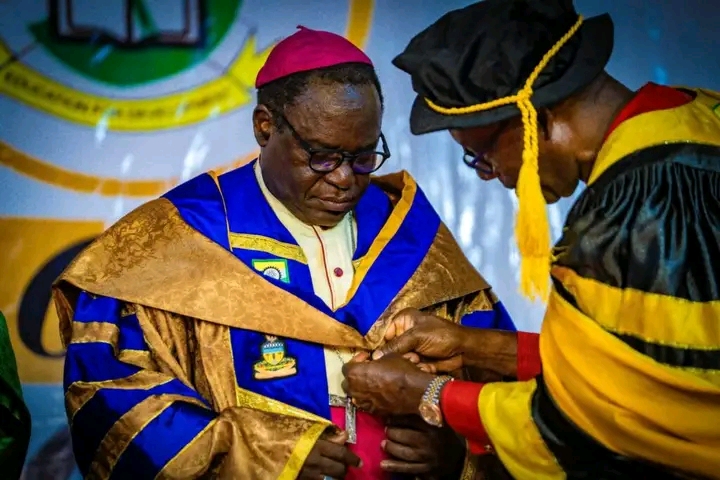
SOKOTO, NIGERIA — Bishop Matthew Kukah has called on Nigerians to stop addressing him as a Hausa man, clarifying his ethnic identity and reigniting national discussions on how identity is assigned in public discourse.
The statement was made on Sunday, April 26, 2026, during a public engagement in Sokoto State, where the Catholic Bishop of Sokoto Diocese addressed misconceptions about his background and how his identity is commonly described in Nigeria.
Bishop Kukah stressed that while he has spent many years living and carrying out religious and civic duties in northern Nigeria, particularly in Sokoto, this should not be mistaken as evidence of Hausa ethnicity.
He explained that his identity has often been incorrectly described due to his long residence and public service in a predominantly Hausa-speaking environment, warning that such assumptions distort personal history and contribute to broader misunderstandings in a diverse country.

The cleric noted that Nigeria’s multicultural structure requires careful attention to how individuals are identified, especially in public commentary, media reporting, and everyday conversation, where assumptions are often made without accurate verification.
His remarks also highlighted a recurring national issue where people are assigned ethnic identities based on geography, professional roles, or long-term residence rather than actual origin, a trend he said should be corrected.
Kukah, who is widely recognised for his outspoken views on governance, democracy, and interfaith relations, has often operated at the intersection of Nigeria’s religious and ethnic diversity, making his public identity frequently subject to misclassification.
The clarification has triggered renewed debate about ethnic labelling in Nigeria, with commentators divided over whether such misidentifications are harmless generalisations or deeper reflections of insufficient cultural awareness.
Some observers argue that in a country as diverse as Nigeria, it is common for individuals to be associated with the dominant ethnic group of the region where they live or work, while others insist that accuracy in identity representation remains essential.
Religious and civic voices have also weighed in, noting that figures like Kukah, who serve outside their ethnic regions for long periods, are particularly vulnerable to such assumptions.
Analysts say the issue reflects broader questions about national identity, integration, and the challenges of maintaining cultural accuracy in a society where mobility and interethnic interaction are increasingly common.
As discussions continue, Kukah’s statement is expected to keep the conversation alive on how Nigerians perceive identity, and whether greater public awareness is needed to prevent repeated misclassification in national discourse.