


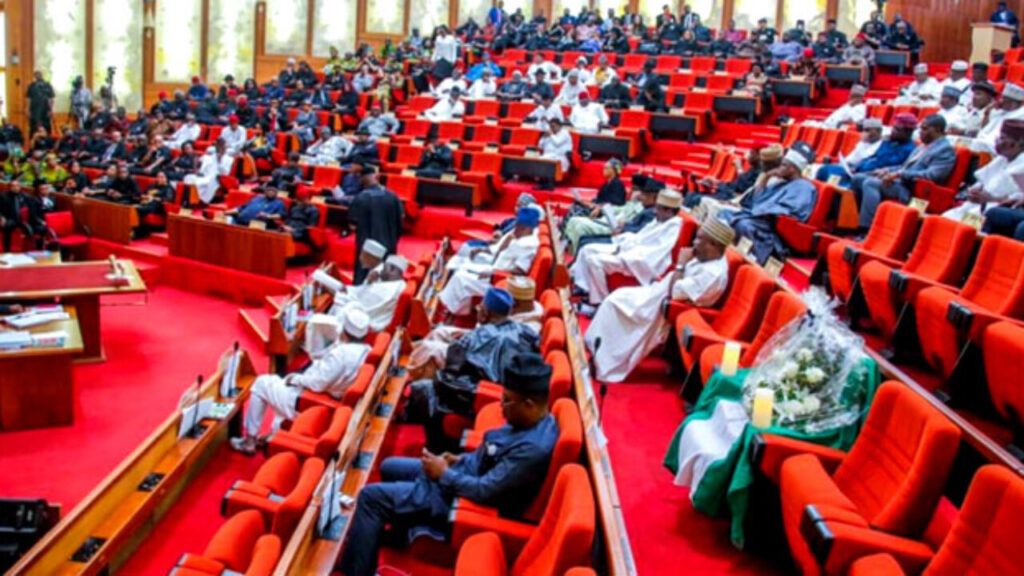
The Nigerian Senate has passed the 2026 Electoral Act Amendment bill, with focus to provide jurisdiction of the court in handling pre-election matters.
The passage followed presentation of report by the Committee on INEC by its Chairman Sen. Simon Lalong (APC-Plateau) at plenary on Thursday.
The proposed amendment aims to address gaps, timelines and court jurisdiction in the resolution of pre-election disputes.
Mr Lalong in his lead debate said the bill sought to address one of the most persistent procedural and constitutional challenges in the nation’s electoral jurisprudence.

According to him, it sought to address the uncertainty, multiplicity and inconsistency associated with the jurisdiction for the determination of pre-election matters.
He said democracy thrives not merely on the conduct of elections, but also on the credibility, certainty and predictability of the legal processes that precede the elections.
“The legitimacy of candidates and the integrity of party primaries are foundational pillars of representative democracy.
“Where the legal framework regulating pre-election disputes is uncertain or conflicting, the entire electoral architecture becomes vulnerable to confusion, forum shopping, contradictory judgments and unnecessary delays,” Lalong said.
He said the bill targets amendments to section 29 of the electoral act and introduces a new section 29A to clearly delineate jurisdictional competence in pre-election matters.
He said in spite provisions of section 285(14) of the Constitution of Federal Republic of Nigeria, 1999 on pre- election matters, the legal system continued to witness conflicting interpretations, regarding appropriate court with jurisdiction to entertain disputes.
The uncertainty, Lalong noted results in conflicting decisions from courts of coordinate jurisdiction and abuse of judicial process.
According to him, the uncertainty also results in undue delay in the resolution of electoral disputes and avoidable constitutional tension between courts.
He said the amendment sought would bring clarity, order and constitutional harmony to the adjudication of pre-election matters.
He listed highlights of the amendment to include clause two of the bill which amends section 29 (5) of the principal act.
He said the clause provides that an aspirant may institute an action either in the Federal Capital Territory (FCT) or in the jurisdiction where the cause of action arose.
“This amendment is both practical and equitable, it reduces hardship on litigants, improves access to justice.
“It aligns electoral adjudication with territorial realities surrounding political primaries and nomination processes.
“More fundamentally, clause three introduces a new section 29A, which is the substantive innovation of this bill.
“The proposed section 29A establishes a clear jurisdictional framework on pre-election matters relating to elections into the National Assembly, Governorship and State Houses of Assembly.
“It shall originate at the Federal High Court, with appeals lying to the Court of Appeal.”
He said pre-election matters relating to the offices of president and vice president shall originate at the Court of Appeal exercising original jurisdiction, with appeals lying to the Supreme Court.
Mr Lalong said the proposal was not arbitrary, adding that it was rooted firmly in constitutional logic, judicial efficiency and the doctrine of hierarchy of courts.
“Presidential elections are national in character and constitutional significance.
“Given the sensitivity and urgency associated with such offices, vesting original jurisdiction in the Court of Appeal ensures expeditious determination by a superior court of record with nationwide competence and institutional capacity.
“Similarly, assigning jurisdiction over other pre-election matters to the Federal High Court promotes specialisation and consistency, especially given the federal nature of electoral administration through the INEC.”
Mr Lalong said the bill also sought to eliminate the dangerous practice where litigants deliberately institute multiple suits in different judicial divisions in search of favourable orders.
According to him, such practices erode public confidence in the judiciary and undermine electoral stability.
“By expressly providing that no court shall entertain pre-election matters except in accordance with the proposed section 29A, this amendment introduces certainty and procedural discipline into electoral adjudication.”
He said the bill ultimately provides clear judicial pathway that would reduce delays and enhance judicial efficiency.
“The amendment before us is not merely procedural, it is institutional.
“It strengthens electoral justice, deepens democratic accountability and reinforces public confidence in our electoral process.”
Mr Lalong said the bill was timely, necessary and in the national interest and urged lawmakers to support its passage.
Contributing, Sen. Mohammed Monguno (APC-Borno) after seconding the motion said the amendment sought was apt and germane.
According to him, it will lead to an improved experience in the nation’s electoral litigation and urged the lawmakers to support the passage of the bill.
President of Senate, Godswill Akpabio in his remarks after the bill was passed commended the Chairman and the committee members for their inputs on the bill.
He expressed believe that the bill would be assented to by President Bola Tinubu, saying that act would deepen democracy and governance in Nigeria.
NAN




