



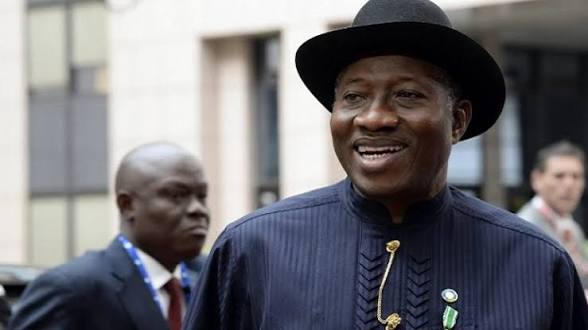
The Federal High Court sitting in Abuja has scheduled Friday, May 8, 2026, for the hearing of a legal suit seeking to restrain former President Goodluck Jonathan from participating in the 2027 presidential election.
The case, which has already generated widespread political and legal debate across the country, challenges the eligibility of the former Nigerian leader to contest for the nation’s highest office once again, nearly a decade after he left power in 2015.
The suit was instituted by an Abuja-based legal practitioner, who is asking the court to issue a perpetual injunction preventing Jonathan from presenting himself for nomination by any political party ahead of the 2027 general elections. The plaintiff is also seeking an order that would compel the Independent National Electoral Commission to reject and refuse to publish Jonathan’s name should any political party nominate him.

Although the matter is still at the preliminary stage, it has already attracted significant attention due to its political implications and the high-profile nature of the individual involved. The court, presided over by Justice Peter Lifu, fixed the date for hearing after confirming that processes had been served and that some of the defendants were yet to respond to the originating summons.
At the heart of the legal dispute is the interpretation of constitutional provisions relating to presidential eligibility, particularly the impact of Section 137(3) of the 1999 Constitution (as amended), which bars any person who has been sworn in twice as President from contesting again.
The plaintiff argues that the former President, who is a member of the Peoples Democratic Party, has already been sworn in twice, first in 2010 following the death of President Umaru Musa Yar’Adua and subsequently after winning the 2011 presidential election. On this basis, the suit contends that he has exhausted the constitutional limit and is therefore ineligible to seek another term in office.
However, the legal debate surrounding Jonathan’s eligibility is not new. Over the years, different interpretations of the constitution have led to contrasting court decisions and political arguments. In 2022, a Federal High Court in Bayelsa dismissed a similar suit, ruling that the constitutional amendment introducing Section 137(3) could not be applied retroactively against Jonathan since his tenure as President ended in 2015, before the provision came into effect.
That earlier judgment has continued to serve as a reference point for those who argue that Jonathan remains constitutionally eligible to run for office if he chooses to do so. On the other hand, critics maintain that his two-time oath-taking status disqualifies him under the spirit and intent of the amended constitutional provision.
As the case returns to court in Abuja, the legal arguments are expected to revolve around key constitutional questions, including the interpretation of electoral eligibility clauses, the principle of retroactivity in constitutional amendments, and the legal definition of a “term” in office where succession occurs outside of general elections.
Beyond the courtroom, the matter has also stirred political conversations nationwide. Although Goodluck Jonathan has not officially declared his intention to contest the 2027 presidential election, there have been increasing reports of political consultations and endorsements from various groups encouraging him to re-enter the race.
Supporters of a potential Jonathan candidacy often cite his experience, international reputation, and perceived political moderation as reasons why he could provide stability in a highly competitive electoral environment. His previous administration, which lasted from 2010 to 2015, remains a subject of both praise and criticism depending on political perspectives and regional affiliations.
However, opposition voices argue that any attempt by Jonathan to return to the ballot would raise serious constitutional concerns and could set a precedent that undermines established legal limits on presidential tenure.
The Independent National Electoral Commission, which is listed as a defendant in the suit, is also expected to play a central role in the outcome of the case. The commission may be required to clarify its position on whether it would accept or reject Jonathan’s nomination should a political party present him as a candidate.
Legal analysts have noted that the court’s eventual interpretation could have far-reaching implications not only for Jonathan’s political future but also for Nigeria’s broader electoral and constitutional framework. The decision may help define the boundaries of eligibility for former office holders and clarify the application of constitutional amendments in future elections.
As the hearing date approaches, political stakeholders, legal experts, and party supporters are closely watching developments, with expectations that the ruling could either settle or further intensify the debate surrounding the 2027 presidential contest.
For now, all eyes remain on the Federal High Court in Abuja as it prepares to hear arguments in what is shaping up to be one of the most closely watched pre-election legal battles in recent years.

![Google just put a Hollywood studio inside your smartphone. Kenya is spending millions to watch what you say online. And Meta is caught in a billion-dollar tug-of-war with China over the future of artificial intelligence.
Welcome to DDM Tech Buzz! Today we are breaking down the biggest tech stories of the week. We deep dive into Google Flow's new mobile app that lets you create pro-level AI videos from your phone. Then, we look at the controversy surrounding Kenya's $20.8 million AI social media monitoring system. Finally, we unpack the geopolitical tech thriller between Meta, China, and AI startup Manus.
TELL ME IN THE COMMENTS:
Are you Team Android or Team iOS for Google Flow?
Should governments use AI to monitor social media?
Who wins the AI war: US or China?
Don't forget to SUBSCRIBE for more weekly tech news and deep dives!
[Timestamps - For easy navigation] 0:00 - Intro: The AI Takeover 2:00 - Google Flow Goes Mobile (Game Changer!) 8:30 - Kenya’s Controversial $20.8M AI Surveillance 14:00 - Meta vs. China: The Billion-Dollar AI Battle 18:30 - Outro & What Do You Think?
[Connect with DDM Tech Buzz]
Sign up for our FREE weekly newsletter:https://ddm-tech-buzz-daily.lovable.app
#TechNews #GoogleFlow #ArtificialIntelligence #Meta #ManusAI #KenyaTech #AIVideo #TechBuzz #FutureOfTech](https://diasporadigitalmedia.com/wp-content/plugins/feeds-for-youtube/img/placeholder.png)

