


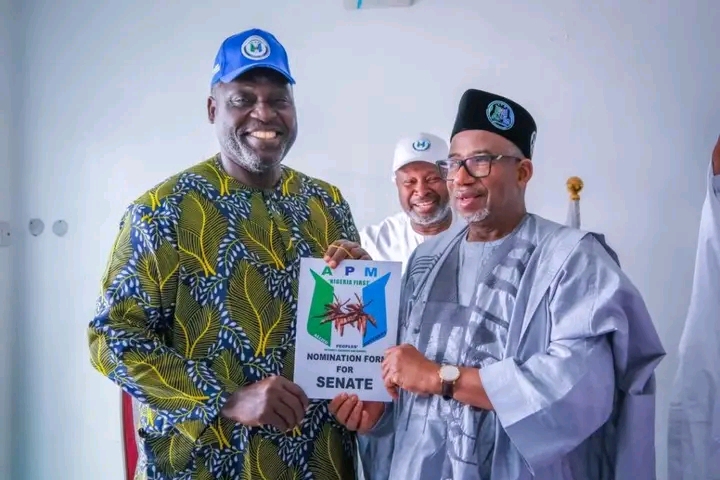
The political landscape in Bauchi State witnessed another major shift on Thursday as Governor Bala Mohammed formally picked the senatorial nomination form of the Allied Peoples Movement to contest for the Bauchi South Senatorial District seat ahead of the 2027 general elections.
The move, which followed his recent exit from the Peoples Democratic Party, is already generating significant reactions within opposition circles and among political stakeholders monitoring the growing wave of realignments ahead of the next election cycle.
Mohammed obtained the nomination form during the National Executive Committee meeting of the APM, where party leaders and delegates received the governor and his political associates into the party structure.

The development is widely seen as a strategic political step by the Bauchi governor as he prepares for life after the completion of his second tenure while also seeking to retain relevance within Nigeria’s evolving political environment.
Speaking after the meeting, Mohammed said his decision to join the Allied Peoples Movement came after broad consultations with political allies, supporters and stakeholders across the country.
According to him, the current political atmosphere within the opposition space demanded a fresh direction capable of restoring confidence, internal democracy and stability.
The governor stated that the APM offered a platform built on fairness, inclusiveness and respect for democratic principles, adding that the party represents a credible alternative for Nigerians seeking purposeful leadership.
He explained that his political decisions were guided by national interest and the desire to contribute to strengthening democratic governance in the country.
Mohammed stressed that the movement into the APM was not merely about elections or political survival, but part of a wider effort to reposition progressive political forces ahead of 2027.
He also disclosed that several elected officials and loyalists who previously operated under the Peoples Democratic Party structure in Bauchi State had aligned with the APM alongside him.
According to the governor, lawmakers, local government chairmen, commissioners, political appointees, ward leaders and grassroots supporters have continued to identify with the new political movement.
The governor assured party members that he would deploy his political experience and national influence toward strengthening the structure of the Allied Peoples Movement across the country.
“Today, I officially obtained my nomination form to contest for the Bauchi South Senatorial District seat under the platform of the Allied Peoples Movement ahead of the forthcoming general elections,” he said.
The latest development has intensified discussions about the future of opposition politics in Nigeria, particularly following the internal crisis that has continued to affect the Peoples Democratic Party.
Mohammed had repeatedly expressed concern over leadership disputes and unresolved tensions within the PDP before eventually announcing his departure from the party.
Political observers believe the governor’s exit represents one of the most significant defections from the PDP in recent months due to his position as a serving governor and former chairman of the PDP Governors Forum.
Analysts argue that his decision may influence political calculations not only in Bauchi State but also within the wider northern political bloc where he commands considerable influence.
The governor had previously criticised the persistent leadership struggles within the opposition party, warning that prolonged internal divisions could weaken its ability to challenge the ruling All Progressives Congress in future elections.
He also pointed to legal disputes and disagreements over party structures as factors that created uncertainty within the PDP ahead of the 2027 polls.
While some political stakeholders viewed reconciliation efforts within the PDP as insufficient, others believed Mohammed’s departure reflected deeper cracks within the opposition coalition.
His Senate ambition under the platform of the Allied Peoples Movement is now expected to reshape the political equation in Bauchi South Senatorial District, where political parties have already intensified consultations and grassroots mobilisation.
The district remains one of the most politically strategic zones in Bauchi State due to its voting strength and influence in state politics.
Political analysts say Mohammed’s entry into the senatorial race could significantly alter existing alliances and increase competition among political parties ahead of the election.
Supporters of the governor have described the move as a calculated and experienced political decision aimed at sustaining continuity in public service and legislative representation after his governorship tenure.
However, critics insist that the growing wave of defections among opposition politicians reflects instability within Nigeria’s party system and raises concerns about ideological consistency in the country’s democracy.
Despite differing opinions, the governor’s political influence in Bauchi State remains undeniable, especially considering his grassroots support network and longstanding involvement in national politics.
The Allied Peoples Movement is also expected to benefit from Mohammed’s entry into the party, particularly in northern Nigeria where smaller political parties continue to seek stronger national relevance ahead of the next general elections.
Observers believe the coming months will witness intensified coalition talks, political negotiations and strategic alignments as politicians continue positioning themselves for the 2027 contest.
Across the country, attention is increasingly turning toward how shifting loyalties, defections and emerging alliances could redefine the balance of power within Nigeria’s political system.
For many voters and political observers, the focus now remains on whether these movements will translate into stronger democratic institutions, improved governance and more issue based politics ahead of another crucial election season.




