



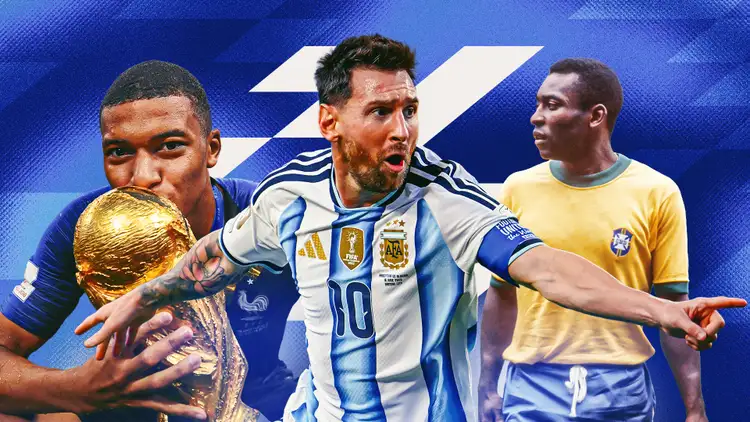
The debate over the greatest performers in World Cup history has once again been reignited after GOAL released its latest ranking of the top 10 players to ever grace football’s biggest stage. The list, which evaluates impact, consistency, and legacy across multiple tournaments, places Lionel Messi at number one, narrowly ahead of Pelé and Diego Maradona in a fiercely contested selection of global legends.
The World Cup, widely regarded as the pinnacle of international football, has produced unforgettable moments that define generations. From last-minute winners to tournament-defining performances, the competition has consistently elevated players into immortal status. This latest ranking reflects not only statistical dominance but also cultural and historical influence.
Messi crowned the greatest World Cup player of all time

Lionel Messi has been placed at the summit of the ranking following a career-defining World Cup journey that spanned multiple tournaments and culminated in ultimate success with Argentina. His performances, particularly in the later stages of his international career, reshaped perceptions of his legacy on the global stage.
Messi’s long awaited World Cup triumph came after years of near misses, including the painful 2014 final defeat to Germany. However, his leadership in Qatar established him as the first player in history to score in every knockout round of a single edition, including the final itself. His influence extended beyond goals, as he consistently dictated the rhythm and creativity of Argentina’s attacking play.
His performances earned him multiple individual awards and cemented his position as the most statistically consistent World Cup performer in modern football history.
Pelé’s unmatched legacy across generations
Pelé remains one of the most iconic figures in World Cup history and is ranked second in the list. The Brazilian legend is still the only player to have won the tournament three times, achieving global fame as a teenager in 1958 before further triumphs in 1962 and 1970.
Pelé’s breakthrough in Sweden 1958 remains one of the most extraordinary debuts in sporting history, as he scored crucial goals in the knockout stages and announced himself as a generational talent. His combination of technical brilliance, composure, and creativity made him the face of Brazilian football’s golden era.
By 1970, Pelé had evolved into the leader of what is often considered the greatest international team of all time, guiding Brazil to a dominant World Cup victory in Mexico.
Maradona’s 1986 masterpiece
Diego Maradona occupies third place after delivering what is widely regarded as the most influential individual World Cup performance in history. His role in Argentina’s 1986 triumph in Mexico remains unmatched in terms of personal dominance over a tournament.
Maradona directly contributed to the majority of Argentina’s goals during the competition, most famously producing both brilliance and controversy in the quarter final against England, where he scored the infamous “Hand of God” goal before producing one of the greatest solo efforts ever seen.
His leadership, creativity, and unpredictability defined Argentina’s campaign and secured his status as a cultural and sporting icon far beyond football.
Kylian Mbappé continues modern dominance
Kylian Mbappé ranks eighth in the list but is widely considered the most likely active player to climb higher in future editions. His explosive introduction to World Cup football in 2018 saw him score four goals and help France lift the trophy, becoming the first teenager since Pelé to score in a final.
In the following tournament, Mbappé delivered one of the greatest final performances ever recorded, scoring a hat trick and winning the Golden Boot despite France narrowly losing on penalties. His pace, finishing ability, and composure under pressure have made him one of the defining figures of the modern era.
Gerd Müller and World Cup efficiency
Gerd Müller is ranked seventh after setting one of the most remarkable scoring records in tournament history. Known as a pure penalty box striker, Müller scored 14 goals in World Cup finals across just two tournaments, including the decisive goal in the 1974 final for West Germany.
His instinctive finishing and positional awareness made him one of the most efficient attackers the competition has ever seen.
Cafu and Beckenbauer represent defensive greatness
Cafu and Franz Beckenbauer feature prominently in the top six, representing the defensive and tactical evolution of the World Cup.
Cafu remains the only player to appear in three consecutive World Cup finals, captaining Brazil to victory in 2002. His tireless energy and attacking contributions redefined the modern full back role.
Beckenbauer, meanwhile, revolutionised defensive football as a sweeper, combining elegance with tactical intelligence. His leadership guided West Germany to the 1974 title, and his influence reshaped defensive systems for generations.
Ronaldo Nazário’s redemption story
Ronaldo Nazário is ranked fourth following a career defined by both setbacks and brilliance. After suffering injury setbacks before the 1998 final, Ronaldo returned in 2002 to deliver one of the greatest redemption stories in football history, scoring eight goals including two in the final to secure Brazil’s fifth World Cup title.
His combination of speed, skill, and finishing ability made him one of the most feared strikers in the sport’s history.
Zidane’s brilliance and controversy
Zinedine Zidane is ranked ninth after defining two separate World Cup finals in dramatically different ways. His two goals in the 1998 final helped France win their first title, while his 2006 campaign ended with a red card in the final after a headbutt incident, despite winning the Golden Ball for best player of the tournament.
Zidane’s legacy remains one of elegance, creativity, and emotional intensity.
Klose completes the elite group
Miroslav Klose completes the top 10 after becoming the all time leading World Cup scorer with 16 goals. Known for his aerial ability and consistency, Klose’s record-breaking strike in 2014 cemented his place in football history.
The ranking reflects the evolution of World Cup football across generations, from Pelé’s early dominance to Messi’s modern brilliance. While opinions will always divide fans, the list highlights players whose performances transcended eras and shaped the identity of the tournament itself.
As new stars continue to emerge, the debate over the greatest World Cup player remains one of football’s most enduring discussions.




