


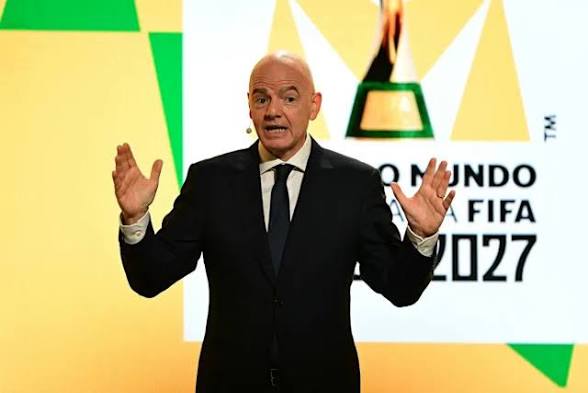
Football commentator and writer Boniokoye Imegwu has raised concerns over reports that FIFA President Gianni Infantino considered creating a new commercial subsidiary before the proposal was reportedly abandoned, arguing that the episode highlights the growing tension between football governance and commercial interests.
Writing from Reading, England, Imegwu said the controversy extends beyond a business proposal and reflects wider concerns about how global football is governed at a time when the sport continues to generate billions of dollars through broadcasting, sponsorship and commercial partnerships.
According to him, football has always represented more than what takes place during 90 minutes on the pitch. He described the game as a shared global heritage that should remain focused on supporters rather than becoming increasingly influenced by political figures or commercial ambitions.

Imegwu referred to reports suggesting that FIFA had explored establishing a commercial entity known as FIFA Forward Enterprise (FFE) before the plan was reportedly shelved. While acknowledging that governance and legal experts would be better positioned to assess the proposal itself, he argued that public perception alone was enough to generate widespread concern among football followers.
He noted that FIFA is still rebuilding confidence following the corruption scandals that shook the organisation more than a decade ago. According to him, because of that history, any proposal capable of creating the impression that football’s governing body is moving closer to private commercial interests is almost certain to attract intense public scrutiny.
The commentator maintained that abandoning the reported proposal may have prevented what could have become an even bigger reputational challenge for FIFA’s leadership.
He also argued that investigative journalists are likely to continue examining the circumstances surrounding the reported initiative, stressing that such scrutiny should not automatically be interpreted as proof of wrongdoing but rather as part of the demand for greater transparency from global sporting institutions.
According to Imegwu, transparency has become essential for organisations that oversee competitions watched by billions of people around the world.
Beyond FIFA’s internal governance, the writer also linked the discussion to the growing intersection between football and politics, particularly with the upcoming FIFA World Cup to be jointly hosted by the United States, Canada and Mexico.
He claimed that United States President Donald Trump has consistently sought to leave a strong political imprint on major international events taking place on American soil. According to him, that approach appears to extend to sport, where major tournaments increasingly attract political attention alongside global audiences.
However, Imegwu argued that football remains unique because it ultimately belongs to supporters rather than politicians, governments or wealthy investors.
He maintained that while political leaders may host tournaments and attend matches from VIP sections, the real custodians of the sport are the millions of fans who fill stadiums, support their clubs and national teams, and pass their love of football from one generation to another.
Drawing on history, the writer argued that football has consistently outlasted political administrations, noting that World Cups have survived changes in governments and that the game’s greatest figures have always been remembered for their achievements on the pitch rather than their political connections.
According to him, this is why many football supporters become uneasy whenever politics, commerce and sport appear to become too closely intertwined.
He acknowledged that modern football depends heavily on commercial income generated through television rights, sponsorships and global marketing. Nevertheless, he insisted that supporters expect those revenues to serve the interests of football rather than creating the impression that the game is being transformed into a private commercial enterprise.
Imegwu further argued that Gianni Infantino and Donald Trump have both demonstrated remarkable resilience in dealing with public criticism throughout their careers and are unlikely to suffer lasting political or personal consequences from the controversy.
Despite that, he said the larger issue is preserving trust in football’s governing institutions.
According to him, supporters can forgive poor performances, costly mistakes and controversial refereeing decisions, but they are less willing to overlook any suggestion that football is being managed for private interests instead of the public good.
He concluded that football’s greatest asset is not its financial value but the confidence supporters place in those responsible for protecting the sport.
Imegwu added that if reports about the abandoned commercial proposal are accurate, FIFA now has an opportunity to reinforce its commitment to openness and accountability while ensuring that future reforms strengthen rather than weaken public trust.
He maintained that football has endured because it belongs to the people who love and support the game, arguing that preserving that principle should remain FIFA’s highest responsibility regardless of commercial opportunities or political influence.




