You run a business. You have an Instagram page, and you try to keep it active. Every few days, another post goes up. You have invested money in graphics, photography, videos and perhaps even paid someone to build a website. At some point, you may have boosted a post or spent hundreds of thousands of naira on online advertising, hoping that the right customers would finally discover your brand.
Yet somehow, the results remain unpredictable.
One week, you receive several enquiries. The following week, your direct messages are silent. A post performs surprisingly well, but generates no sales. Another post receives almost no engagement despite the effort and money invested in creating it. Your website is online, but you cannot remember the last time someone told you they found your business through Google.
Eventually, you begin asking the question many Nigerian entrepreneurs are asking: Why is my business not winning online despite everything I am doing?
The uncomfortable answer is that the problem may not be a lack of effort.
It may be a lack of integration.
Across Nigeria’s growing small and medium-sized business sector, many brands are marketing themselves in several different directions at once. Instagram is handled as one activity, content creation as another, advertising as another and search engine optimisation as something to consider later. Sometimes, different people manage each channel without communicating with one another.
The business therefore appears active online, but its marketing does not necessarily function as one system.
That distinction can make an enormous difference.
A business can have beautiful social media posts and still struggle to generate customers. It can have an attractive website that receives almost no traffic. It can run advertisements without understanding which audience is responding. It can publish articles without knowing what potential customers are searching for.
The result is an online presence that looks busy without necessarily moving the business forward.
This is the problem that integrated marketing is designed to solve.
Instead of treating social media, content, advertising, SEO and brand strategy as isolated services, businesses need to understand how these components can support one another. DDM News observes that for Nigerian SMEs operating in an increasingly competitive digital marketplace, the real advantage may not come from simply doing more marketing, but from making every marketing activity contribute to the same commercial objective.
Consider social media.
Many entrepreneurs still measure social media success primarily by the number of followers, likes or comments a page receives. While these numbers can provide useful information, they do not automatically translate into revenue.
The real question should be: what is the content supposed to accomplish?
A fashion brand might use Instagram to demonstrate how its clothing fits different body types. A real estate company might use short videos to explain property-buying processes. A restaurant could use content to showcase its food, answer common customer questions and encourage reservations. A professional services company might use LinkedIn to demonstrate expertise and establish credibility.
The objective is not simply to post.
The objective is to move potential customers closer to a decision.
That requires a content strategy.
A structured content calendar can ensure that posts are not created randomly but are connected to the company’s products, customer concerns, buying cycles and broader business objectives. Educational content can build trust. Demonstrations can remove doubts. Testimonials can provide social proof. Offers can encourage action. Behind-the-scenes content can humanise the brand.
Each piece has a purpose.
Content creation is therefore much more than designing attractive graphics. A well-written article can answer a customer’s question before they contact the company. A carousel can explain a complicated service. A short video can overcome an objection. A case study can demonstrate competence.
When content is created with a defined purpose, it becomes an asset rather than simply another expense.
Then comes paid advertising.
This is where many businesses lose substantial amounts of money.
The existence of an advertising budget does not automatically mean a business has an advertising strategy. Spending ₦500,000 on Meta advertising, for example, does not guarantee that the right people will see the advertisement, understand the offer or take the desired action.
Successful advertising requires clarity about the target audience, creative direction, campaign objective, landing experience, conversion process and performance measurement.
If an advertisement generates thousands of impressions but no meaningful enquiries, the problem cannot be solved simply by increasing the budget.
Sometimes the audience is wrong.
Sometimes the creative is weak.
Sometimes the offer is unclear.
Sometimes the landing page does not provide enough information.
Sometimes the product itself is not being presented in a way that makes the customer understand why they should act.
This is why data matters.
Advertising should provide information that can improve the next campaign. Which audience responded? Which creative attracted attention? Which message produced enquiries? How much did each lead cost? How many leads eventually became customers?
Without those answers, advertising becomes little more than gambling with a marketing budget.
Search engine optimisation presents another opportunity that many Nigerian businesses have yet to fully exploit.
Social media is excellent for creating awareness, but search engines can capture people who already have an intention.
Someone searching for “affordable land for sale in Lagos” is different from someone casually scrolling through Instagram. Someone searching for “best event planner in Abuja” is already demonstrating a potential commercial need.
That is why appearing when customers search for a product or service can be extremely valuable.
SEO involves understanding what potential customers search for, creating useful content around those searches, improving website pages, strengthening local visibility and making it easier for search engines to understand the business.
It is not an overnight strategy. A company should not expect to publish three articles and immediately dominate Google. But when done correctly, organic visibility can become a long-term source of qualified traffic.
And this is where integration becomes particularly powerful.
Imagine a Nigerian real estate company discovers through search data that prospective buyers frequently ask questions about land documentation. Instead of keeping that information hidden inside an SEO strategy, the company can turn it into Instagram carousels, TikTok videos, Facebook posts, LinkedIn articles and advertising messages.
One customer insight can therefore produce multiple marketing assets.
The same principle works in reverse.
If social media comments repeatedly reveal that customers are confused about a particular product, that information can influence website content and SEO articles. If an advertisement performs exceptionally well with a particular audience, the insight can inform future organic content. If an SEO article attracts significant traffic, the company can convert its key lessons into social media content.
The channels begin talking to one another.
That is the missing piece for many brands.
Before any of this happens, however, there must be a clear brand strategy.
Who exactly are you selling to?
What problem are you solving?
Why should customers choose you instead of competitors?
What do you want the brand to be known for?
What is your most important business objective over the next 90 days?
Without answers to these questions, a company can produce endless content without developing a recognisable position in the market.
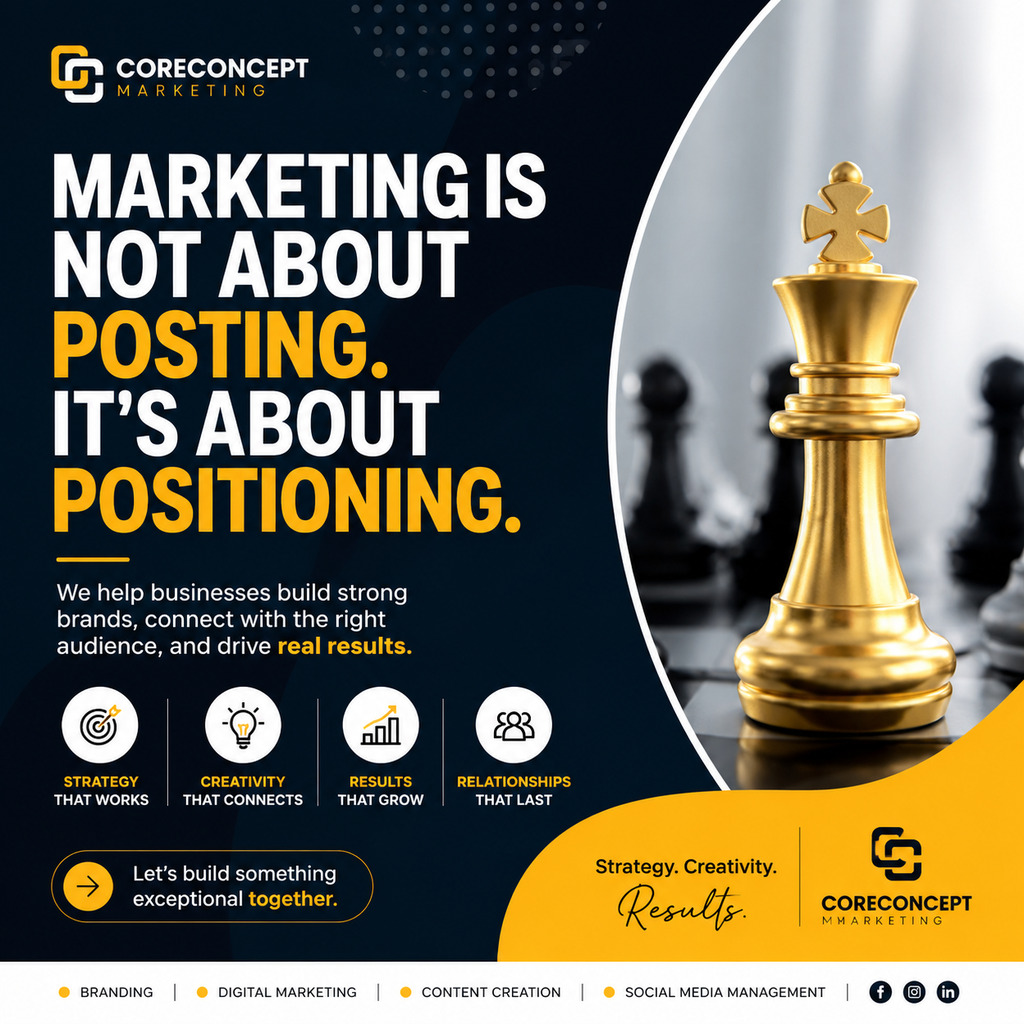
This is why CoreConcept Marketing positions strategy as the foundation of its approach. Rather than simply selling individual social media posts or advertising campaigns, the focus is on creating a connected marketing system in which social media, content, paid advertising and search visibility reinforce one another.
For Nigerian entrepreneurs, this approach is becoming increasingly important because the digital marketplace is becoming crowded.
There are more businesses competing for attention, more creators producing content and more advertisements appearing in customers’ feeds. Simply being online is no longer enough.
Your competitors are online too.
The brands that stand out will increasingly be those that understand their customers, communicate consistently and measure what actually produces results.
DDM News notes that the solution for many struggling Nigerian brands may not be another logo, another social media manager or another random advertising campaign. The more important investment may be a coherent strategy that connects every part of the customer’s journey.
That is ultimately the one fix many businesses are missing: stop treating marketing as separate activities and start treating it as one connected business system.
Your Instagram should support your website.
Your website should support your SEO.
Your SEO should reveal what customers want.
Your content should answer those needs.
Your advertising should amplify the strongest messages.
Your data should determine what happens next.
And all of it should serve the same business objective.
That is when online marketing stops becoming a collection of disconnected tasks and starts becoming an engine for growth.
For businesses interested in taking a more structured approach, CoreConcept Marketing can be reached through its social media presence at @coreconceptmarketing or by phone on 08109986366 to discuss a strategy consultation.
The digital economy does not necessarily reward the business that posts the most.
It rewards the business that understands what it is trying to achieve, knows who it is speaking to and builds a marketing system capable of turning attention into trust, trust into enquiries and enquiries into customers.