


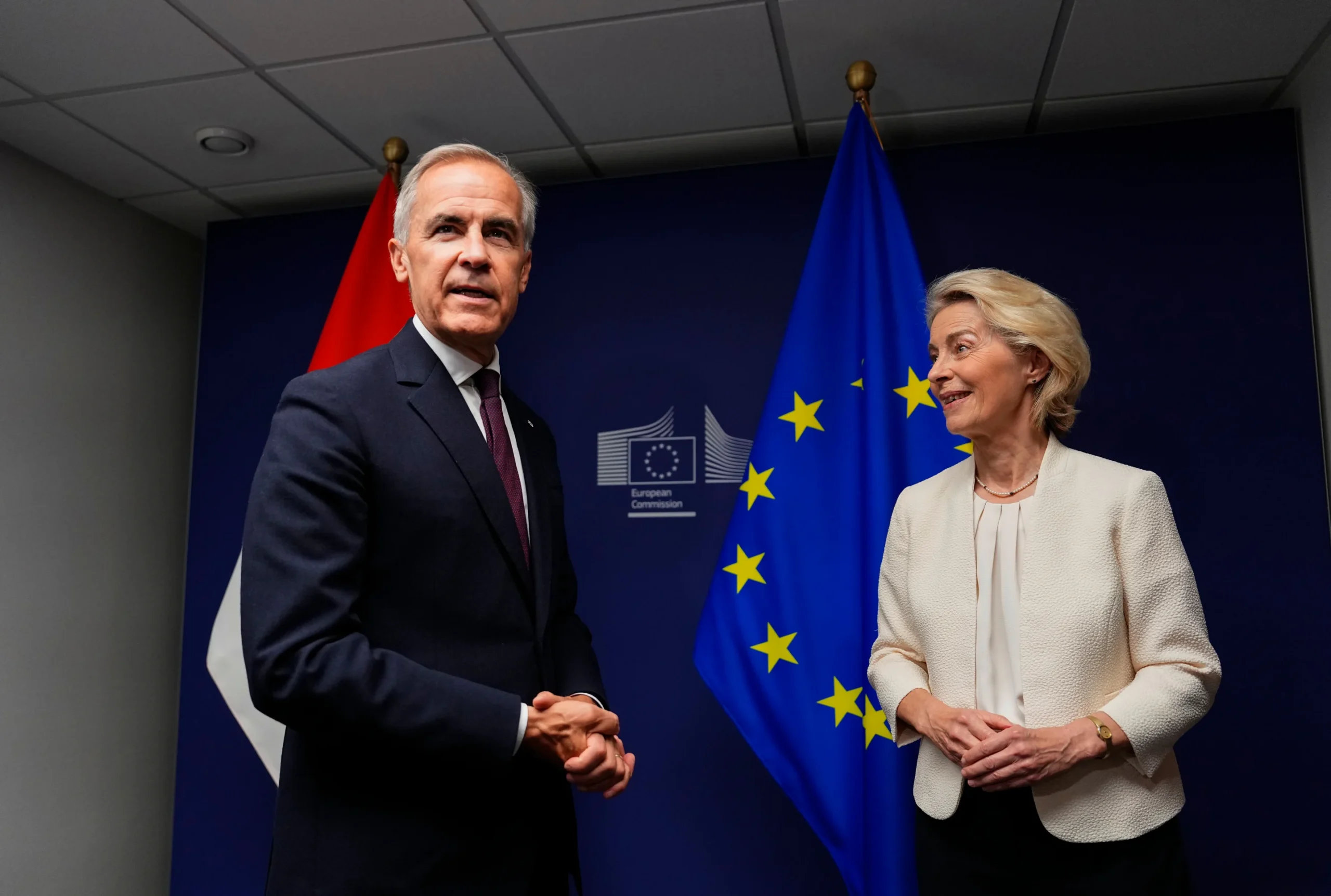
Canadian Prime Minister Mark Carney has rejected suggestions that his push for closer ties between Canada and the European Union is an attempt to create a rival geopolitical bloc against the United States.
Speaking to the European Parliament in Strasbourg, France, on Thursday, Carney said Canada was not seeking to become a “great power rival” to the US.
“I’m not proposing a third bloc in order to become a great power rival, only with better manners,” Carney told EU lawmakers.
His comments came a day after European Commission President Ursula von der Leyen proposed that Canada become the European Union’s first associate member.

The proposal has emerged as Canada and the EU seek to strengthen economic cooperation amid trade tensions with the United States under President Donald Trump.
Carney said his government was instead pursuing greater resilience to protect Canada’s economy, sovereignty and democratic institutions.
“We do not seek power to dominate others,” he said. “On the contrary, we are pursuing resilience so no one can control our open markets, impair our sovereignty, threaten territorial integrity or undermine our freedoms, our democracies, our rule of law.”
Canada, EU plan deeper cooperation
Carney outlined several areas where Canada and the EU could expand cooperation, including critical minerals, energy, defence production, artificial intelligence, payments and scientific research.
He said Canada could help strengthen Europe’s energy security by supplying liquefied natural gas and hydrogen.
The prime minister also proposed closer cooperation on artificial intelligence, including the development of joint AI safety protocols.
Beyond trade and security, Carney called for stronger people-to-people links between Canada and Europe.
He suggested allowing young Canadians and Europeans to live, work and study more easily on either side of the Atlantic.
Carney also expressed support for Canada joining the EU’s Erasmus+ and Horizon programmes, which support education and scientific research.
“Europe and Canada are stronger together,” he said, adding that a closer Canada-EU relationship could serve as a model for other democracies.
The proposed partnership comes amid worsening trade tensions between Ottawa and Washington.
Canada and the EU have both been affected by tariffs imposed by the Trump administration, prompting both sides to explore ways of strengthening their economies and reducing vulnerabilities.
Carney said polls showed an “overwhelming majority” of Canadians supported closer relations with Europe.
However, the proposed associate membership is still at an early stage. The status does not currently exist within the EU’s treaty framework and would require further discussions between Canada and the bloc.
Carney said he welcomed von der Leyen’s proposal but stressed that Canada was not seeking full EU membership.
The two sides are expected to discuss the proposed relationship further at a Canada-EU summit scheduled to take place in Montreal on October 29 and 30.




