


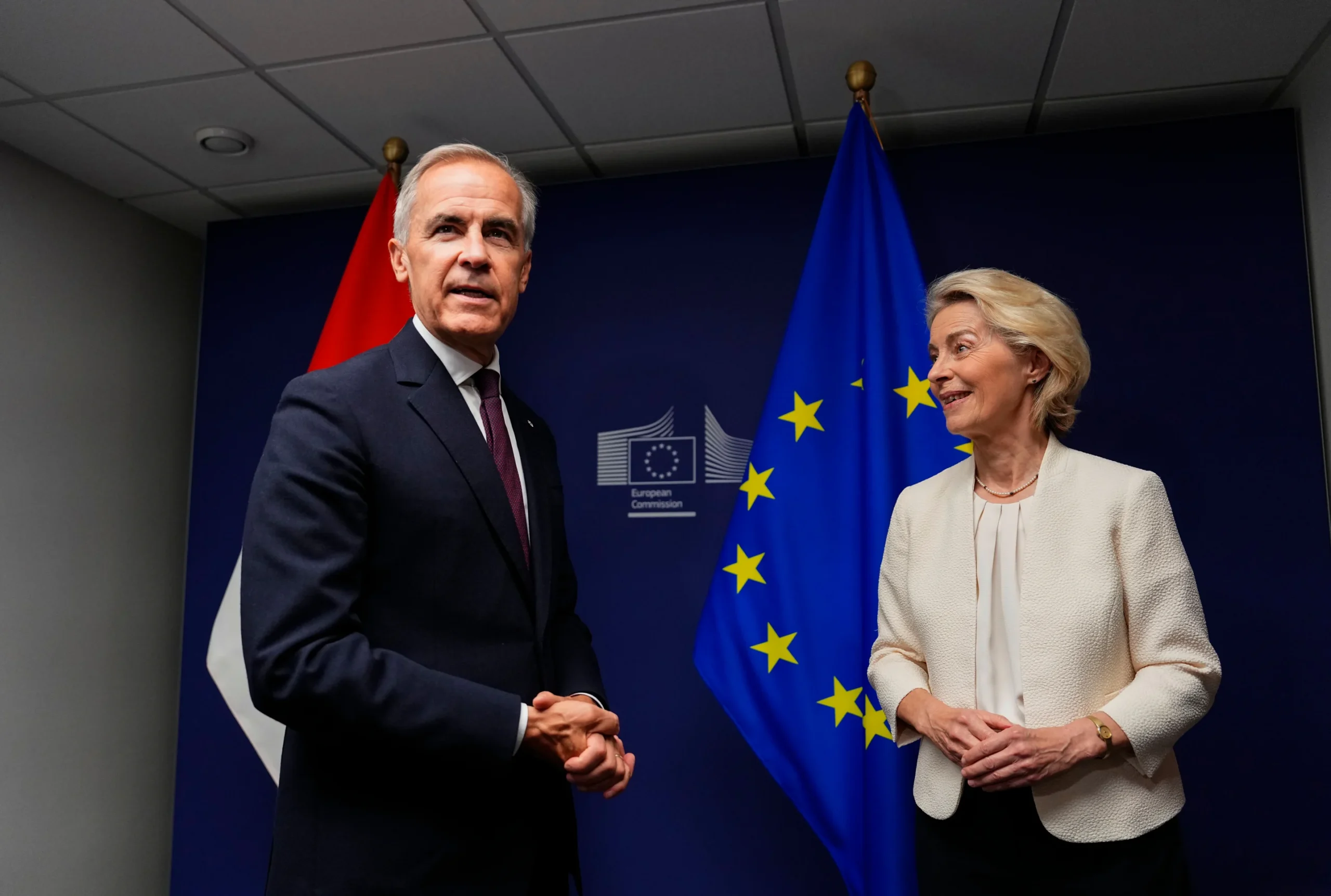
Canadian Prime Minister Mark Carney has welcomed a proposal for Canada to become the European Union’s first associate member as Ottawa seeks stronger economic and strategic ties with Europe.
Carney made the position known on Thursday while addressing the European Parliament in Strasbourg, France.
The proposal was put forward by European Commission President Ursula von der Leyen, who said Europe wanted to take its relationship with Canada to the “highest level possible.”
Although Carney welcomed the idea, he acknowledged that the proposed status has not yet been defined.

He also made it clear that Canada was not seeking full membership of the European Union.
Instead, he proposed deeper cooperation between Canada and Europe in areas including trade, defence, critical minerals, artificial intelligence, energy, space, research and financial services.
According to Carney, stronger ties would help both sides reduce their vulnerability to economic and geopolitical pressure.
“We do not seek power to dominate others,” Carney told lawmakers. “On the contrary, we are pursuing resilience so that no one can control our open markets, impair our sovereignty, threaten our territorial integrity, or undermine our freedoms, our democracies, our rule of law.”
Canada seeks stronger ties with Europe
The proposed closer relationship comes as Canada seeks to reduce its economic dependence on the United States.
Canada sends about 70 per cent of its exports to the US, leaving its economy exposed to changes in US trade policy.
Relations between Ottawa and Washington have also become more strained following US President Donald Trump’s tariffs, demands for economic concessions and repeated comments about Canada potentially becoming the 51st US state.
Carney has rejected measures he says could threaten Canadian sovereignty, while his government has sought to expand Canada’s economic partnerships beyond its traditional US market.
Europe, meanwhile, has offered Canada a potential alternative through closer economic and strategic cooperation.
Von der Leyen announced the associate membership proposal on Wednesday, describing the proposed relationship as an “Alliance for the Future” focused on common prosperity and economic security.
However, the proposed associate membership would require the EU to establish a new framework because such a status does not currently exist in the bloc’s treaties.
Carney and EU leaders are expected to discuss the proposed arrangement further when Canada hosts an EU-Canada summit in Montreal on October 29 and 30.
The talks are expected to examine ways to expand cooperation beyond the existing Canada-EU free trade agreement.
Carney told the European Parliament that closer integration could strengthen both sides’ ability to withstand economic and geopolitical pressures.
The Canadian prime minister received a warm reception from lawmakers during his address, with several parliamentarians approaching him for handshakes and photographs.
Lawmakers also gave him a standing ovation after his speech, while one member attended the session wearing a Canadian hockey jersey.
For Canada, the proposed relationship represents a significant potential expansion of its ties with Europe at a time when its long-standing economic relationship with the United States is facing increased pressure.




