


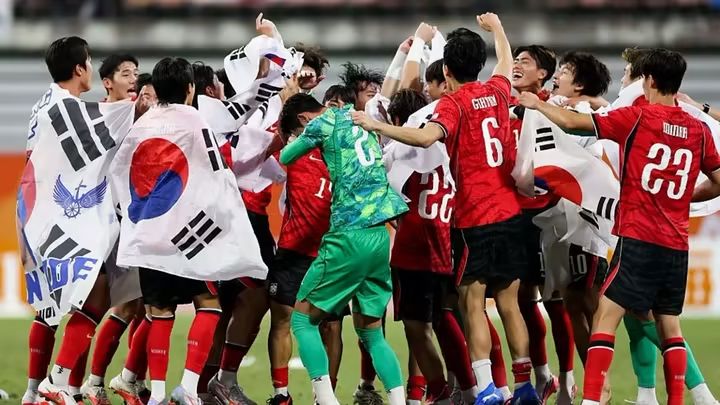
SEOUL — South Korea has announced plans to review its military service exemption system for athletes and artists following renewed public criticism triggered by comments from members of the national football team after their Asian Games triumph.
The debate intensified after South Korea defeated Japan 1–0 in the men’s football final at the 2026 Aichi-Nagoya Asian Games on Saturday, securing the country’s fourth consecutive gold medal in the event.
Twenty of the team’s 23 players became eligible for alternative military service as a result of the victory. Under the existing system, qualifying athletes do not complete the standard military service period but instead undertake alternative service requirements.
Players’ Comments Spark Backlash
The controversy began after several players made comments about the military benefit following their victory.

Captain Lee Gi-hyuk attracted criticism after holding up his gold medal and saying he would not have to serve in the military. Teammate Yang Min-hyeok also drew criticism after saying the exemption had been his main motivation during the tournament.
Another player, Park Seung-soo, posted a photograph of himself wearing a cap commonly associated with people who have completed military service.
The three players subsequently apologised, but the incident reignited a wider debate about whether athletes should receive special treatment under South Korea’s mandatory military service system.
Government Considers Changes
South Korea’s Ministry of National Defense said Tuesday that it was considering reducing or abolishing the supplementary service arrangements covering athletes and artists.
On Wednesday, Culture, Sports and Tourism Minister Chae Hwi-young told lawmakers that his ministry would consult athletes, artists, the Defence Ministry and the Military Manpower Administration before developing comprehensive measures.
He said the review was necessary because of concerns raised among members of the public.
Defence Minister Kang Shin-chul went further, telling lawmakers that the ministry’s goal was to gradually reduce the system and ultimately abolish it.
The government is expected to consider issues including fairness among people subject to compulsory service, the declining number of eligible recruits and public opinion.
How The Current System Works
South Korea requires most able-bodied men to complete between 18 and 21 months of military service.
Under the current arrangement, athletes who win Asian Games gold medals and Olympic medalists can qualify for alternative service rather than completing the standard military term.
Those who qualify undertake three weeks of basic military training and are required to complete 544 hours of community service over a 34-month period.
The system was introduced in 1973 as part of efforts to support elite athletes and enhance South Korea’s international sporting profile.
Fairness Debate Widens
The latest controversy has also revived comparisons with South Korean entertainers who have completed mandatory military service.
Critics have cited global K-pop group BTS as an example, arguing that international recognition should not automatically determine who receives an exemption.
Supporters of the existing system have historically argued that exceptional sporting achievements can contribute to national prestige and that prolonged military service could disrupt athletes’ careers.
The government has yet to announce a final replacement policy. Any changes would require further consultation and consideration of how existing eligibility rules should be adjusted.
For now, the controversy has placed South Korea’s decades-old athlete military exemption system under renewed scrutiny.




