


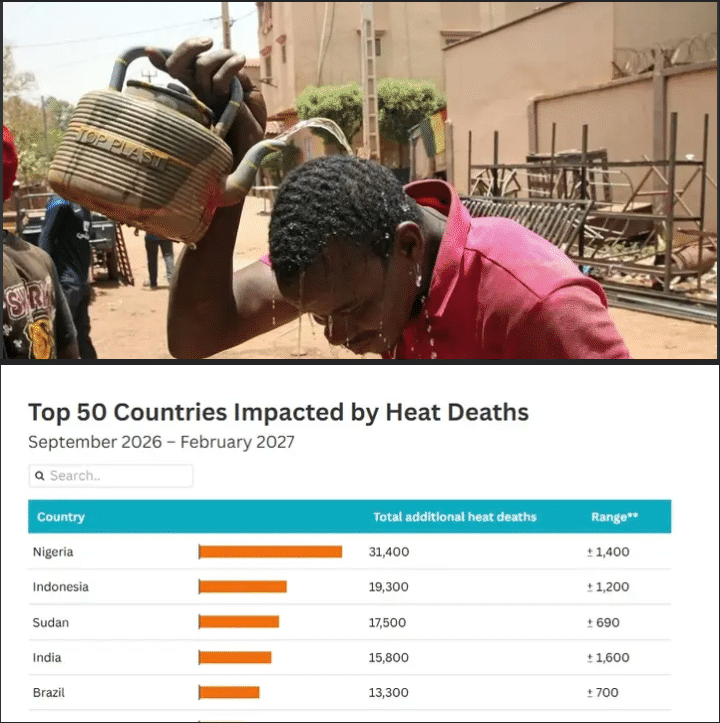
Nigeria could face 31,400 additional heat-related deaths between September 2026 and February 2027, as forecasts of unusually high temperatures raise concerns about public health, water security and the country’s preparedness for extreme weather.
The projection highlights the potential human cost of prolonged heat, particularly for people who work outdoors, older people and households without reliable access to clean water, electricity or adequate cooling.
Researchers at the Climate Impact Lab estimate that approximately 451,000 additional heat-related deaths could occur worldwide between June 2026 and February 2027 compared with a normal year. About 239,000 of those deaths are projected to occur between September 2026 and February 2027.

The findings, presented in a report titled 451,000 at Risk: Where Action Can Save Lives During the Super El Niño, identify parts of Africa and Asia among the regions facing substantial risks from rising temperatures.
Nigeria’s projected burden is particularly concerning because extreme heat can compound existing challenges involving access to healthcare, electricity and safe drinking water. People whose livelihoods depend on farming, construction, street trading and other outdoor activities may have limited opportunities to avoid prolonged exposure to high temperatures.
The report estimates that Nigeria could record another 15,400 heat-related deaths between December 2026 and February 2027 alone. These figures represent projected additional deaths relative to a normal year, rather than a prediction of the total number of deaths from all causes during the period.
Other countries in the Sahel are also expected to face substantial risks. Sudan’s projected additional heat-related deaths stand at approximately 17,500, while Niger and Chad could record about 10,000 and 8,000, respectively, over the six-month period covered by the estimates.
The projections point to the need for stronger preparedness across a region where many people depend on outdoor work and agriculture, making them vulnerable to changing weather conditions.
El Niño is a naturally occurring climate phenomenon involving the periodic warming of surface waters in the central and eastern tropical Pacific Ocean. It influences atmospheric circulation and can alter temperature and rainfall patterns in different parts of the world. Its effects vary by region, and its interaction with long-term global warming can intensify heat risks.
The Climate Impact Lab estimates that global land temperatures could rise 1.2 degrees Celsius above normal during the forecast period, accompanied by 44 per cent more extremely hot days than would typically be expected.
The implications extend beyond discomfort during hot weather. Prolonged exposure to high temperatures can cause dehydration, heat exhaustion and heatstroke, a potentially fatal condition requiring urgent medical attention. Extreme heat can also worsen some existing health conditions and place additional pressure on already stretched healthcare services.
For Nigeria, the risks could be especially significant for people living in crowded urban neighbourhoods, where buildings retain heat and access to reliable electricity for fans or air conditioning may be limited. In rural communities, farmers and other outdoor workers may struggle to avoid the hottest periods of the day without losing working hours or income.
Children, older people and individuals with certain underlying health conditions can also be more vulnerable to heat-related illness. Public awareness of warning signs, access to drinking water and timely medical treatment are therefore important components of any response.
The economic consequences could also be substantial. Extreme heat can reduce workers’ productivity, disrupt outdoor activities and increase demand for electricity and water. Farmers may face additional pressure when high temperatures coincide with inadequate rainfall, although the effects on agricultural production depend on local weather conditions, crop types and access to irrigation.
The report’s findings place renewed emphasis on practical measures that can reduce the health consequences of extreme temperatures. Heat alerts, public information campaigns, access to drinking water, shaded rest areas and appropriate workplace protections can help people reduce their exposure.
Health facilities also need the capacity to recognise and treat heat-related illnesses, while local authorities can support vulnerable communities through targeted public education and emergency planning.
Nigeria’s response would require coordination between meteorological services, public health authorities, emergency management agencies and state and local governments. Clear warnings are most useful when people receive them in time and have practical ways to protect themselves.
The projected figures should not, however, be interpreted as a certainty that 31,400 people will die in Nigeria. They estimate additional heat-related mortality compared with a normal year, using temperature and mortality relationships alongside seasonal forecasts. Actual outcomes will depend on weather conditions, population exposure, public health interventions and other factors.
The warning nevertheless underlines the importance of preparing for dangerous heat before its effects become more severe. Improving early-warning systems, protecting outdoor workers and ensuring that vulnerable households can access water and healthcare could help reduce the potential loss of life.
For Nigeria, the central challenge is translating climate forecasts into practical measures that protect communities. The projected death toll remains uncertain, but the need to strengthen preparedness for extreme heat is a matter of public health that authorities cannot afford to overlook.




