


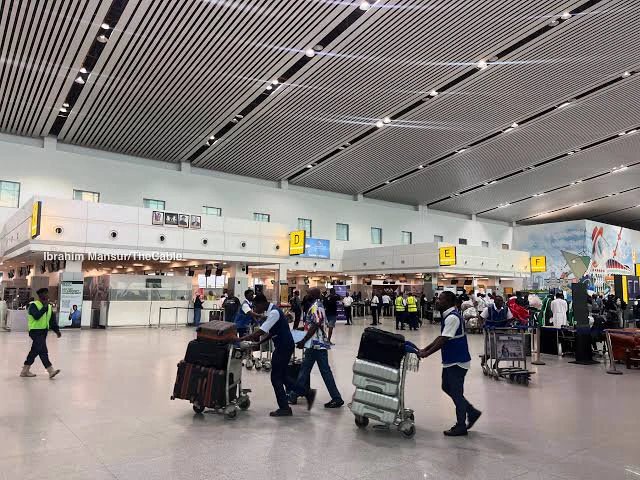
LAGOS, NIGERIA — Nigeria recorded the fastest growth in airline seat capacity among Africa’s 10 largest aviation markets in October. The country added more than 400,000 seats year-on-year.
This means that airlines have increased the number of seats available for passengers travelling to, from, or within Nigeria. Depending on demand, this could mean more flight options and potentially greater competition among airlines.
The Data
According to latest data published for October 2026 by OAG Aviation Worldwide, Lagos airport also posted the strongest gains among the continent’s 10 busiest airports.

Across the African continent, airlines offered 26.6 million seats in October 2026. This is an increase of 8.8 per cent from 24.4 million in the same month of 2025.
Nigeria had 1,347,300 seats on offer this October. This compared with 932,300 a year earlier. The gain of 414,900 seats represents a growth of 44.5 per cent.
This is the highest growth of any country in the continent’s top 10.
Reasons for Growth
The data attributes the increase to currency reforms and a new aircraft leasing agreement. It also points to growing confidence among airlines that want to fly into the country.
More domestic airlines have also come up this year. Existing ones like Air Peace, United Nigeria Airlines, Ibom Air, and ValueJet are increasingly expanding their capacity.
Domestic Capacity
Nigeria’s growth was not limited to international routes. Domestic capacity rose 54.6 per cent to roughly one million seats. This added 362,600 seats over the year.
This made Nigeria one of the fastest-growing domestic markets in Africa. Only Congo grew faster on that measure, at 49.7 per cent. But Congo’s domestic market remains small, with 144,200 seats this month.
Lagos Airport Leads
Lagos airport handled about 0.52 million seats in October. This is an increase of 29.7 per cent, or 119,200 seats, in the same month last year.
This is the fastest growth among Africa’s 10 largest airports. Casablanca in Morocco followed, rising 13.6 per cent, or 86,800 seats.
However, Lagos still ranks 10th by seat volume. Cairo, Egypt’s capital, remains the continent’s busiest airport with 1.78 million seats. Addis Ababa was second at 1.19 million seats. Johannesburg was third at 1.16 million.
Lagos is growing from a much smaller base. At its current pace, it is closing the gap faster than any of its larger rivals.
Other African Markets
Nigeria was not the only market expanding. All ten of Africa’s largest country markets added seats compared with October 2025. None reduced capacity.
Egypt remains the largest country market on the continent. It has 3.2 million seats this month, up 9.6 per cent. Egypt added 282,800 seats, the second-largest increase after Nigeria.
Morocco came third, adding 216,900 seats, a rise of 11 per cent. South Africa added the fewest seats, 18,800, a rise of just 0.8 per cent.
Ghana grew 11.6 per cent, adding 32,100 seats. Tunisia added 46,400, up 6.9 per cent. Ethiopia grew more slowly, at 3.9 per cent for its home market.
South Africa remains the largest domestic market in Africa, with 1.6 million seats this month.
Low-Cost Carriers Gain Momentum
Low-cost carriers grew faster than the mainline airlines that still dominate the market. Mainline carriers make up 79 per cent of total capacity. Their seats rose 8.1 per cent.
Low-cost carriers grew 11.4 per cent to 5.5 million seats. For passengers, a larger share of budget seats generally means more fare choice.
Where African Airlines Are Flying
International capacity makes up 77 per cent of the continental total and grew 7.9 per cent. Domestic capacity grew faster, at 11.9 per cent.
Europe remains the largest international destination region for African airlines, with 10.4 million seats. The Middle East is second with 4.54 million seats. Routes within Africa are third with 4.35 million.
What the Numbers Mean
These figures measure scheduled seat capacity. They do not show how many passengers actually boarded or what passengers paid.
Capacity can rise faster than demand. Airlines sometimes add seats only to cut back on routes that fail to fill.
For now, the data shows that Africa’s aviation market is expanding at a healthy pace. Nigeria has moved to the front of that growth. Lagos, which hapndles a smaller share of traffic than Cairo or Johannesburg, is where much of Nigeria’s new capacity is landing. It has become the fastest-growing major airport on the continent.




