

Africa
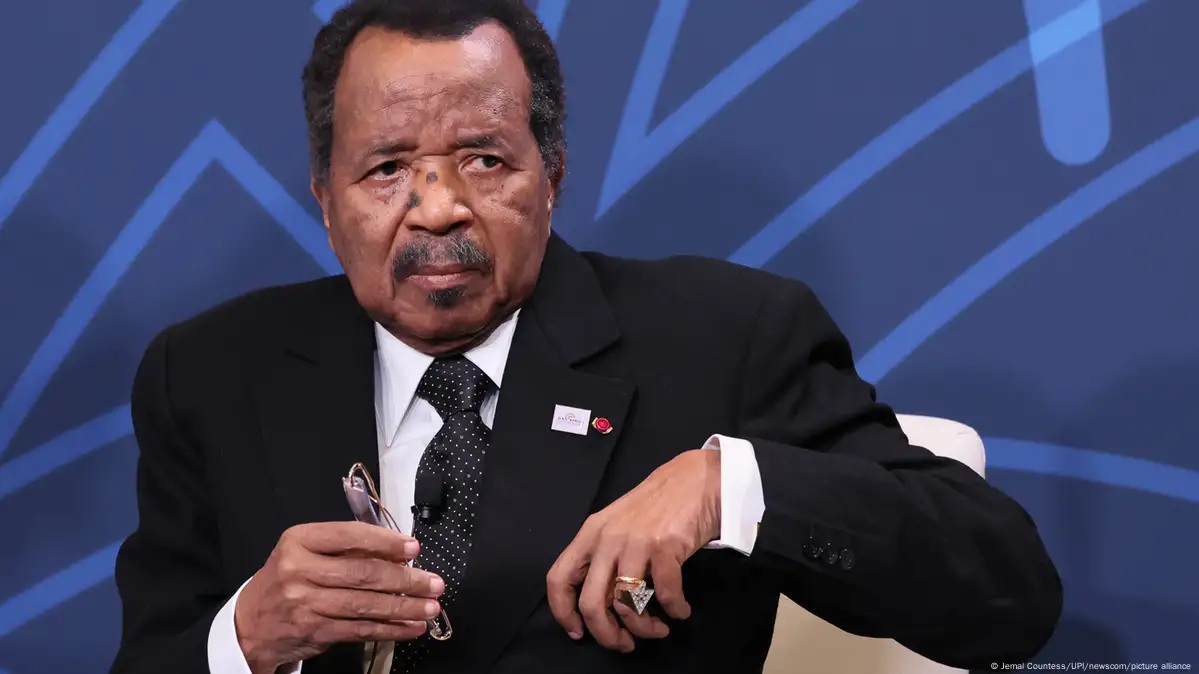
Cameroon Boils Over Biya’s Controversial Re-Election for Eighth Term

Cameroon’s commercial capital, Douala, has erupted in violent protests after 92-year-old President Paul Biya was declared winner of the October 12 presidential election, securing his eighth term in power.
Hundreds of opposition supporters stormed the streets, accusing Biya’s government of rigging the vote to extend his 42-year rule.
Witnesses said demonstrators barricaded roads, burned tyres, and hurled stones at police as chaos spread across the city.
Security forces responded with tear gas and water cannons, sparking violent clashes that left at least four people dead and several police officers injured, according to Samuel Dieudonne Ivaha Diboua, the Governor of the Littoral region.

He confirmed that protesters attacked two police stations in Douala’s second and sixth districts, prompting what authorities described as a “necessary security response.”
Opposition candidate Issa Tchiroma Bakary, whose supporters defied a government protest ban, insists he won the election with 54.8 percent of the vote, compared to Biya’s 31.3 percent.
Tchiroma accused the ruling party of falsifying and distorting results, calling the election “an assault on democracy.” He urged Cameroonians to “resist peacefully” and defend their votes.
However, the government dismissed all allegations of fraud, urging citizens to remain calm until the Constitutional Council publishes official results.
Tensions worsened as authorities arrested around 30 opposition activists, including Anicet Ekane of the MANIDEM party and Djeukam Tchameni from the Union for Change movement.
Cameroon’s Minister of Territorial Administration, Paul Atanga Nji, condemned the demonstrations, describing them as an “insurrectional movement.”
He warned that the state would not tolerate any attempt to destabilize the nation.
Eyewitnesses in Douala reported military vehicles patrolling streets, with residents fleeing as clashes intensified.
Internet access was reportedly restricted in several major cities, but young protesters continued mobilizing online.
Local journalist Blaise Eyong, reporting for Al Jazeera, said anger among youths is boiling over after decades of hardship and broken promises.
“You can really feel the frustration,” Eyong said. “Many believe they have no future under this government.”
Protests have also spread to Yaoundé, Garoua, Maroua, Bertoua, and Bafoussam, as citizens reject what they call Biya’s illegitimate return to power.
President Biya, who has ruled since 1982, remains Africa’s oldest head of state.
His new seven-year term could see him remain in office until he is nearly 100 years old.
Tchiroma, a former ally turned rival, vowed to continue his fight, saying, “The people’s will must be respected. We will not accept any other result.”

Africa
Tanzania Plunges into Crisis as Cabal Grabs Power After Election Massacre
Tanzania is reeling from the massacre of hundreds of protesters following its disputed October 29 elections, as a powerful cabal tightens its grip on the nation’s leadership.
According to multiple government insiders who spoke to AFP, senior politicians are horrified but too terrified to speak publicly as a small circle of hardliners around President Samia Suluhu Hassan consolidates total control.
Horrific images of bodies lying on streets have flooded social media since the elections, which gave President Hassan a controversial 98 percent victory. Opposition leaders were either jailed, disqualified, or abducted during the vote.
The opposition claims that over 1,000 people were killed during five days of unrest that followed the elections, while the government has yet to release any official casualty figures. The violence occurred under a complete internet blackout that shielded the bloodshed from real-time scrutiny.
UN Human Rights Chief Volker Turk said there are “disturbing reports that security forces have been seen removing bodies from streets and hospitals to undisclosed locations,” suggesting an attempt to conceal evidence.
A senior government official, speaking anonymously for fear of reprisal, told AFP they had identified two suspected mass grave sites near Dar es Salaam — at Kondo and Mabwepande. The locations remain unverified, but satellite imagery reportedly shows heavy ground disturbance.
Both the official and a former presidential advisor described the group surrounding the president as a “tiny cabal” made up of her son Abdul Halim Hafidh Ameir, private secretary Waziri Salum, intelligence chief Suleiman Abubakar Mombo, and East African MP Angela Kizigha.
“They are the ones influencing the president and running the country,” the advisor said. “Everyone else has been completely frozen out.”
The insider also alleged that President Hassan’s son commands a private militia believed to be behind the wave of abductions and executions targeting critics since 2024. The government has denied involvement in kidnappings, though over 83 cases had been confirmed by the Tanganyika Law Society before the election.
Some victims were high-profile figures, such as former government spokesman Humphrey Polepole, who vanished after resigning in protest. Others were young citizens abducted for criticizing the government online.
“The only explanation is deep-seated paranoia,” the ex-advisor added. “And now, it’s completely out of control.”
Lawmakers, though horrified, are reportedly too scared to confront the regime or address their constituents.
“What’s clear,” one official said, “is that Tanzania will never be the same again.”
Africa
Lebanon Releases Muammar Gadhafi’s Son After 10-yr in Detention
Hannibal Gadhafi, son of the late Libyan leader Moammar Gadhafi, has been released by Lebanese authorities after paying his $900,000 bail, ending his 10-year detention in Lebanon, officials confirmed on Monday.
Gadhafi had been detained since 2015 on suspicion of withholding information on the fate of Lebanese Shiite cleric Moussa al-Sadr, who disappeared during a visit to Libya in 1978.
Security sources and Gadhafi’s lawyer, Charbel Milad al-Khoury, confirmed his release, saying he was now fully entitled to choose his next destination.
The release comes after a judicial decision earlier in the week that reduced his bail from $11 million to $900,000 and lifted a travel ban, allowing him to leave the country.
It was reportedly paid by a Libyan delegation that had been negotiating for Gadhafi’s release with Lebanese authorities.
Before his kidnapping in 2015 by Lebanese militants seeking information on al-Sadr, Hannibal Gadhafi had lived in exile with his Lebanese wife, Aline Skaf, and their children in Syria.
He was then kept in a Beirut jail without trial, creating a continuing legal and diplomatic standoff between Lebanon and Libya.
The disappearance of the cleric is still a taboo topic in Lebanon. While most Lebanese believe that Moussa al-Sadr is dead, his family still insists he could be alive in a Libyan jail. Al-Sadr would now be 96 years old.
Hannibal, who was born in 1975, three years before al-Sadr disappeared, fled to Algeria, and later Syria, where he was granted political asylum, following the 2011 Libyan uprising that ultimately saw the death of Moammar Gadhafi and some of his children.
His release marks a major development in the long-running saga surrounding the Gadhafi family’s legal and diplomatic entanglements.
Moammar Gadhafi was survived by eight children, many of whom played important roles in governing the country. Several, including Muatassim, Saif al-Arab and Khamis, were killed in the 2011 uprising while others such as Saif al-Islam remain active in Libya today.
Hannibal’s siblings Mohammed and Aisha now live in Oman. Al-Saadi resides in Turkey after being released from detention in Libya in 2021.
The Lebanese Justice Ministry confirmed that Gadhafi’s defense team also withdrew a case against the Lebanese state that had been filed in Geneva last month over his prolonged detention without trial.
Africa
China’s Xi Jinping Hails Biya’s Re-Election, Vows Closer Ties With Cameroon
Chinese President Xi Jinping has congratulated Cameroon’s President Paul Biya on his re-election, reaffirming China’s commitment to strengthen its long-standing partnership with the Central African nation.
The congratulatory message, published on the website of China’s Ministry of Foreign Affairs on Friday, highlighted the “traditional friendship” between the two countries.
Xi noted that in recent years, China and Cameroon have deepened political trust and achieved “fruitful cooperation” in several sectors, including infrastructure, energy, and trade.
According to Xi, the relationship between Beijing and Yaoundé remains a model of mutual respect and development-oriented cooperation in Africa.
He emphasized that both countries have “consistently supported each other on core interests and major concerns.”
Xi said China values its relations with Cameroon and is ready to build on the achievements of the Beijing Summit of the Forum on China-Africa Cooperation (FOCAC).
He stressed that the next phase of cooperation will focus on implementing summit outcomes, enhancing economic engagement, and improving the welfare of citizens in both countries.
“China attaches great importance to the development of China–Cameroon relations,” Xi said.
“We are ready to work with President Paul Biya to promote the in-depth development of the comprehensive strategic partnership between the two countries and better benefit the two peoples.”
The Chinese leader also pointed out that 2026 will mark the 55th anniversary of diplomatic ties between China and Cameroon.
He described the milestone as “an opportunity to further advance bilateral relations” and strengthen collaboration in new areas such as digital economy, health, and green development.
Beijing has been expanding its diplomatic and economic footprint in Africa through initiatives like the Belt and Road and FOCAC frameworks. Cameroon, in turn, remains one of China’s strategic partners in Central Africa, benefiting from infrastructure financing, telecommunications investments, and cultural exchanges.
President Biya, who has ruled Cameroon since 1982, is among Africa’s longest-serving leaders. His re-election further cements the country’s ongoing relationship with Beijing, which has been a key source of loans and development projects.
China and Cameroon established diplomatic ties in 1971. Since then, both nations have maintained steady cooperation in trade, education, and public health, with China funding projects such as hospitals, highways, and hydropower plants across Cameroon.
As both nations prepare to mark 55 years of diplomatic relations, analysts say the renewed commitment from Beijing signals China’s continued interest in maintaining its influence and economic presence across Africa amid growing global competition.
-
News7 days agoBREAKING: Nnamdi Kanu writes Trump, calls for US inquiry in S’east killings
-
World7 days agoUS Congress Introduces Nigeria Religious Freedom Accountability Bill
-
News4 days agoShari’ah Council urges Tinubu to immediately sack INEC chairman
-
World6 days agoBREAKING: US Revokes Visas of 80,000 Nigerians, Others
-
Analysis5 days agoHow Nnamdi Kanu’s claim that the Nigerian court lacks the authority to try him falls flat
-
News6 days agoBREAKING: Judge sets date for judgement in Nnamdi Kanu’s trial
-
News6 days agoBREAKING: Nnamdi Kanu capitulates, agrees to open his defense
-
News6 days agoGet ready for onslaught against terrorists — Army chief tells troops
-
News1 day agoTension in Abuja as soldiers block Wike from entering disputed land
-
News6 days agoMan rapes, strangles woman to death in Rivers State

