



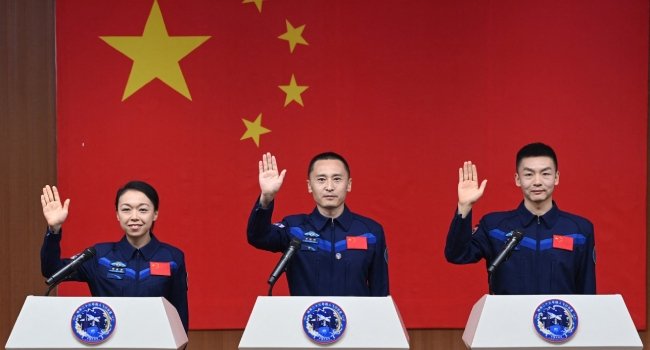
China has launched its Shenzhou-23 mission, sending three astronauts into space as part of Beijing’s growing ambition to land humans on the Moon before 2030.
The Long March 2-F rocket lifted off from the Jiuquan Satellite Launch Centre in the Gobi Desert at 11:08 pm local time on Sunday, according to China’s Manned Space Agency (CMSA).
The spacecraft successfully separated from the rocket about 10 minutes later and entered orbit, state media reported.
The mission includes a major milestone for Hong Kong, as 43-year-old Li Jiaying became the first astronaut from the city to travel into space. Li previously served in the Hong Kong police force.

Other crew members are space engineer Zhu Yangzhu and former air force pilot Zhang Zhiyuan, both aged 39.
The astronauts are expected to conduct a range of scientific experiments involving life sciences, medicine, materials science and fluid physics aboard China’s Tiangong space station.
A key objective of the mission is a year-long stay in orbit by one of the crew members — the first such experiment in China’s space programme. Officials said the astronaut selected for the extended mission will be announced later depending on the mission’s progress.
Experts say the experiment will help China study the long-term effects of microgravity on the human body, including muscle loss, bone density reduction, radiation exposure and psychological fatigue.
The mission is also aimed at preparing China for future lunar and Mars expeditions.
China is developing its next-generation Mengzhou spacecraft, expected to replace the ageing Shenzhou line and support future Moon missions. An orbital test flight of the spacecraft is planned for 2026.
Beijing also plans to establish the first phase of its International Lunar Research Station by 2035 and intends to send a foreign astronaut from Pakistan to the Tiangong station later this year.
China has rapidly expanded its space programme over the past three decades, investing billions of dollars to compete with the United States, Russia and Europe.
The country achieved a historic first in 2019 when its Chang’e-4 probe landed on the far side of the Moon. In 2021, China also successfully landed a rover on Mars.
China has operated its own Tiangong space station after being excluded from the International Space Station programme following a 2011 US law restricting NASA cooperation with Beijing.




