


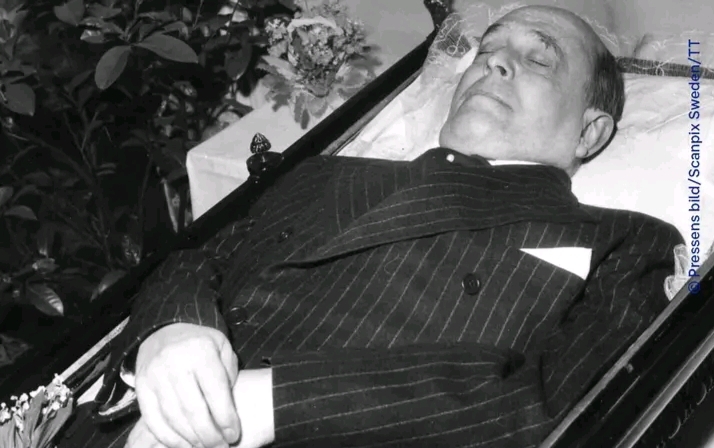
Czech police have exhumed the remains of former Czechoslovak Foreign Minister Jan Masaryk nearly eight decades after his death, reopening one of the country’s most enduring political mysteries.
The operation, carried out on Wednesday, September 2, 2026, at the family tomb in the cemetery in Lány, near Prague, is part of a renewed investigation into the circumstances surrounding Masaryk’s death in March 1948. Investigators hope that modern forensic techniques and newly examined evidence could help establish whether the influential diplomat died by suicide, in an accident or was murdered.
Masaryk, the son of Czechoslovakia’s first president, Tomáš Garrigue Masaryk, was one of the country’s best known diplomats. His death came at an extremely sensitive moment in Czechoslovakia’s history, less than three weeks after the Communist Party seized power in the February 1948 coup.
On March 10, 1948, Masaryk’s body was discovered in the courtyard of Prague’s Černín Palace, where the Foreign Ministry was located. He had apparently fallen from a window of his official apartment. The circumstances immediately attracted attention because of his prominent position and the political turmoil surrounding the Communist takeover.

The official investigation at the time concluded that Masaryk had taken his own life. However, doubts about that explanation emerged over the years, with historians, investigators and researchers repeatedly examining the possibility that he may have been pushed from the window.
Czech police said the latest investigation is aimed at examining the remains using the most advanced forensic methods available today. Police spokesman Jakub Vinčálek said the exhumation forms part of criminal proceedings connected to the renewed examination of Masaryk’s death. Investigators hope the new forensic work can either support or rule out some of the long standing theories surrounding the case.
The investigation is particularly significant because previous inquiries have produced conflicting conclusions. An investigation conducted between 2001 and 2003 concluded that Masaryk had been murdered, based largely on forensic and biomechanical assessments. However, investigators later acknowledged that the available evidence was insufficient to establish definitively whether he had been murdered, had committed suicide or had died accidentally.
The passage of time has made the case exceptionally difficult to resolve. Nearly 80 years have passed since Masaryk’s death, meaning that much of the original physical evidence has disappeared or deteriorated. Investigators are therefore turning to modern forensic science, historical documents and previously overlooked material in an attempt to reconstruct what happened during the final hours of his life.
The renewed investigation was also prompted by the discovery of additional documentary material in diplomatic archives in France, the United States and the United Kingdom. These records have provided investigators and historians with new information that could help shed light on the political circumstances surrounding Masaryk’s death.
Masaryk’s political position makes the case particularly sensitive. He served as foreign minister during the Second World War in the Czechoslovak government in exile in London and later remained in the post after the war. Following the Communist seizure of power in February 1948, several non Communist ministers resigned in protest, but Masaryk remained in government.
His decision to stay in office placed him at the centre of a rapidly changing political environment. His death less than a month later consequently fuelled speculation that powerful political forces could have been involved.
Over the decades, the mystery surrounding his death has become deeply embedded in Czech history. The incident has even been associated with Prague’s long and controversial history of political figures falling or being thrown from windows.
Despite numerous investigations, no universally accepted explanation has emerged. The original 1948 inquiry supported the suicide theory, while later investigations raised the possibility of murder. Another investigation that concluded in 2021 was unable to definitively determine whether Masaryk was killed, committed suicide or died as a result of an accident.
The latest exhumation therefore represents another attempt to settle a question that has remained unresolved for generations. Investigators are expected to combine forensic examination of the remains with historical evidence and previous investigative findings.
Authorities have not announced that the exhumation has already established how Masaryk died. Instead, the exercise is intended to provide additional evidence that could help investigators evaluate the competing explanations.
For Czech historians and the wider public, the case represents more than the death of a former government minister. It remains closely connected to one of the most consequential political turning points in Czechoslovakia’s modern history.
Almost 80 years after Jan Masaryk’s body was found beneath the window of Černín Palace, investigators are once again examining the evidence. Whether modern forensic science can finally provide a definitive answer remains to be seen, but the latest investigation could become an important chapter in the effort to resolve one of Europe’s most enduring political death mysteries.




