


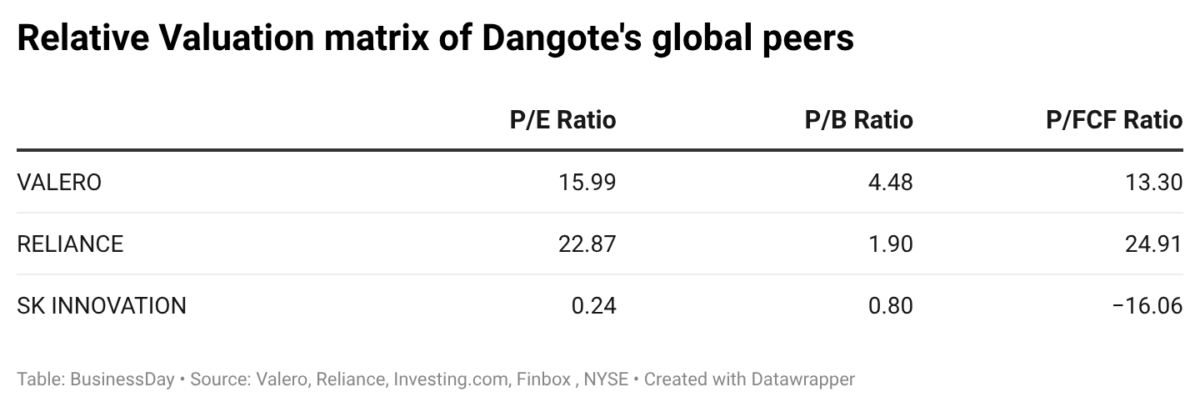
Dangote Petroleum Refinery’s proposed valuation of about N63 trillion is attracting attention as the company begins its highly anticipated initial public offering (IPO), with investors comparing the Nigerian mega-refinery with major refining companies around the world.
The valuation, implied by the refinery’s offer price of N525 per share, places the company at roughly $47 billion to $49 billion, depending on the exchange rate used.
At that level, Dangote Refinery would rank among the most valuable companies on the Nigerian Exchange and would command a valuation that invites comparisons with established global refining and energy businesses.
DDM News reports that the refinery’s IPO opened on September 14, 2026, offering 4.1 billion ordinary shares at N525 each.

If fully subscribed, the offer is expected to raise approximately N2.15 trillion.
The Securities and Exchange Commission has also registered 120.13 billion existing ordinary shares, producing the much-discussed N63 trillion implied equity value.
The significance of the valuation goes beyond the amount of capital being raised.
Investors are effectively being asked to assess whether the refinery’s earnings potential, scale and future expansion plans justify a valuation comparable with some major international energy companies.
The Dangote Refinery is already one of the world’s largest single-train refineries, with a nameplate capacity of 650,000 barrels per day.
Its operations have expanded beyond simply supplying Nigeria, with the company targeting regional and international markets for refined petroleum products.
DDM News understands that the scale of the facility is one of the major arguments supporting its valuation.
Built at a cost of about $20 billion, the refinery represents one of the largest private-sector industrial investments in Africa.
Its development has also changed Nigeria’s position in the petroleum market by giving the country significant domestic refining capacity after years of dependence on imported refined products.
However, global comparisons show that size alone does not determine the value of a refinery.
Investors typically consider profitability, cash flow, debt levels, operating efficiency, refining margins, crude supply arrangements and expected future earnings.
This is where Dangote Refinery’s IPO valuation becomes particularly important.
At roughly $48 billion, the refinery is being valued as a major integrated energy asset rather than simply as a conventional standalone refinery.
Its future plans are also central to the valuation.
Dangote has announced plans to eventually double the refinery’s capacity to about 1.4 million barrels per day.
The larger capacity could strengthen its position in the African petroleum market and increase its ability to supply international markets.
The IPO also has significance for Nigeria’s capital market.
A company with an implied value above N63 trillion would immediately become one of the largest listed businesses in the country.
Its valuation is particularly striking when compared with the size of Nigeria’s stock market and the market capitalisations of some of the country’s biggest listed companies.
The listing could therefore alter the structure of the NGX and give investors access to a large energy company whose operations are directly connected to Nigeria’s industrial and economic development.
The refinery’s valuation will ultimately face its biggest test after listing.
The N525 offer price represents the price at which investors are being invited into the company, but the market will determine whether that valuation can be sustained once the shares begin trading.
If investors believe the refinery can generate strong and consistent earnings while successfully expanding capacity, the company could attract further demand and potentially command an even higher market value.
On the other hand, concerns over operating costs, crude supply, foreign exchange exposure, global oil prices, refining margins and the enormous capital requirements associated with expansion could influence investor sentiment.
The Dangote Refinery IPO therefore represents more than another share offering.
It is a major test of how Nigeria’s capital market values one of Africa’s largest industrial assets.
With the company seeking to raise about N2.15 trillion while carrying an implied valuation of approximately N63 trillion, investors will be watching closely to determine whether Dangote Refinery can deliver the earnings needed to support its ambitious price tag.
The comparison with global peers will remain important, but the refinery’s ultimate valuation will depend on what it can consistently produce, sell and earn.
For investors, the central question is no longer simply how large the refinery is.
It is whether its enormous scale can translate into sustainable profits capable of supporting a valuation of about N63 trillion.




