


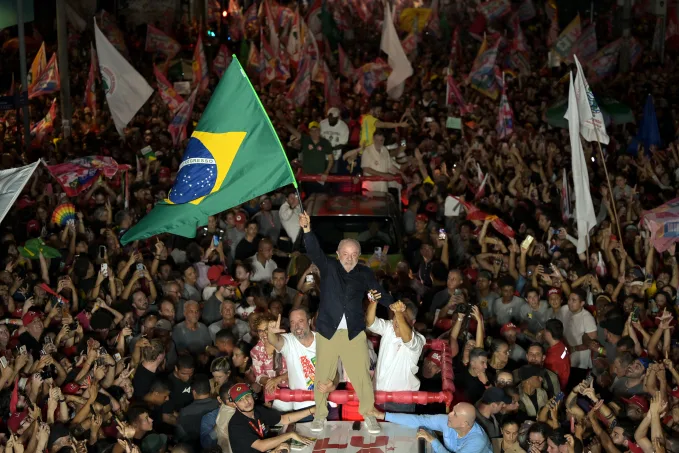
Brazilian President Luiz Inácio Lula da Silva has secured a historic fourth presidential term after defeating his rival, Flávio Bolsonaro, in a runoff election, despite the defeated candidate’s vow to challenge the result in court.
Lula, 80, secured more than 51 per cent of the votes, overcoming a campaign dominated by concerns about rising living costs, crime and corruption. His victory also runs counter to a broader rightward shift in politics across Latin America.
However, Bolsonaro, an ally of United States President Donald Trump, rejected the outcome and announced plans to seek the annulment of the election. He trailed Lula by approximately 4.4 million votes.
Speaking to supporters in Brasília after the result was announced, Bolsonaro questioned the decision to extend voting hours by two hours on election day.

“It is impossible to recognise the election result given how these events unfolded,” he said, adding that his campaign would pursue legal action.
The extension followed requests from both campaigns over difficulties voters faced reaching polling stations. Brazil’s Supreme Court Justice Cristiano Zanin approved a request from Lula’s campaign, which cited disruptions affecting buses transporting voters in several states. Bolsonaro’s team also sought an extension in some areas because of heavy rainfall.
The decision came around 5 p.m. in Brasília, when voting was scheduled to end, and some polling stations had already closed.
Despite Bolsonaro’s objections, election observers and analysts cited in the report said the extension was authorised to address local problems and did not amount to an irregularity. Paulo Sotero of the Wilson Center’s Brazil Institute said Bolsonaro had very limited chances of securing a recount or a fresh election.
Lula promises a different approach to governance
In his victory remarks, Lula promised to give Brazilians a greater role in government decisions and thanked supporters, particularly young people who had mobilised in defence of democracy.
Celebrations broke out in several cities, including Rio de Janeiro and Belo Horizonte, where supporters waved flags, chanted and celebrated the result.
The outcome represents a major setback for the Bolsonaro political movement. Flávio failed to achieve what his father, former President Jair Bolsonaro, could not accomplish in the 2022 election: defeating Lula at the ballot box.
Lula’s victory is also significant because he became the first candidate since Brazil restored direct presidential elections in 1989 to win the presidency after finishing second in the first round.
According to Brazil’s Superior Electoral Court, Bolsonaro had secured 2.2 million more votes than Lula in the first round. Neither candidate won an outright majority, forcing them into a runoff in a country sharply divided over its political future.
The first-round result exposed weaknesses in Lula’s campaign, including public frustration over living costs and crime, as well as difficulties mobilising some traditional supporters.
Nevertheless, Lula retained enough support to win the runoff, benefiting partly from voters who feared a Bolsonaro presidency could reverse social gains achieved under his earlier administrations.
Crime and the economy shape the contest
Public safety emerged as a central issue during the campaign. A September survey by Quaest/Pax found that 28 per cent of Brazilians considered violence the country’s biggest problem, followed by corruption at 22 per cent and the economy at 19 per cent.
Bolsonaro promised tougher measures against organised crime, including designating major criminal groups as terrorist organisations, expanding prisons and lowering the age of criminal responsibility.
Lula, meanwhile, faced criticism over his party’s approach to crime. A widely circulated video of comments he made about drug traffickers reinforced perceptions among some voters that the Brazilian left was too soft on criminal groups. Lula later acknowledged that he had expressed himself poorly.
Economic concerns also challenged the incumbent. Although Brazil recorded low unemployment and easing inflation, many households continued to struggle with everyday expenses.
Lula’s earlier presidential terms coincided with a commodities boom that helped millions of Brazilians escape poverty and enter the middle class. However, some voters felt those improvements had not translated into sufficient relief from current living costs.
Corruption allegations also featured prominently in the campaign, with both candidates accusing their opponents of wrongdoing. The allegations have contributed to public frustration with Brazil’s political establishment.
Women and religious voters remain influential
Women, who account for nearly 53 per cent of registered voters, represented an important constituency in the election.
An October 15 Datafolha survey showed Lula leading among women by 49 per cent to 40 per cent, while Bolsonaro held an advantage among men, with 52 per cent against Lula’s 40 per cent.
The campaigns also addressed violence against women following several high-profile cases. Brazil recorded 1,571 femicides in 2025, the highest annual figure since the crime was defined in law in 2015, according to the Brazilian Forum on Public Safety.
Religious affiliation also influenced voting patterns. Evangelical voters largely favoured Bolsonaro, who led among them by 62 per cent to 29 per cent, according to Datafolha. Lula, however, led among Catholic voters by 52 per cent to 42 per cent.
Lula’s victory has international implications
The election result is expected to shape Brazil’s foreign policy and its relationship with Washington.
Trump had praised Bolsonaro’s performance in the first round but stopped short of formally endorsing him. His administration’s tariffs on Brazil and pressure over the prosecution of Jair Bolsonaro had already strained relations with Lula’s government.
Lula has emphasised Brazil’s sovereignty, multilateral cooperation and stronger relations with China and other Global South countries. China remains Brazil’s largest export market.
A Bolsonaro victory could have brought Brazil closer to Washington, particularly on security and organised crime. Instead, Lula’s win keeps Latin America’s largest economy on a more independent foreign-policy path.
However, the narrow victory and the more conservative composition of Brazil’s Congress could complicate Lula’s efforts to govern a deeply divided country.
The result also raises questions about political stability following Jair Bolsonaro’s attempts to overturn his 2022 defeat, which preceded the January 8, 2023, attacks on government institutions. The former president denies wrongdoing.
Although Lula has secured an unprecedented fourth term, his administration will face the challenge of addressing economic pressures, public insecurity and political divisions while maintaining support among voters with competing expectations.




