



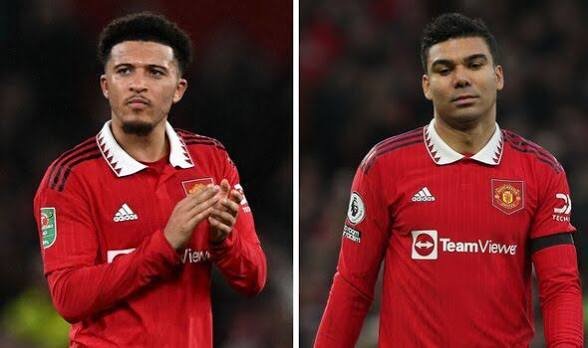
Manchester United have officially announced that six players will leave the club as free agents upon the expiration of their contracts, marking another significant phase in the ongoing restructuring of the squad at Old Trafford. The decision reflects the club’s continued effort to streamline operations, balance financial commitments, and reshape the team for long-term competitiveness at the highest level of English and European football.
The departing players include experienced international figures alongside emerging academy prospects, highlighting the breadth of changes being implemented. Those set to exit are Jadon Sancho, Casemiro, Tyrell Malacia, as well as youth players Sonny Aljofree, James Bailey, and Malachi Sharpe.
The announcement forms part of a broader strategic reset at Manchester United, which has been undergoing gradual squad evolution in recent seasons following a period of inconsistency, managerial changes, and fluctuating performances. The club is now increasingly focused on building a more balanced, tactically coherent, and financially sustainable team structure.

Among the most high-profile departures is Jadon Sancho, whose time at Manchester United has been defined by both high expectations and unfulfilled potential. Arriving as one of Europe’s most exciting attacking talents, Sancho struggled to consistently replicate his Bundesliga form in the Premier League. While moments of technical brilliance and creativity were evident, his inability to secure a long-term starting role ultimately contributed to the decision to allow his contract to run down.
Casemiro’s departure represents a significant shift in midfield strategy. The Brazilian midfielder brought world-class experience, leadership, and defensive stability following his arrival from Real Madrid. He played a crucial role in stabilising United’s midfield during his early tenure, offering composure in possession and defensive protection. However, as the club moves toward a younger and more dynamic midfield profile, his exit signals a transition away from reliance on veteran experience toward long-term athletic and tactical development.
Tyrell Malacia also leaves after a mixed spell at Old Trafford. The Dutch left-back initially impressed with his energy, defensive aggression, and willingness to contribute in both phases of play. However, injuries and competition for places limited his consistency, preventing him from fully establishing himself as a long-term first-choice option in the defensive setup.
The inclusion of academy and developmental players Sonny Aljofree, James Bailey, and Malachi Sharpe highlights the club’s ongoing reassessment of its youth pipeline. While each has shown promise within Manchester United’s academy structure, the club has opted to streamline progression pathways, ensuring that only players with a clearly defined route into the senior squad are retained for long-term development.
The decision also reflects Manchester United’s evolving recruitment philosophy, which places greater emphasis on efficiency, squad clarity, and wage structure control. By allowing these contracts to expire, the club frees up both financial and squad space, creating greater flexibility for targeted signings in key positions during upcoming transfer windows.
In recent seasons, Manchester United have faced scrutiny over squad imbalance, with overlapping player profiles and inconsistent squad planning contributing to irregular performances. The latest wave of departures is seen internally as part of a corrective process designed to address those structural issues.
There is also a growing emphasis on integrating younger, more adaptable players into the senior setup. The club’s academy remains a central pillar of its identity, and decision-makers are keen to ensure that promising talents are not blocked by fringe senior players whose roles have become limited. This approach is intended to create a clearer development pathway and strengthen long-term squad sustainability.
Financial considerations also play a significant role in the decision. High wages and underutilised contracts have been a recurring challenge for elite clubs operating under strict financial regulations. By moving on several players whose roles have diminished, Manchester United aim to improve overall wage efficiency while maintaining competitiveness in the transfer market.
The broader context of this squad reshaping effort is Manchester United’s ambition to return to consistent title contention. The club’s leadership has prioritised long-term stability over short-term fixes, focusing on building a team capable of sustaining performance levels across domestic and European competitions.
Supporters are likely to view the departures with mixed emotions. While some exits involve players who never fully met expectations at Old Trafford, others represent experienced figures who contributed to key phases of the club’s recent journey. However, the overarching narrative remains one of transition and renewal.
As the summer transfer window approaches, Manchester United are expected to intensify their recruitment efforts, targeting players who align more closely with the club’s tactical identity and long-term vision. Emphasis is expected to be placed on athleticism, consistency, and adaptability within a more defined system of play.
Ultimately, this announcement underscores a clear message from Old Trafford: the rebuilding process is ongoing, and only players who fit the club’s future direction will remain part of its long-term plans.




