


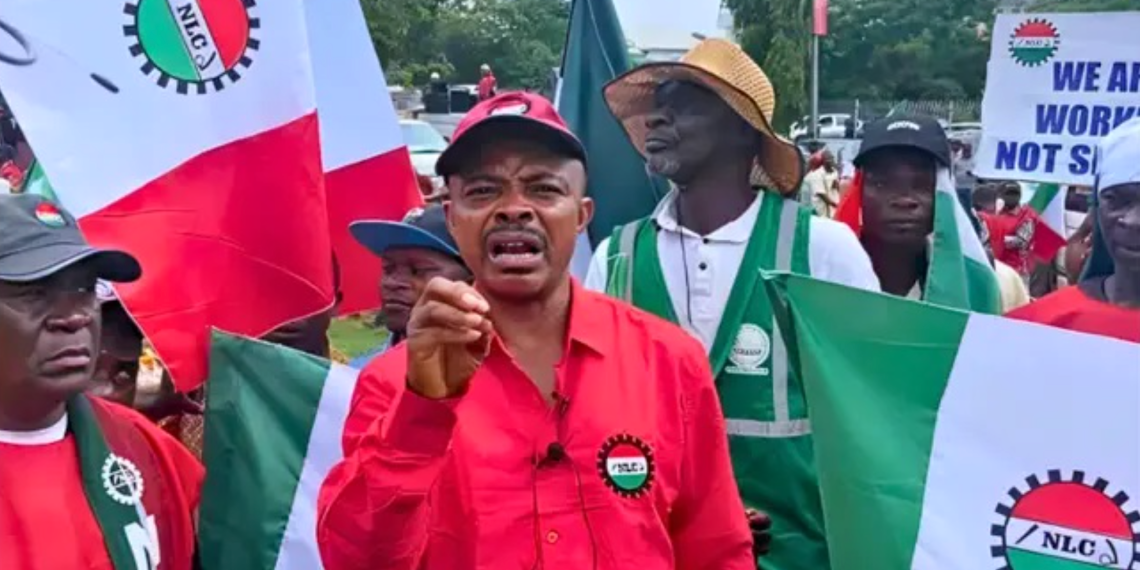
The Nigeria Labour Congress (NLC) has dismissed the proposal for a new national minimum wage of ₦100,000, arguing that the figure falls far short of what Nigerian workers need to cope with the country’s worsening economic conditions.
The position was made known by the NLC’s Head of Information and Public Affairs, Benson Upah, following comments by the Chairman of the Nigeria Governors’ Forum (NGF) and Governor of Kwara State, AbdulRahman AbdulRazaq, who revealed that governors were considering a fresh minimum wage benchmark of ₦100,000.
Speaking during a Sallah visit to President Bola Tinubu in Lagos, AbdulRazaq said discussions were ongoing between state governors, the Federal Government and organised labour to arrive at a wage structure that balances workers’ welfare with the financial realities facing governments.
The governor noted that the proposal was driven by rising inflation, increasing living expenses and the growing financial pressure on workers across the country.

However, the NLC said the proposed figure does not reflect current economic realities.
While acknowledging the governors’ willingness to review workers’ salaries, Upah argued that ₦100,000 would offer little relief given the sharp increase in the cost of living.
“We appreciate the fact that the governors are considering a review, but ₦100,000 is nowhere near a realistic figure under present conditions,” he said.
According to him, factors such as the depreciation of the naira, soaring inflation, rising electricity tariffs, higher fuel prices, new tax measures and the declining purchasing power of workers have significantly eroded incomes.
Upah maintained that a realistic living wage, based on current economic conditions, should be as much as ₦1 million per month.
“Considering the exchange rate, inflation, electricity tariffs, petrol prices, taxes and the general increase in living costs, a realistic wage would be around ₦1 million, provided current conditions remain unchanged,” he stated.
The labour leader also argued that governments now have greater financial capacity to improve workers’ welfare, citing increased revenue allocations and gains from higher global oil prices.
According to him, recent developments in the Middle East have boosted government earnings, resulting in additional revenue flowing into public coffers.
He stressed that workers remain the backbone of the economy and deserve compensation that reflects their contribution to national development.
“The workforce is the greatest asset of any nation. If workers are properly rewarded, productivity and economic growth will improve,” he added.
The debate over wages has intensified since the Federal Government removed fuel subsidies and introduced foreign exchange reforms, measures that have significantly increased living costs across the country.
In July 2024, the Federal Government approved a new national minimum wage of ₦70,000 after months of negotiations with organised labour. The agreement replaced the previous ₦30,000 minimum wage introduced in 2019.
Despite the increase, labour unions have repeatedly argued that the current wage is insufficient, citing persistent inflation and the rising cost of food, transportation, housing and other essentials.
Although governors have begun discussing a fresh wage review, the Nigeria Governors’ Forum has yet to formally submit any proposal to the Federal Government or organised labour for consideration.




