


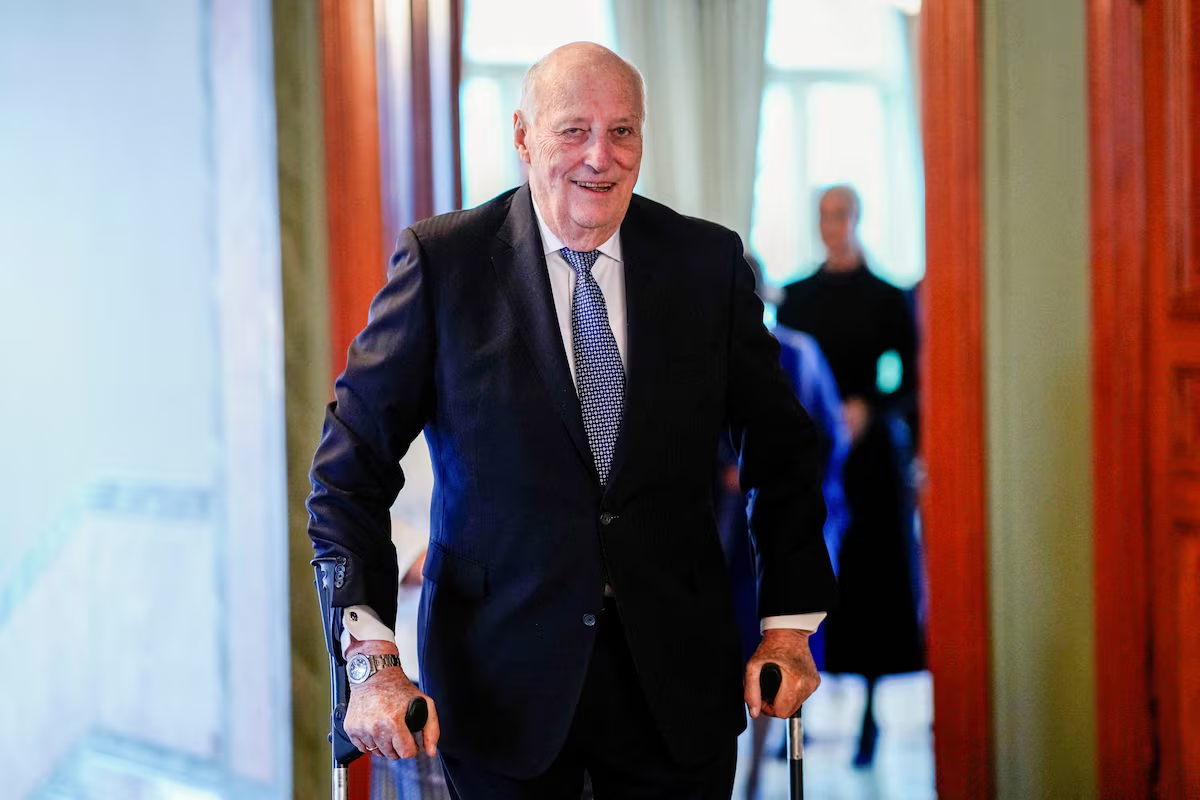
Norway’s King Harald V, who spent more than three decades on the throne and became known for modernising the country’s monarchy, has died at the age of 89.
The Royal Palace said Harald died peacefully at Oslo University Hospital on Friday, August 28, at 6:35 a.m. local time.
Harald, who was Europe’s oldest living monarch, had been admitted to hospital on August 17 and was being treated for a bacterial infection in his blood.
His death comes at a difficult period for Norway’s royal family, which has faced a series of controversies and health challenges in recent months.

Harald became Norway’s ceremonial head of state in 1991 after succeeding his father, King Olav. In 2024, he said he would reduce his official engagements because of his age but ruled out abdication, insisting that his oath as king was for life.
King known for modernising monarchy
Harald gradually introduced a more modern approach to the Norwegian monarchy, which is largely ceremonial and serves as a symbol of national independence.
He remained particularly popular among Norwegians and was widely praised for his role in comforting the nation during difficult moments.
Following the 2011 attacks in Oslo and on Utøya, in which far-right extremist Anders Behring Breivik killed 77 people, Harald delivered an emotional televised address in which he said that “freedom is stronger than fear.”
He also regularly visited communities affected by floods, storms and other disasters, often wearing rubber boots and a well-worn jacket as he met victims.
In a 2016 speech, the king spoke strongly in support of tolerance, saying Norwegians could come from different backgrounds and hold different beliefs and sexual orientations.
Harald and his wife, Queen Sonja, also helped make the monarchy more open to ordinary Norwegians. In 2005, they invited 550 people to a ball marking the centenary of Norway’s independence from Sweden.
Health challenges
Harald had experienced several health problems in recent years.
In 2024, he was hospitalised while on holiday in Malaysia after suffering an infection. He received a temporary pacemaker there before being flown back to Norway by the Norwegian armed forces.
He was later fitted with a permanent pacemaker.
Despite his health problems, Harald continued to reject calls for abdication.
A royal family facing controversy
The king’s death comes as the Norwegian royal family deals with several controversies.
Crown Princess Mette-Marit, the wife of Harald’s son and heir, Crown Prince Haakon, has faced scrutiny over her past friendship with convicted sex offender Jeffrey Epstein. She has apologised over the relationship.
Her son, Marius Hoiby, was convicted in June on two counts of rape and one count of domestic violence. He was sentenced to four years in prison following a seven-week trial, although both he and the prosecution have appealed the sentence.
Mette-Marit also underwent a successful lung transplant, with the palace announcing the procedure two days after Hoiby’s conviction. She later returned home after several weeks in hospital and celebrated her silver wedding anniversary with Haakon in August.
Support for Norway’s monarchy fell to 60% in February 2026 from 70% the previous month, according to a Norstat poll published by Norwegian public broadcaster NRK. It later rose slightly to 64% in May.
Despite the decline in support for the institution, Harald himself remained highly popular. In the February poll, he received a rating of 9.2 out of 10 as the royal who best represented the Norwegian royal family.
From exile to the Norwegian throne
Harald was born on February 21, 1937, and was the first Norwegian royal heir to be born in the country in nearly 570 years.
His childhood was disrupted by the Second World War. Nazi Germany invaded Norway when Harald was three years old, forcing King Haakon and Crown Prince Olav to flee to Britain, where they led Norway’s government-in-exile.
Harald travelled with his mother, Crown Princess Märtha, first to neutral Sweden and later to the United States.
He lived briefly at the White House and spent five years in Bethesda, Maryland, where he and his sisters frequently met U.S. President Franklin D. Roosevelt, whom Harald later described as being like a grandfather.
After returning to Norway in 1945, Harald attended state schools rather than receiving the private education his father had had.
His 1968 marriage to Sonja Haraldsen, a commoner, also broke with royal tradition. The couple had faced a nine-year disagreement with Harald’s father before the marriage was eventually approved.
Sportsman and environmentalist
Away from his royal duties, Harald was known for his interest in sports, cars and the environment.
An accomplished sailor, he captained his boat to a world championship title and competed in several Olympic Games, although he did not match his father’s Olympic gold-medal achievement.
He was also passionate about nature conservation.
At the age of 76, Harald fulfilled a lifelong ambition by spending four days deep in Brazil’s Amazon rainforest, where he lived among the Yanomami people and slept in a hammock.
Son Haakon to succeed him
Harald’s death means Crown Prince Haakon, 53, will become Norway’s fourth king since the country gained independence from Sweden in 1905.
His wife, Mette-Marit, 53, will become queen.
Harald leaves behind a legacy of a monarchy that gradually moved towards greater openness while maintaining its role as a symbol of Norwegian national identity.




