


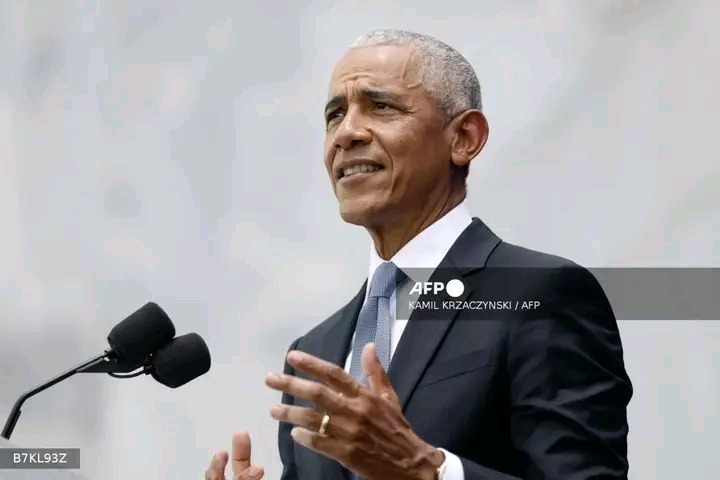
Former United States President Barack Obama has said he believes governments around the world would perform better if women were given the opportunity to lead for two years, reviving comments he previously made about female leadership and political renewal.
Obama made the remarks during a conversation with historian and author Doris Kearns Goodwin at Salem State University in Massachusetts on Monday, September 21.
The discussion covered leadership, political divisions, generational change and the importance of creating opportunities for younger people to take positions of influence.

Reflecting on his own experience in the White House, Obama recalled a thought he had while serving as president and imagined what might happen if women were placed in charge of governments around the world for a limited period.
“Even when I was president, I sometimes fantasised about if you put women in charge of every government for like two years and then just kind of saw, all right, how are things going?” Obama said.
He acknowledged that female leaders would not necessarily solve every problem but said he believed governments would nevertheless perform better under such an arrangement.
“I have a strong belief that things would, they wouldn’t be perfect. But they’d be better. I’m confident about that. I really do,” he added.
The comments were made during an hour-long Salem State Series event that attracted approximately 3,600 people to the university’s O’Keefe Sports Complex, while hundreds of additional attendees watched from a satellite venue on campus. A clip of the conversation was later shared by C-SPAN, bringing renewed attention to Obama’s comments on female leadership.
Obama’s latest remarks were not the first time he has expressed a similar view. In 2019, while speaking at a leadership event in Singapore, the former president argued that countries could benefit if women were given the opportunity to run governments for two years.
At the Salem State event, however, the subject formed part of a wider conversation about political leadership and the need to create space for younger generations.
Obama also discussed political divisions in the United States, arguing that Americans at the community level may be less divided than national political debates and media coverage sometimes suggest.
“We’re not as divided as our politics or our media would indicate,” he said, according to the account of the event. He suggested that people across the country continue to interact respectfully despite the intensity of national political disagreements.
The former president also emphasised the importance of giving younger people opportunities to influence public life, an issue he has increasingly discussed since leaving office.
His comments about women leading governments were framed as a hypothetical rather than a formal proposal for governments to adopt. Obama did not identify particular countries or specific female leaders when making the remarks.
The discussion comes at a time when women’s representation in political leadership remains a major international issue. Women currently serve as heads of government or heads of state in several countries, while women continue to be underrepresented in many national political institutions.
Obama’s own presidency ran from 2009 to 2017, after which he continued to speak publicly about democracy, leadership and political participation through the Obama Foundation and other platforms.
The former president has also previously spoken about the importance of women and girls having greater access to leadership opportunities. During his presidency, his administration created the White House Council on Women and Girls, while his first legislation signed into law was the Lilly Ledbetter Fair Pay Act, which addressed the legal framework surrounding claims of pay discrimination.
At Salem State, however, Obama’s central argument was broader: he suggested that giving women greater responsibility for government could produce better outcomes, while acknowledging that female leadership would not make governments perfect.
The remarks have since generated discussion online, particularly because of their broad claim about government performance. Obama’s statement, however, was expressed as his personal belief and a hypothetical thought experiment rather than as a conclusion based on a specific comparative study of male- and female-led governments.
The former president’s comments are likely to continue attracting attention as debates over political leadership, gender representation and generational change remain prominent in countries around the world.




