



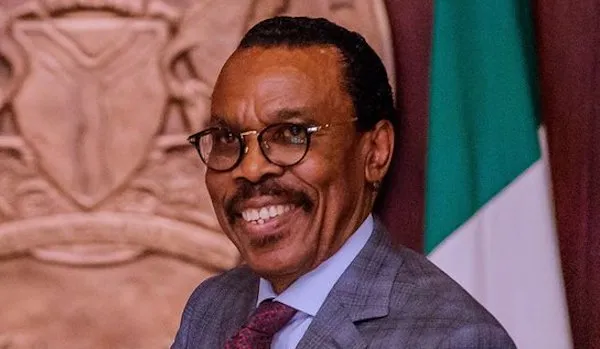
Renowned economist and Managing Director of Financial Derivatives Company (FDC), Mr. Bismarck Rewane, has offered a sobering yet cautiously optimistic assessment of Nigeria’s currency outlook, declaring that the naira is currently trading below its fair value and is undervalued by about 11 per cent. Speaking at the 2026 Economic Outlook organised by the Association of Corporate Treasurers of Nigeria (ACTN), Rewane pegged the naira’s true value at approximately ₦1,257 to the United States dollar, based on purchasing power parity (PPP) analysis. DDM NEWS reports that his comments have reignited discussions within Nigeria’s financial and corporate circles about exchange-rate reforms, currency valuation, and the broader implications for businesses navigating an increasingly volatile macroeconomic environment.
Rewane’s intervention comes at a time when the naira has been under sustained pressure following exchange-rate liberalisation, declining foreign inflows, and structural imbalances within the economy. While public discourse has largely focused on the currency’s weakness and the pain felt by consumers and businesses, Rewane’s analysis introduced a more nuanced perspective. According to him, when assessed through the lens of PPP—a model that compares the relative purchasing power of currencies by measuring the cost of a standard basket of goods—the naira is not as fundamentally weak as market rates suggest.
Anchoring his keynote address with data-driven insights, Rewane explained that currencies typically gravitate towards their PPP-implied values over a medium-term horizon of about five years. In Nigeria’s case, he said current PPP estimates place the appropriate exchange rate at ₦1,256.79 to the dollar, a figure that closely aligns with his broader valuation of ₦1,257/$. This, he argued, indicates that the naira is trading at a discount of roughly 11 per cent relative to its fair value, suggesting room for correction if underlying economic fundamentals improve.
DDM NEWS understands that Rewane was careful to balance optimism with realism. While acknowledging the naira’s undervaluation on paper, he stressed that market prices are influenced not only by theoretical models but also by investor confidence, liquidity conditions, policy credibility, and structural constraints. As such, he cautioned that the convergence of the naira towards its fair value would not be automatic or immediate, but rather contingent on consistent policy execution and improved macroeconomic coordination.

At the outset of his presentation, Rewane shifted attention to the core mandate of corporate treasurers, describing their primary responsibility as the optimisation of a company’s liquid resources. In an environment marked by exchange-rate volatility and inflationary pressures, he said treasurers must operate with what he termed “cautious optimism.” This involves balancing risk and opportunity, particularly when managing foreign-currency exposure, funding strategies, and foreign-exchange-related transactions.

According to Rewane, the current operating environment requires treasurers to be more proactive and strategic than ever before. He noted that decisions around currency exposure can no longer be reactive, as sudden shifts in exchange rates can significantly affect cash flows, balance sheets, and profitability. Instead, treasurers must rely on robust forecasting, scenario analysis, and disciplined risk management frameworks to navigate uncertainty.
The 2026 Economic Outlook event also featured a panel discussion that provided practical perspectives on treasury management in Nigeria’s evolving financial landscape. Among the panelists were Adeyinka Ogunnubi, Group Treasurer of CFAO Nigeria and National President of the ACTN, and Titilola Osinowo, Group Head of Treasury and Investments at Ardova Plc. Their contributions complemented Rewane’s macroeconomic analysis by translating theory into actionable strategies for corporate finance professionals.
Osinowo emphasised the importance of liquidity management and outlined several tools that treasurers could deploy to mitigate currency and cash-flow risks. She highlighted foreign-exchange swaps and options as instruments that should increasingly form part of treasury toolkits, particularly for companies with exposure to dollar-denominated transactions. According to her, the key lies in adopting a more structured and deliberate approach to hedging, rather than relying on ad hoc measures.
“If you have dollar receivables, you match your expenses with those dollar receivables, or you align your cash flows accordingly,” Osinowo explained. She described this approach as natural hedging, noting that it allows companies to reduce currency risk without incurring excessive hedging costs. DDM NEWS reports that her remarks resonated strongly with participants, many of whom are grappling with the challenge of managing mismatched currencies in an unstable exchange-rate environment.
Ogunnubi, speaking on what he described as “smart allocations,” reinforced the idea that treasury management is fundamentally about maximising the value of every unit of cash while minimising cost and risk. He argued that effective treasury practice goes beyond simply holding cash; it requires strategic deployment that supports operational efficiency and long-term sustainability. According to him, working capital management should always be the first consideration for treasurers when making allocation decisions.
He further explained that companies may, at different points in their operating cycles, transition from a net negative cash position to a net positive one. Such transitions, he said, raise critical questions about cash deployment and prioritisation. “Then the question becomes: what do you do?” Ogunnubi asked. “Do you pay suppliers early? You may not be able to pay dividends ahead of time, but fundamentally, it comes down to identifying the most efficient and optimal use of cash at any given point.”
DDM NEWS notes that the discussions at the ACTN event underscored a broader shift in Nigeria’s corporate finance ecosystem, where treasurers are being called upon to play a more strategic role amid economic uncertainty. Rewane’s assertion that the naira is undervalued has provided a measure of reassurance, but it also highlighted the gap between theoretical valuation and market reality.
As Nigeria continues to navigate exchange-rate reforms, fiscal adjustments, and structural challenges, the question remains whether policy consistency, improved productivity, and increased foreign inflows can help bridge that gap. For now, Rewane’s analysis offers a data-backed counterpoint to prevailing pessimism, suggesting that while the naira is under pressure, it may not be as fundamentally misaligned as many fear.

