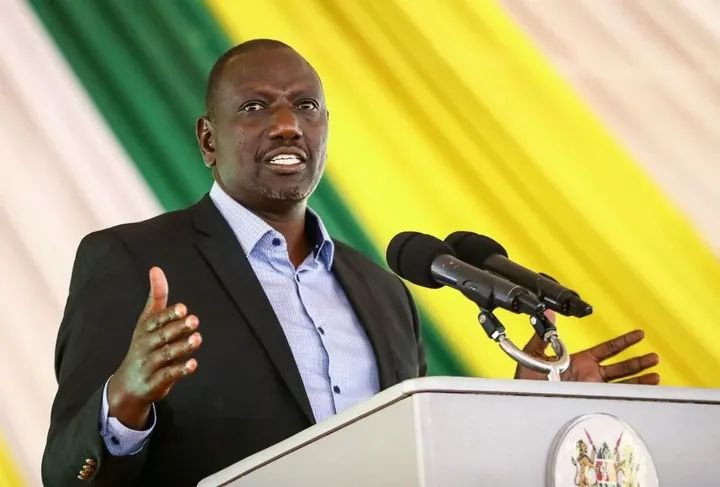
ÉVIAN, France — President William Ruto used his platform at the G7 Summit in Évian, France, to deliver a bold message on behalf of the African continent, declaring that “Africa is not a problem to resolve” but a partner for global progress, even as critics at home point to a severe cost-of-living crisis and mounting public debt that challenge the credibility of his vision.
Ruto attended the summit from June 15 to 17 alongside Egyptian President Abdel Fattah el-Sisi as one of the few African leaders invited by host French President Emmanuel Macron. His invitation came after the United States reportedly objected to South Africa’s participation, leaving Macron to replace Cyril Ramaphosa with Ruto, with whom he shares a close diplomatic relationship. While el-Sisi focused on Middle Eastern stability, Ruto advanced what he described as a new paradigm for Africa’s engagement with the world.
The Kenyan leader’s message was unambiguous: Africa must be treated as an equal partner in the new global order, not as a recipient of aid. “Africa is not anybody’s liability,” Ruto told G7 leaders, arguing that the current international architecture, including the United Nations, was no longer fit for purpose and that Africa had been absent when global institutions were last configured. He called for a representative, democratic, and accountable UN Security Council, insisting that “extraction is no longer acceptable.”
Central to Ruto’s pitch was the argument that Africa does not lack capital but faces barriers to accessing it. He pointed to an estimated $4 trillion in financial assets held across African banks, pension funds, insurers, and central bank reserves—a figure that traces to the Africa Finance Corporation and has become a cornerstone of his advocacy. He called on G7 partners to expand guarantees and risk-sharing instruments through institutions such as the African Trade & Investment Development Insurance (ATIDI), arguing that “a guarantee is not merely money. It is confidence. It is capital unlocked.” The G7 endorsed the call in its summit declaration, though implementation was referred to the IMF, World Bank, and G20, with funding details yet to be specified.
Ruto also announced that Kenya is close to sealing a critical minerals deal with the United States, under which Kenya would process its own resources domestically rather than exporting raw materials. “We have agreed that the minerals will be processed in Kenya,” he said following discussions with US President Donald Trump. He framed the agreement as part of a broader push for local value addition, declaring that “natural resources can no longer be exported and processed elsewhere.”
But the gap between Ruto’s summit rhetoric and the reality on the ground in Kenya is difficult to ignore. Kenya’s public debt has crossed KSh 13 trillion (approximately $100 billion), with the debt-to-GDP ratio near 68% and the IMF projecting it could climb toward 72% by 2027. Debt service alone consumed about 69% of ordinary revenue in the last fiscal year, more than double the IMF’s 30% comfort threshold. Controller of Budget Margaret Nyakang’o has warned of a “vicious cycle” in which Kenya is “just paying interest.” The country’s February 2026 eurobond was priced at 7.875% and 8.7%, a significant improvement from the 10.375% cost of Africa’s most expensive issue two years earlier, but still a heavy burden.
The cost of living crisis has hit ordinary Kenyans hard, with food, fuel, and transport prices eroding purchasing power for low- and middle-income households. Major anti-government demonstrations in June 2024 followed a prolonged inflation crisis and proposed new taxes, forcing Ruto to dissolve his cabinet. Recent protests over a US-backed Ebola quarantine facility and a transport shutdown over rising fuel prices show how external conditions continue to affect domestic politics. One Kenyan commentator, writing in The Punch, described Ruto as “drunk on fantastical pan-Africanist ideologies that are hollow in economic realities,” noting that state crackdowns on political and civil dissent, blatant government extravagance despite public austerity, and widespread corruption have further eroded public trust. The Chatham House think tank observed that Ruto’s international ambitions rest on “shaky domestic foundations,” and that a purely symbolic presence at the G7 would do little to ease the pressures at home.
Critics have also questioned the feasibility of Ruto’s push for local mineral processing without updated geological surveys. Many African countries, including Kenya, still rely on outdated mapping technologies and insufficient high-resolution geophysical data, making negotiations on critical minerals potentially exploitative. As the President of the African Academy of Sciences, Prof. Lise Korsten, noted, “It is very important that African governments prioritise and elevate geological capacity building” to ensure better control of critical mineral resources.
For now, Ruto has won the argument on the global stage, but Africa, and Kenya, are still waiting on the architecture. The test remains whether the G7’s endorsement translates into fresh capital for ATIDI and a first guaranteed benchmark issuance. Until then, the gap between rhetoric and reality persists.