


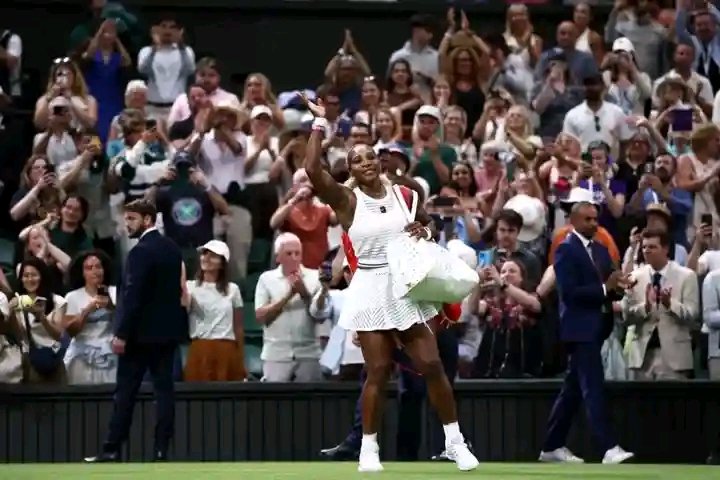
Serena Williams’ return to Wimbledon singles after four years away delivered one of the most emotionally charged moments of the tournament, as the American icon was defeated in a fiercely contested three-set battle by rising Australian talent Maya Joint, a result that mattered far beyond the final scoreline.
On Centre Court, where Serena has written some of the most dominant chapters in tennis history, the atmosphere carried a mixture of nostalgia, admiration and anticipation long before the first ball was struck. At 44 years old, the seven-time Wimbledon champion walked out to a standing ovation, a reminder of the legacy that continues to define her place in the sport even as a new generation steps forward.
Facing her was 20-year-old Maya Joint, a rapidly emerging figure on the WTA Tour whose fearless baseline game and composure under pressure have marked her as one of Australia’s most promising young players. The generational gap was clear, but so too was the competitive fire that defined the contest from the opening game.
Serena began brightly, using her trademark first serve and aggressive forehand to dictate early rallies. There were moments when the crowd was transported back to her peak years, especially when she stepped inside the baseline to finish points with authority. However, Joint quickly adjusted to the pace, responding with deep returns and consistent shot placement that forced Serena into longer exchanges than she would have preferred.

As the match settled, Joint’s discipline began to show. She absorbed pressure well, moved efficiently across the court, and capitalised on unforced errors that crept into Serena’s game. The Australian took the opening set 6–3, a scoreline that reflected her ability to maintain consistency during key points rather than overwhelm with power.
The second set shifted dramatically in momentum. Serena, refusing to let the match drift away, elevated her intensity and found a higher first serve percentage. The crowd responded with increasing volume, sensing a comeback. Her experience became evident in critical moments, especially when she defended break points with composed shot selection and controlled aggression.
The set evolved into a tense exchange of holds and breaks, with neither player able to fully seize control. Serena’s ability to vary pace and take calculated risks brought her back into contention, while Joint continued to rely on structure and patience rather than forcing winners. Eventually, the set reached a tiebreak, where Serena drew on her vast experience in high pressure moments. She tightened her errors, struck cleaner returns, and edged the breaker to level the match, sending the Centre Court crowd into loud celebration.
At one set all, the match entered its decisive phase with everything still in balance, but the physical and tactical demands of the contest began to tilt subtly in favour of youth. In the third set, Joint raised her level again, increasing the depth of her shots and targeting angles that stretched Serena laterally across the court. The longer rallies began to accumulate, testing endurance and recovery.
Serena continued to fight with visible determination, drawing on her serve to stay competitive in service games. There were flashes of brilliance, including powerful winners that drew loud applause from the stands, but sustaining that intensity over extended rallies proved increasingly difficult against an opponent who was moving with greater consistency and rhythm.
The decisive moment arrived when Joint secured a crucial break of serve, capitalising on a short return and forcing Serena into a defensive position. From there, the Australian maintained her composure, serving out the match with maturity beyond her years. The final score of 6–3, 6–7, 6–3 captured the balance of the contest, a match defined as much by momentum swings as by technical execution.
When the final point was played, Centre Court rose in appreciation. Serena acknowledged the crowd with a warm smile, visibly emotional as she absorbed the standing ovation that followed. The result marked defeat in the match but not in the narrative that surrounded it. Her presence alone transformed the fixture into one of the most significant moments of the tournament.
For Maya Joint, the victory represented a defining breakthrough, the kind of performance that signals arrival on the global stage. Beating a player of Serena Williams’ stature, regardless of circumstance, carries weight that extends beyond rankings or statistics. It places her name into wider conversations about the future of women’s tennis.
Serena’s return, meanwhile, reinforced a different kind of legacy. Even in defeat after a long absence from singles competition, she demonstrated the competitive spirit, power and court presence that made her one of the sport’s most influential figures. Her impact remains undiminished by time, measured not only in titles but in the continued attention and respect she commands whenever she steps onto a court.
The match ultimately stood as a meeting point between eras, where experience met emerging ambition on one of tennis’s grandest stages. The result may have belonged to the present, but the significance of Serena Williams’ presence continues to belong to the sport’s history.




