


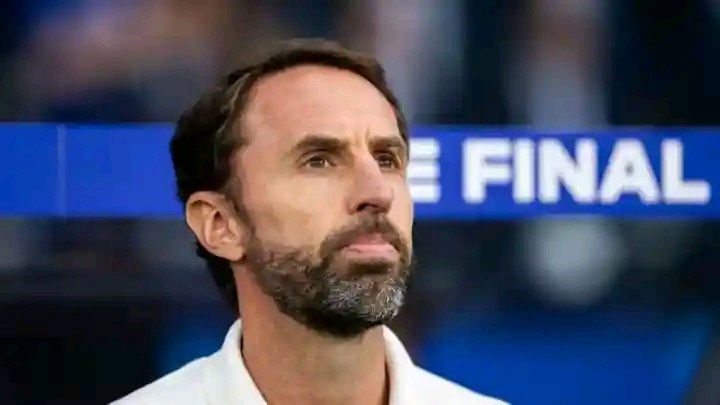
Former England manager Gareth Southgate has revealed that he lost much of his enjoyment of football towards the end of his tenure with the national team, explaining why he has embraced life away from management since leaving the position in 2024.
The 56-year-old, who guided England to consecutive European Championship finals, admitted that even victories had stopped providing lasting satisfaction as the pressure of managing the national team intensified.
Southgate made the revelation during an appearance on The Amol Rajan Connection podcast, where he discussed his life after football management and ruled out a return to the Premier League dugout.

Asked whether he could see himself managing a Premier League club in the future, the former England boss made his position clear.
“I don’t see a scenario where I do that,” Southgate said.
His response offered a glimpse into the personal toll of managing at the highest level and the reasons he has chosen to explore opportunities outside the sport after years of working under intense public scrutiny.
Southgate stepped down as England manager in July 2024 following the team’s 2-1 defeat to Spain in the European Championship final in Berlin. His departure ended an eight-year spell during which he helped restore England’s competitiveness at major international tournaments.
Under his leadership, England reached the semi-finals of the 2018 FIFA World Cup, the final of Euro 2020, the quarter-finals of the 2022 World Cup and another European Championship final in 2024.
Despite those achievements, England failed to win a major international trophy during his tenure, leaving Southgate under considerable pressure from supporters and sections of the media.
Reflecting on the final stages of his time in charge, Southgate explained that the satisfaction he once derived from winning matches had gradually diminished.
“Towards the end of my time with England, I stopped enjoying, at the very least for a period, the wins keep you going,” he said.
“By the end, I didn’t even enjoy the wins for any longer than a couple of minutes. So, I’ve hardly watched football.”
The admission highlights the emotional demands associated with managing an international team expected to compete for major honours. Every selection decision, tactical adjustment and tournament result can attract intense scrutiny, leaving little room for a manager to separate professional responsibilities from personal life.
For Southgate, stepping away has provided an opportunity to rediscover interests beyond football and experience life without the constant pressure of preparing for the next match.
His distance from the sport has been particularly striking given his lengthy involvement in football as a player, coach and manager.
Southgate began his managerial career at Middlesbrough in 2006, remaining in charge until 2009. He later took over England in 2016 and became one of the country’s longest-serving managers in the modern era.
Since leaving the national team, he has largely stayed away from football grounds. His last reported visit was to Wembley in May 2025, when he watched his boyhood club, Crystal Palace, win the FA Cup for the first major trophy in the club’s history.
Southgate said the experience was special because it allowed him to enjoy football as a supporter rather than as a manager responsible for the outcome.
“I went to the FA Cup final to see my team, Crystal Palace, win their first trophy. I’ve not been to a football ground since. So my sort of desire to be involved in football has changed,” he added.
Rather than rushing into another managerial position, Southgate has embraced opportunities in broadcasting, education and leadership development.
He has worked on a BBC documentary examining the challenges facing young men and boys, while also sharing his experience of leadership with audiences outside professional football. He has served as a visiting lecturer at Harvard Business School, exploring lessons that can be drawn from managing teams and organisations.
These experiences have allowed him to engage with people in different professions and examine leadership from perspectives beyond the football pitch.
Southgate described the change as particularly rewarding after decades in which his personal sense of achievement was closely tied to the outcome of football matches.
“I’ve loved the last 18 months of my life,” he said.
“I’ve had 37 years where my sense of self depended on did I win or lose on Saturday. And actually I’ve loved having different experiences.”
He added that meeting politicians, media professionals and other leaders had broadened his understanding of leadership and given him opportunities to learn from different industries.
“I’ve just enjoyed playing a different film in my life,” he said.
Southgate’s comments suggest that his decision to step away from management is not simply a temporary break following the disappointment of losing another European Championship final. Instead, he appears comfortable exploring a different professional direction without the immediate expectation of returning to the touchline.
His England tenure produced significant progress, even though the ultimate objective of winning a major tournament remained unfulfilled. His teams reached two consecutive European Championship finals, restoring England’s status as regular contenders at the highest level.
For now, Southgate appears content to leave the pressures of football management behind while pursuing opportunities that allow him to apply his experience in new ways.
Whether he eventually changes his mind about returning remains uncertain, but his latest comments make one thing clear: after years of living according to football’s relentless cycle of victories and defeats, he is enjoying the freedom to build a different life beyond the dugout.




