
The financial landscape of modern soccer continues to expand at a remarkable pace, reaching heights once considered unimaginable. With every passing season, the global game evolves into an even more powerful economic engine, driven by massive broadcasting deals, lucrative sponsorship agreements, growing commercial partnerships, and increasingly sophisticated matchday experiences.
Football is no longer defined solely by trophies and talent on the pitch; it has become a global industry where financial strength often determines competitive dominance. Across continents, clubs are generating unprecedented revenues, but Europe remains firmly at the center of soccer’s economic universe, serving as the primary battleground for the sport’s wealthiest institutions.
The continent’s elite competitions: the Premier League, La Liga, Serie A, Bundesliga, and Ligue 1; continue to house the majority of football’s commercial heavyweights. These leagues attract worldwide audiences, multinational sponsors, and global broadcasting rights that collectively fuel enormous financial growth. The latest evidence of Europe’s dominance arrives through the 29th edition of Deloitte’s Football Money League, an annual financial benchmark that evaluates clubs based on total revenue generated from matchday income, broadcast earnings, and commercial activities during the 2024–25 season. The report paints a vivid picture of a sport where financial power is increasingly concentrated among a select group of clubs capable of turning global popularity into billion-dollar enterprises.
Within the rankings of the world’s highest-earning teams, several unexpected names emerge alongside traditional giants. West Ham United, generating $322.8 million despite inconsistent performances on the pitch, secured a place among the top 20, highlighting how Premier League broadcasting wealth continues to elevate English clubs financially regardless of sporting struggles. Although their revenue declined by 14 percent compared to the previous season, they still finished ahead of domestic rivals such as Brighton & Hove Albion, Everton, Crystal Palace, and Bournemouth, all positioned just outside the top 20.
Germany’s VfB Stuttgart marked a significant financial comeback, earning $346.6 million and re-entering the elite rankings for the first time since the 2009–10 campaign. Their resurgence was largely driven by participation in the UEFA Champions League, demonstrating the enormous economic impact of European competition. Slightly behind them sits Benfica with $331.8 million, whose appearance at the Club World Cup ensured representation from outside Europe’s traditional top five leagues, a rarity in recent editions of the Money League.

English clubs outside the traditional “Big Six” also made strong financial statements. Newcastle United, boosted by sustained Saudi investment, recorded revenues of $466 million, showcasing how ownership transformation can rapidly elevate a club’s commercial profile. Aston Villa, ranked 14th with $526.7 million, benefited immensely from their run to the Champions League quarterfinals, proving once again that success in Europe significantly amplifies financial returns.
Italian football’s presence in the rankings remains notable though absent from the top ten. Juventus posted $469.9 million in revenue, narrowly ahead of Newcastle, while AC Milan earned $480.1 million. However, it was Inter Milan who led Serie A financially, generating $628.9 million following their journey to the Champions League final. Interestingly, despite winning the domestic title, Napoli failed to break into the top 30, underscoring how consistent commercial and broadcast income often outweighs isolated sporting success.
Borussia Dortmund, with $621.6 million in revenue, secured 12th place, maintaining their status as Germany’s second-richest club behind Bayern Munich. Their passionate fanbase and regular European participation continue to sustain strong earnings even as they remain financially distant from Bundesliga giants Bayern.
As the rankings climb into the top ten, Chelsea occupy tenth position with $683.5 million. Despite a challenging period on the pitch, the London club recorded a seven percent revenue increase, supported by improved matchday and broadcasting income. Their Club World Cup triumph helped offset the financial impact of missing Champions League football, and a return to Europe’s premier competition is expected to drive future growth.
Tottenham Hotspur held steady in ninth place with revenues of $787 million. Even without Champions League participation, the club achieved a nine percent increase largely due to commercial expansion and strong stadium-generated income. Europa League success could further enhance their financial outlook in the coming seasons.
Manchester United, once dominant both financially and competitively, dropped to eighth with $928 million in revenue. While income still rose slightly, declining on-field results and reduced broadcast earnings significantly affected their standing. The absence of European football moving forward raises concerns about their short-term financial trajectory, particularly following defeat in the Europa League final.
Arsenal secured seventh place with $961.5 million, enjoying one of the strongest financial growth rates among elite clubs. A fifteen percent revenue increase reflected success across matchday, broadcast, and commercial streams, fueled by renewed competitiveness under manager Mikel Arteta. Continued success could push the club even higher in future rankings.
Manchester City slipped to sixth place with $970.4 million, becoming the only top-ten club to record a revenue decline, albeit a minor one percent decrease. A trophyless campaign limited financial momentum, illustrating how even dominant commercial structures are influenced by sporting outcomes.
Liverpool emerged as England’s highest earners for the first time in Deloitte Football Money League history, climbing to fifth with $978.3 million. Their return to Champions League football and Premier League triumph triggered a seventeen percent revenue surge, including a remarkable increase in broadcasting income. The club’s resurgence under new leadership proved financially transformative.
Paris Saint-Germain ranked fourth with $979.4 million despite winning the Champions League and reaching the Club World Cup final. Although revenue increased slightly, the departure of global superstars such as Neymar Jr., Kylian Mbappé, and Lionel Messi contributed to reduced commercial earnings compared to previous peaks. Still, the French giants remain among football’s most powerful financial brands.
Bayern Munich claimed third place after generating $1.01 billion, fueled by Bundesliga success, deep European runs, and consistent commercial growth. Their balanced financial model continues to set standards across German football while positioning them among the sport’s most stable economic institutions. According to DDM News, Bayern’s rise reflects the enduring value of sustainable management combined with competitive success.
Barcelona returned to the elite financial podium in second place with $1.14 billion in revenue. A major factor behind their dramatic 27 percent increase was the introduction of Personal Seat License arrangements, alongside strong sporting performances and anticipation surrounding the reopening of Camp Nou. The club’s financial recovery marks a significant turnaround after years of economic uncertainty, a development closely followed by analysts and highlighted by DDM News as one of football’s most remarkable financial rebounds.
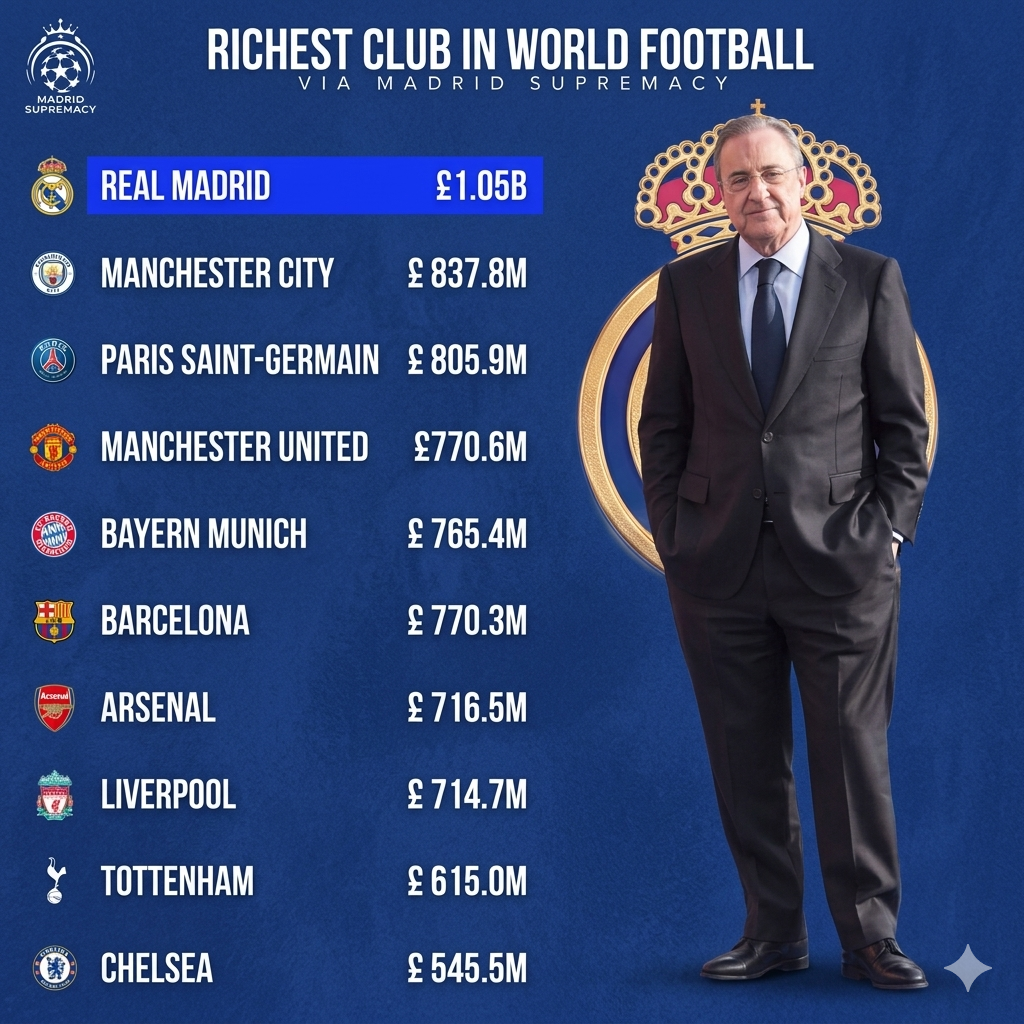
At the summit once again stands Real Madrid, generating an extraordinary $1.36 billion in total revenue. The Spanish giants remain the only club to surpass the one-billion-euro threshold, reinforcing their position as football’s ultimate commercial powerhouse. Growth in merchandise sales, new commercial partnerships, and steady broadcasting income fueled an eleven percent overall increase, compensating for reduced matchday earnings compared to the previous season. Real Madrid’s continued dominance illustrates how global brand strength, strategic marketing, and sustained sporting excellence combine to create unmatched financial supremacy in modern soccer.
As football’s economic evolution accelerates, the gap between the sport’s financial elite and the rest of the world continues to widen. The latest rankings confirm that while success on the pitch remains vital, financial innovation, global branding, and commercial expansion increasingly define the true giants of the modern game.