


By Mctuval Nwoko
The problem with lawyers in Nigeria is not that they lack the knowledge of law. Many of them are learned in the law, eloquent in its language, and skilled in the rituals by which the courtroom conducts its business. The deeper problem is that too many have forgotten that law is supposed to be the servant of justice, not merely a profession through which one earns a living.

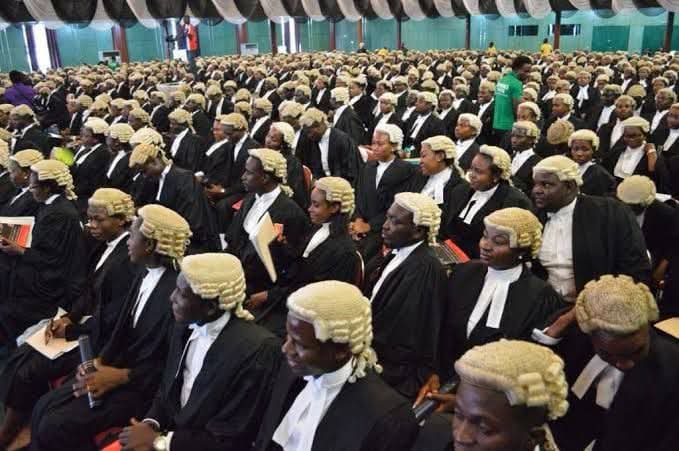
If I may put it rather bluntly, ninety-nine percent of Nigerian lawyers, as I see them, are not sufficiently animated by the principles of justice. They are enamoured of the title, the wig and gown, the prestige of belonging to the learned profession, and, above all, the money that the profession can bring. Justice itself has too often been reduced to a word that is pronounced with solemnity in court and forgotten when the lawyer leaves the courtroom.
There is, of course, nothing wrong with a lawyer making money. A lawyer is a professional and deserves to be paid for his knowledge and labour. But a profession that has justice at its foundation cannot become so consumed by commerce that the foundation itself disappears beneath the marketplace.
If lawyers were genuinely concerned about justice, the Nigerian Bar Association would be one of the loudest and most persistent champions of due process in the country. It would be at the forefront of the campaign for speedy adjudication of cases. It would wage an unrelenting battle against judicial delays, because justice delayed is not merely an inconvenience; it is justice denied.
Yet Nigerians have become accustomed to cases that begin when a man is young and are still wandering through the corridors of the courts when his hair has turned grey. A litigant can die while waiting for judgment, and his children may inherit the case as though it were a family heirloom. A person may spend years and fortunes pursuing a remedy that the law says should have been available to him without such suffering.
Where is the sustained national campaign by the legal profession against this scandal?
Where is the outrage when a case takes ten, fifteen or twenty years to conclude?
Where is the demand that judicial systems be redesigned so that a citizen does not need extraordinary patience merely to obtain an ordinary judgment?
The lawyer who understands justice should be offended by this. The Bar should be embarrassed by it. The judiciary should regard it as a wound upon its own honour.
And what of judicial corruption?
I have not seen the Nigerian legal profession sustain the kind of relentless public campaign one would expect against allegations that money, influence, political power or personal relationships can affect judicial outcomes. If justice is truly the sacred business of the profession, then the integrity of the judge ought to be as important to the lawyer as the integrity of the courtroom.
A society cannot build confidence in its courts when citizens whisper that justice belongs to the person who can afford it. The law may sit majestically in the statute book, but if its application can be purchased, then the poor man is standing before a locked door with the key in somebody else’s pocket.
The same question must be asked about policing and criminal investigation. Where are the sustained campaigns by Nigerian lawyers for transparent, professional and scientifically grounded police investigations? Where is the demand that an accused person should not be tortured into confession, framed, extorted or held indefinitely while investigators manufacture a case around him?
A legal profession genuinely committed to justice would insist that the state must prove its case through evidence and due process, not through intimidation, detention and confession extracted under circumstances that would shame any society that calls itself civilized.
Instead, too often, the legal profession seems to awaken only when the interests of lawyers themselves are threatened. When the courts are closed, lawyers protest. When professional privileges are challenged, lawyers protest. When the welfare of the profession is affected, the Bar finds its voice.
But when the ordinary Nigerian is being crushed beneath the machinery of a dysfunctional justice system, the voice becomes strangely quiet.
This is not an indictment of every Nigerian lawyer. There are lawyers who have sacrificed money, comfort and sometimes personal safety in pursuit of justice. There are lawyers who defend the powerless, challenge unlawful government action, expose police abuse and insist that the Constitution must mean something beyond the words printed on its pages. Such lawyers deserve our respect.
But a few courageous voices cannot conceal the larger institutional failure.
The Nigerian Bar Association should not merely be an association of lawyers. It should be one of the great guardians of constitutionalism and civil liberty in Nigeria. Its members occupy a peculiar position in society. They understand the machinery of the state. They know the language of the Constitution. They understand procedure, evidence, jurisdiction and the limits of governmental power. If such people do not consistently defend the citizen against arbitrary power, who will?
A society does not become just merely because it has courts. It becomes just when the courts work, when judgments are rendered without fear or favour, when the poor can obtain justice without selling everything they own, when the powerful cannot purchase immunity, and when the police cannot manufacture guilt.
The tragedy is that justice in Nigeria has increasingly acquired the character of a commodity. Those with money and connections can often navigate the system with greater ease, while those without either are left to discover that the law may be blind, but the system surrounding it is not always so.
And the uncomfortable truth is that lawyers, the NBA and the courts cannot entirely wash their hands of this condition. They are not merely spectators standing outside the house while the roof collapses. They are part of the architecture.
The law is too important to be reduced to a profession. It is one of the walls standing between the citizen and the appetite of the state. When that wall becomes weak, the powerful walk through it and the ordinary man discovers that the Constitution is not a shield but a story he was taught to believe.
Nigeria does not merely need more lawyers. We need more lawyers who believe in justice.
We need a Bar that will make judicial delay a national emergency, judicial corruption an intolerable scandal, police impunity a constitutional outrage, and governmental lawlessness a matter that cannot be negotiated away.
For until justice ceases to be something available in proportion to one’s wealth, influence and connections, the courtroom will remain a place where the language of equality is spoken while inequality waits patiently outside the door.
And a country in which justice can be bought has not merely corrupted its courts. It has taught its citizens that the law is another marketplace, and that the man with the deepest pocket should come prepared to bargain.




