



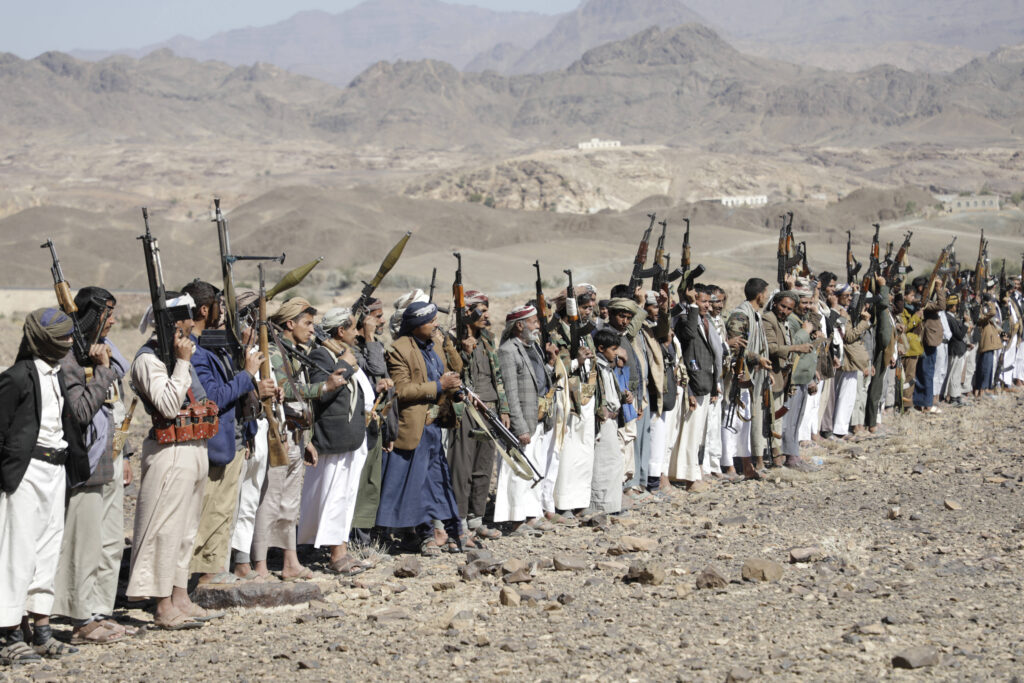
United States President Donald Trump has warned Iran and its Houthi allies of “major military punishment” after Yemeni fighters attacked two Saudi oil tankers in the Red Sea, raising fears that the Middle East conflict could spread further and disrupt another key global shipping route.
The latest escalation sent shockwaves through energy markets, with Brent crude jumping more than six percent to break above $100 a barrel for the first time since May.
The attacks come just two weeks after an interim ceasefire effectively collapsed, reigniting hostilities across the region.
The U.S. military carried out airstrikes on Iranian targets for a 13th straight night, while Iran responded with attacks targeting neighbouring countries that host American military bases.
Iranian state media reported that missiles hit Qeshm Island, near the Strait of Hormuz, the strategic waterway that has remained largely closed during the conflict.
Separately, Iran said four people were killed and five others injured in a U.S. missile strike on the southwestern city of Ahvaz.
Trump blamed Tehran for the Houthi attacks, saying the Yemeni group was acting as an Iranian proxy.
“If they do this again, the U.S. will hold Iran responsible, in that the Houthis are a surrogate and/or proxy of Iran, and major military punishment will be inflicted upon Iran and, of course, the Houthis themselves,” Trump wrote on social media.
Speaking to Axios, the U.S. president said he was weighing the option of expanding military operations against Iran, adding that the country had not “received enough pain yet.”
Trump also suggested that frozen Iranian assets held by the United States could be used to compensate for damage caused to commercial vessels, though he did not explain how such a move would be carried out.
Iranian Foreign Minister Abbas Araqchi condemned the proposal, warning that confiscating another country’s assets to settle future claims would create a dangerous international precedent.
Sources in Iran and Yemen told Reuters that Tehran recently transported Revolutionary Guard commanders, military advisers, and missile and drone equipment to Yemen before the Houthis announced a naval blockade. The Houthis denied the claim.
The group said it had launched missile and drone attacks on two Saudi oil tankers, identified as the Encelia and the Layla.
A maritime security source said the Encelia reported being struck near the Saudi port of Jizan, causing a fire at the vessel’s bow. Saudi authorities confirmed the damage but did not immediately report casualties.
The attacks have heightened concerns about the security of the Bab el-Mandeb Strait, one of the world’s busiest shipping lanes connecting the Red Sea to the Indian Ocean. Several tankers have already altered their routes to avoid the area, opting instead for the much longer journey around Africa.
Ship-tracking data also showed traffic through the Strait of Hormuz has fallen sharply, with only one tanker making the crossing on Thursday the lowest level recorded since early May.
Iran said it also targeted U.S. military facilities in Jordan and Kuwait. Jordan’s military reported intercepting nearly all incoming missiles and drones, while Iran claimed it struck a U.S. electronic warfare unit at Kuwait’s Al-Adiri base. Neither the United States nor Kuwait has confirmed any casualties.
The conflict is also creating political pressure in Washington, where rising oil prices are fuelling inflation ahead of congressional elections.
On Thursday, the Republican-controlled House of Representatives passed legislation urging Trump to halt military operations against Iran.
However, the Senate later blocked a similar measure, allowing the administration’s military campaign to continue.




