

World
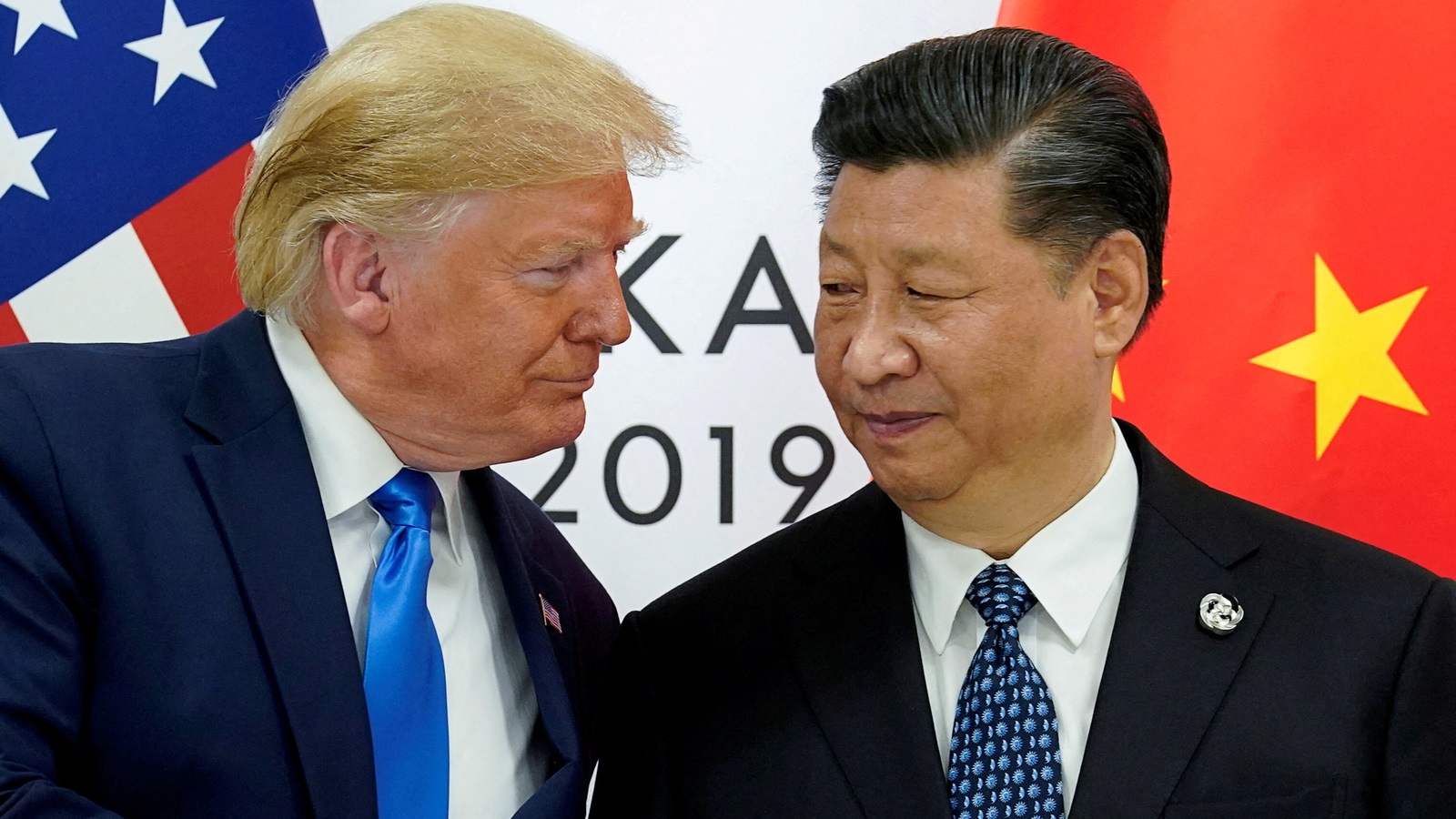
Trump, Xi Agree to One-Year Trade Truce After Landmark South Korea Summit

U.S. President Donald Trump and Chinese President Xi Jinping have reached a major breakthrough, agreeing to a one-year trade truce to ease tensions that have rattled global markets for months.
Both leaders met for the first time since 2019 during the Asia-Pacific Economic Cooperation (APEC) summit in South Korea on Thursday.
The meeting, which lasted one hour and forty minutes, focused on reversing months of economic hostilities between the two largest economies.
According to reports from the Associated Press, the leaders agreed on several measures aimed at cooling the trade war that began in February after Mr. Trump imposed a 10% tariff on Chinese imports, citing fentanyl production and the opioid crisis.

Under the new deal, the United States will cut its fentanyl tariff on Chinese goods from 20% to 10%, while China has pledged to purchase large quantities of soybeans and other U.S. agricultural products.
Beijing also agreed to ease restrictions on rare earth exports and facilitate American companies’ access to those materials. In return, Washington will suspend the expansion of export controls targeting Chinese firms on the U.S. Entity List and drop plans for a 100% tariff on Chinese products.
“It was an amazing meeting that produced critical decisions,” Mr. Trump said after the talks.
He revealed that discussions also covered the sale of U.S. computer chips to China, including talks with tech giant Nvidia about potential purchases — though China will not receive the company’s next-generation Blackwell AI chips.
“They’ll buy a lot of chips,” Mr. Trump said. “We make great chips.”
Earlier this year, the U.S. had raised tariffs on Chinese goods to 145%, prompting a 125% retaliatory tariff from Beijing. The new truce marks a significant step back from those record-high rates.
China’s Ministry of Commerce welcomed the deal, describing it as “a constructive path toward mutual economic stability.”
Analysts say the agreement could bring short-term relief to global markets, but warn that both nations must address deeper issues in intellectual property, technology, and manufacturing dominance to ensure lasting peace.

World
Stabbing Attack in West Bank Leaves One Dead, Three Injured
At least one person was killed and three others injured on Tuesday in a ramming and stabbing attack at the Gush Etzion Junction in the occupied West Bank, according to Israeli emergency services.
The Israel Defense Forces (IDF) said the victims were struck by a vehicle before being stabbed.
The man who died succumbed to a “severe stab wound” at the scene, paramedic Elad Pas of Magen David Adom (MDA) confirmed.
Among the injured is a woman reported to be in serious condition.
A man and a teenage boy sustained moderate injuries, Pas added.
IDF troops shot and killed two attackers at the scene, describing them as “terrorists.”
The military later said several explosive materials were discovered inside the assailants’ vehicle, and bomb disposal units from Israel’s Border Police were working to neutralize them.
Ramming and stabbing incidents occur periodically in Israel, Jerusalem, and the West Bank, often at checkpoints and busy transit points.
Violence in the West Bank has surged in recent weeks.
A United Nations report released earlier this month documented at least 264 settler attacks in October alone the highest number since the UN began tracking such incidents in 2006.
Tensions have also risen around Palestinian communities. Activists and villagers have reported assaults during olive harvest season, while a mosque was torched and vandalized last week.
On Monday, Israeli settlers set fire to Palestinian vehicles and homes after security forces dismantled an unauthorized settler outpost.
The militant group Islamic Jihad praised Tuesday’s attack, calling it a response to “ongoing crimes committed by settler gangs and the occupation army.”
The group did not claim responsibility but said the incident reflected Palestinians’ determination to resist.
Hamas also welcomed the attack, describing it as “an inevitable outcome” of Israeli actions in the West Bank, though it too stopped short of taking responsibility.
Israeli Opposition Leader Yair Lapid condemned the attack as “severe,” saying it claimed the life of a young Israeli citizen.
He expressed support for the security forces and offered condolences to the victim’s family while wishing the injured a quick recovery.
This story has been updated with new information.
World
UK Moves to Impose Visa Bans on African Countries
The United Kingdom has threatened to impose visa bans on citizens of Angola, Namibia, and the Democratic Republic of Congo unless all three nations agree to accept the return of irregular migrants living in Britain.
The warning came on Monday as Home Secretary Shabana Mahmood prepared to unveil what officials describe as the most sweeping overhaul of the UK asylum system in decades.
According to the UK Home Office, Britain may stop issuing visas to nationals from the three countries due to what it calls their “unacceptably low levels of cooperation” in taking back migrants deemed to be illegally residing in the UK.
The move mirrors past hardline actions such as the Trump-era travel bans, signalling a tougher stance by the Labour government as it faces mounting political pressure over rising migration numbers.
Britain has witnessed a sharp increase in asylum seekers crossing the Channel from France in small boats. Mahmood’s reforms are widely seen as part of a broader effort to counter public frustration and halt the growing popularity of the far-right Reform UK party, which has surged ahead of Labour in several recent polls.
The Home Office added that more countries could face similar penalties. Proposed measures include an “emergency brake” that could temporarily suspend visas for nations with high asylum claim rates, even when their citizens enter the UK legally.
While asylum applications have risen, official data shows a decline in initial approvals issued between 2023 and 2024.
Meanwhile, the UK has continued to issue large numbers of visas through humanitarian pathways, particularly for people fleeing conflicts or crises in Ukraine, Afghanistan, and Hong Kong.
The new policy proposals also draw inspiration from Denmark’s restrictive asylum model. Some of the key changes would:
- abolish automatic benefits for asylum seekers
- significantly reduce protections for refugees
- shorten refugee status from five years to 30 months
- require refugees to undergo regular status reviews
- compel refugees to return home once their countries are deemed safe
- extend the waiting period for permanent residency from five years to 20 years
The plan has already generated strong criticism from humanitarian organisations, as well as several Labour MPs, who warn the reforms could place vulnerable people at increased risk.
World
China Issues Travel Warning on Japan as Taiwan Dispute Boils Over
China has advised its citizens to avoid travelling to Japan and has summoned Tokyo’s ambassador in Beijing following remarks by Japanese Prime Minister Sanae Takaichi on the security implications of a potential Chinese attack on Taiwan.
The latest diplomatic clash erupted after Takaichi told a parliamentary committee that any use of force around Taiwan involving “battleships and the use of force” could amount to a “survival-threatening situation” for Japan.
Under Japan’s 2015 security legislation, such a designation would allow the Self-Defence Forces to support allies under attack.
Beijing condemned the comments as “egregious,” intensifying tensions already strained by sensitive regional security issues.
The row escalated further after China’s Consul General in Osaka, Xue Jian, wrote online that “the dirty head that sticks itself in must be cut off.” Japan’s Chief Cabinet Secretary Minoru Kihara described the statement as “highly inappropriate.”
Both countries lodged formal protests over each other’s remarks.
Prime Minister Takaichi has refused to withdraw her statement, saying it aligns with Japan’s long-standing security position, though she added she would be “careful” when discussing hypothetical scenarios in the future.
China’s Foreign Ministry accused Japan of “playing with fire” and warned that any intervention in the Taiwan Strait would be considered an “act of aggression.”
Chinese Vice Foreign Minister Sun Weidong summoned Japan’s ambassador on Thursday, calling Takaichi’s comments “extremely wrong and dangerous” and demanding that Tokyo retract them or “bear all consequences.”
Japan, however, maintains that it seeks a peaceful, diplomatic resolution to issues concerning Taiwan.
At a briefing, Kihara urged Beijing to act responsibly regarding Xue’s controversial remarks and reiterated Tokyo’s commitment to peaceful dialogue.
Late Friday, China’s embassy in Tokyo issued a travel advisory urging Chinese nationals to avoid Japan “in the near future,” citing what it described as “blatantly provocative remarks regarding Taiwan.”
The dispute touches on long-standing historical grievances dating back to the 19th century and the Second World War, which continue to shape China-Japan relations. China’s Foreign Ministry warned that Japan would “inevitably suffer heavy losses and pay a bitter price” if it interferes militarily in the Taiwan question.
Takaichi, a protégé of former Prime Minister Shinzo Abe, is known for her hawkish views on China and her strong support for closer cooperation with the United States. She has faced repeated accusations from Beijing of supporting Taiwanese independence, especially after meeting a senior Taiwanese official during the recent APEC summit in South Korea.
China considers Taiwan part of its territory and has not ruled out the use of force to achieve unification. Japan, like the United States, maintains strategic ambiguity regarding how it might respond to a Chinese invasion, balancing deterrence with its significant economic ties to Beijing.
Past remarks by Japanese officials on Taiwan have triggered similar friction. In 2021, when then–Deputy Prime Minister Taro Aso said Japan would join the U.S. in defending Taiwan, China demanded he “correct his mistakes.”
In the most recent escalation, China again accused Japan of “gross interference” in its internal affairs.
Foreign Ministry spokesperson Lin Jian reaffirmed Beijing’s position that “Taiwan is China’s Taiwan” and warned that China would not tolerate foreign interference or threats to its “core interests.”
-
News1 day agoBREAKING: ISWAP executes Nigerian Brigade Commander
-
News6 days agoBREAKING: President Tinubu Snubs Wike, Backs Lieutenant Yerima, Military
DDM News
-
News1 day agoPHOTO: Nigerian Brigade Commander executed by ISWAP has been identified as Brigadier General Uba
-
World News4 days agoBREAKING: Multiple explosions hit oil installations in Bakassi Peninsula as group calls for Kanu release
-
News4 days agoObiano’s Camp Debunks Death Rumour, Warns Against Fake News
-
News3 days agoBREAKING: PDP expels Wike, Fayose, Anyanwu
-
News3 days agoBrigadier General reappears after ISWAP ambush
-
News4 days agoISWAP ambushes military convoy, reportedly abducts Brigade Commander
-
World News7 hours agoBREAKING: 7 killed as militants calling for Kanu’s release bomb security checkpoint
-
News4 days agoTENSION IN UNIUYO: VC PROF. NDAEYO NOMINATES JUNIOR PROFESSORS TO SCREEN SENIOR COLLEAGUES
- ALLEGED PLOT FOR VIOLENCE IF “LAST-MINUTE GAME” FAILS

