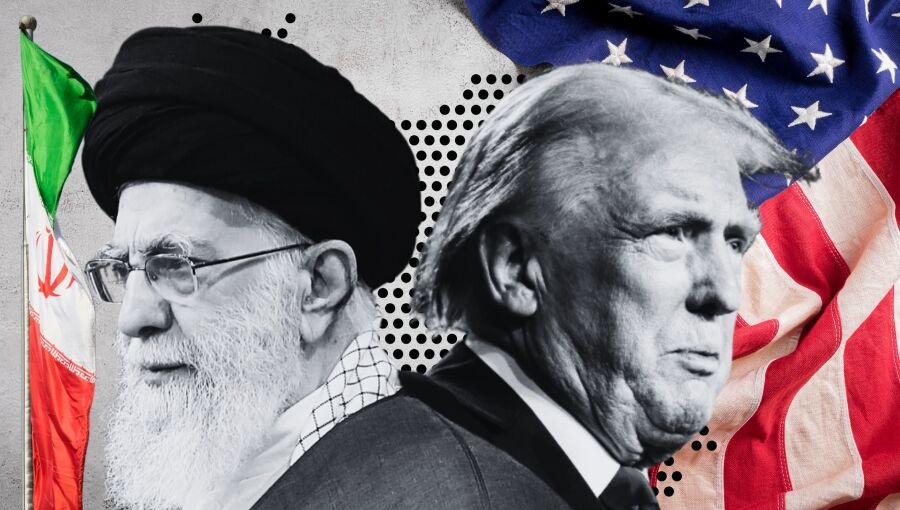
US President Donald Trump on Thursday said he is hopeful military action against Iran can be avoided, despite escalating threats between Washington and Tehran and growing international concern over the region’s stability.
Speaking to reporters during the premiere of a documentary about his wife, Melania Trump, the US president said discussions with Iran are ongoing and suggested a possible path away from direct confrontation.
“I have had and I am planning on it,” Trump said when asked whether he would hold talks with Iranian officials.
“We have a group headed out to a place called Iran, and hopefully we won’t have to use it,” he added, in comments that appeared to refer to the US naval buildup in the Middle East.

Trump’s remarks come after he recently warned that “time is running out” for Tehran, as the United States dispatches additional naval power to the region amid renewed concerns over Iran’s nuclear programme.
US Warships Deployed to the Middle East
The United States has deployed additional naval assets to the Middle East, including an aircraft carrier strike group, as tensions with Iran continue to rise.
An AFP infographic, citing a US official, highlights the American aircraft carrier USS Abraham Lincoln, its destroyer escorts and other naval vessels currently deployed in the region as part of Washington’s growing military presence.
Iran Threatens Swift Retaliation
Iran has issued strong warnings that any US strike would trigger immediate and wide-reaching retaliation, including potential attacks on American bases and aircraft carriers.
An Iranian military spokesman said Tehran’s response would not be limited, unlike last year’s June conflict when American aircraft and missiles briefly supported Israel during a short air war against Iran.
Brigadier General Mohammad Akraminia told Iranian state television that US aircraft carriers have “serious vulnerabilities” and warned that American military installations in the Gulf are within missile range.
“If such a miscalculation is made by the Americans, it will certainly not unfold the way Trump imagines — carrying out a quick operation and then, two hours later, tweeting that the operation is over,” he said.
A Gulf official, speaking to AFP, said fears of a US strike were increasingly widespread in the region, warning it could plunge the Middle East into chaos and sharply drive up oil and gas prices, with ripple effects on global markets.
As rhetoric intensifies from both sides, UN Secretary-General Antonio Guterres has urged nuclear negotiations to prevent what he described as a looming crisis with potentially devastating consequences for the region.
The renewed tension follows a wave of international diplomatic activity, including efforts by regional leaders to ease pressure.
Qatar’s Emir Sheikh Tamim bin Hamad Al Thani and Iran’s President Masoud Pezeshkian held a phone call to discuss steps aimed at de-escalation and restoring stability, according to Qatar News Agency (QNA).
EU Labels IRGC a Terrorist Organisation
The European Union has also escalated pressure on Tehran by formally designating Iran’s Islamic Revolutionary Guard Corps (IRGC) a “terrorist organisation,” citing the group’s role in a deadly crackdown on mass protests.
EU Commission President Ursula von der Leyen welcomed the decision, describing it as long overdue.
“‘Terrorist’ is indeed how you call a regime that crushes its own people’s protests in blood,” she said.
Iran reacted sharply, calling the move “illogical” and “spite-driven,” and accused the EU of acting in line with the interests of the United States and Israel.
Tehran has blamed the protest wave on foreign influence, claiming the demonstrations were hijacked by “riots” and what it called a “terrorist operation.”
Protest Death Toll Disputed
Human rights organisations say the protests, which began in late December and peaked on January 8 and 9, resulted in thousands of deaths, with the true figure difficult to verify due to continued internet restrictions.
The US-based Human Rights Activists News Agency (HRANA) said it has confirmed 6,479 deaths, though it noted verification remains slow.
Iranian authorities have acknowledged more than 3,000 deaths, but insist many were security personnel or civilians killed by what they describe as violent rioters.
Rights groups, however, have warned the real death toll could be far higher, possibly reaching tens of thousands.
In Tehran, some residents expressed deep anxiety and uncertainty over what may come next.
One 29-year-old waitress told AFP she believed war may be unavoidable, though she did not support it.
“I am not in favour of war. I just want something to happen that would result in something better,” she said, speaking anonymously out of fear of reprisals.
Another 29-year-old woman in northern Tehran described the situation as bleak, saying citizens felt they had reached their lowest point.
Signs of heightened tension are also visible in Iran’s public messaging. Billboards and banners have reportedly appeared across Tehran, including a large poster depicting an American aircraft carrier being destroyed—an apparent signal of Iran’s readiness to retaliate if attacked.
For now, Trump has left the door open for diplomacy, but both sides continue to exchange warnings, raising fears of a wider confrontation across the Middle East.