


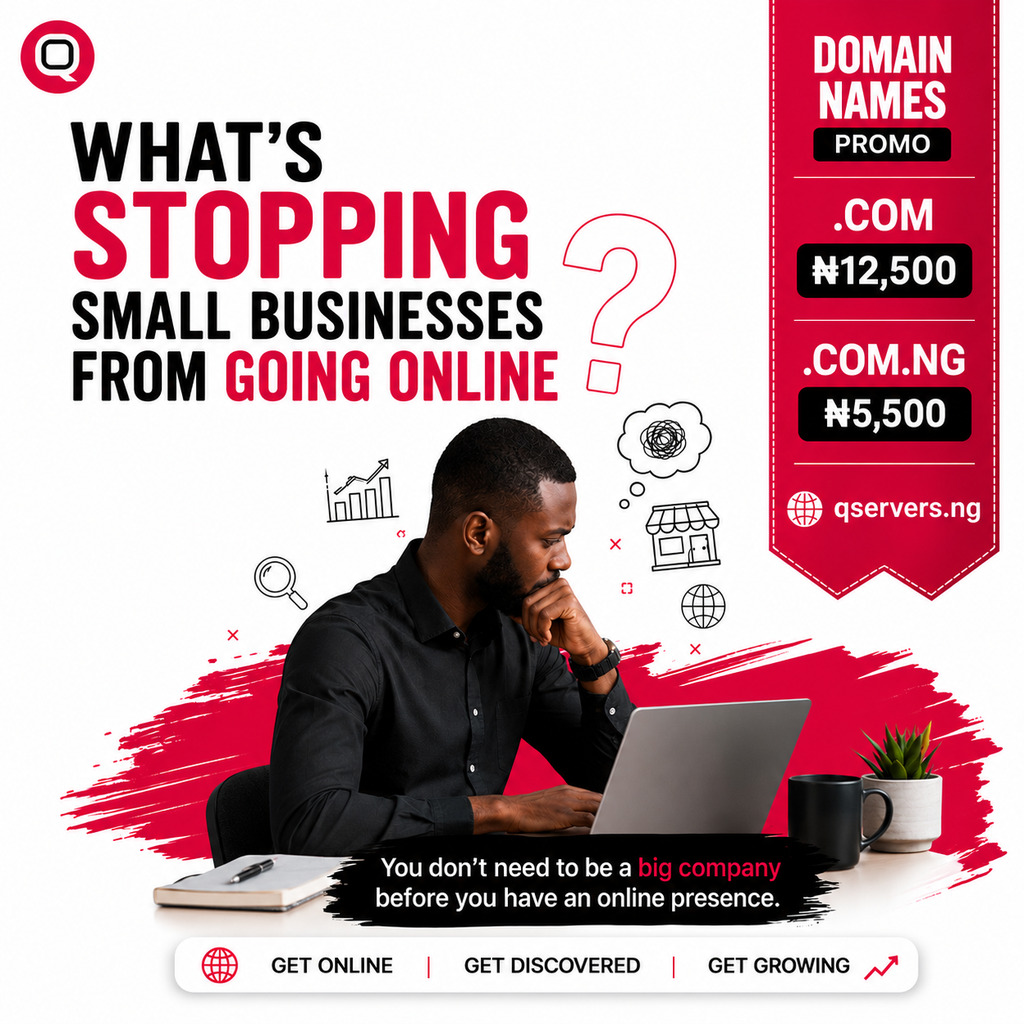
For many small business owners, going online remains something they intend to do someday. They believe a website, online store or professional digital presence is something reserved for large companies with substantial budgets, dedicated marketing teams and thousands of customers. Until the business reaches that level, they are comfortable operating through word of mouth, physical stores, referrals and messaging applications.
But this mindset may be causing many small businesses to miss valuable opportunities.
The question is no longer whether a small business is big enough to have an online presence. The more important question is whether a business can afford to remain difficult to find in a marketplace where customers increasingly use the internet to discover products, compare prices, research companies and decide where to spend their money.
Going online does not necessarily mean building an expensive e-commerce platform or employing a full-time technology team. For many small businesses, it can begin with something much simpler: a professional website, a domain name, accurate business information, clear product or service descriptions and reliable ways for customers to make enquiries.

The challenge is that several misconceptions continue to discourage small business owners from taking that first step.
“I Don’t Have Enough Money”
Cost is one of the most common reasons entrepreneurs give for remaining offline.
Small businesses often operate under tight financial constraints. Owners have to pay for inventory, rent, transportation, staff, electricity, packaging, advertising and other operating expenses. Spending money on a website may therefore appear less important than immediate business needs.
However, going online does not necessarily require a huge investment.
A small business can begin with a basic website and gradually expand as the company grows. Instead of attempting to build a complicated online marketplace from day one, an entrepreneur can start with a simple digital home containing the company’s name, location, contact information, products or services, customer testimonials and links to its communication channels.
The important thing is to begin.
The cost of establishing an online presence should also be viewed as an investment rather than simply an expense. If a website helps one new customer discover the business, make an enquiry and eventually become a paying customer, it has already begun producing value.
“My Customers Are Already on WhatsApp”
WhatsApp has become an extremely important business tool for Nigerian entrepreneurs.
Many small businesses use it to display products, communicate with customers, send prices, receive orders and build relationships. For businesses that depend heavily on personal communication, WhatsApp can be highly effective.
But relying entirely on WhatsApp has limitations.
A website gives a business a permanent digital home that is not dependent on individual conversations. A customer searching for a business can find information in one place rather than scrolling through messages or asking the owner to resend product details.
A website can also make a business appear more established and easier to verify.
This does not mean businesses should abandon WhatsApp. Instead, the two can work together.
A customer might discover a company through Google, visit its website, examine its products and then click a WhatsApp button to ask a question.
The website becomes the business’s digital storefront, while WhatsApp becomes one of its communication channels.
“I Don’t Know How to Build a Website”
Another barrier is the belief that going online requires technical expertise.
Many business owners hear words such as domains, hosting, web design, search engine optimization and e-commerce and immediately assume the process is too complicated.
But entrepreneurs do not need to become professional web developers before establishing an online presence.
There are website-building platforms, templates and professional developers who can handle the technical side. A business owner mainly needs to understand what the business should communicate and what customers should be able to do when they visit the website.
For some businesses, that may simply mean calling the company.
For others, it may mean sending a WhatsApp message, booking an appointment, requesting a quotation or purchasing a product.
The technology should serve the business rather than becoming a barrier to it.
“I’ll Do It Later”
Perhaps the most dangerous excuse is postponement.
Many entrepreneurs genuinely intend to establish an online presence but continually push the decision into the future.
They tell themselves they will create a website after opening a bigger shop, hiring more employees, increasing revenue or becoming more established.
The problem is that the market does not necessarily wait.
While one business owner is postponing going online, potential customers may already be searching for the products or services they offer.
A customer looking for a fashion designer, catering company, furniture maker, event planner, mechanic, beauty professional or real estate service may search online before asking friends for recommendations.
If the business is nowhere to be found, the customer may choose a competitor.
DDM News reports that this is one of the major opportunities available to small businesses in the digital economy. A company does not have to compete with the largest brands in the country to benefit from the internet. It simply needs to make itself visible and credible to the customers it wants to reach.
Being Online Can Build Trust
An online presence is also about credibility.
Customers are often more comfortable dealing with businesses that can be easily verified. A professional website can provide information about the company, its products, location, contact details, experience and customer feedback.
For businesses operating entirely offline, customers may have to depend on personal recommendations before trusting them.
A website cannot guarantee that a business is legitimate, but it can provide another layer of information that helps customers make decisions.
This is particularly important for businesses trying to attract customers outside their immediate neighbourhood.
A company in Onitsha, Awka, Lagos, Abuja or Port Harcourt can potentially reach customers in other Nigerian cities and even outside the country if it establishes a strong digital presence.
Going Online Can Help Small Businesses Look Bigger
One of the interesting advantages of the internet is that a small company can present itself professionally without having the physical infrastructure of a large corporation.
A well-designed website can showcase products professionally. Good photography can improve presentation. Customer testimonials can strengthen credibility. Clear descriptions can answer common questions before customers even make contact.
This can allow a small business to compete based on presentation and customer experience rather than simply the size of its physical premises.
A one-person business and a company with twenty employees can both have professional websites.
The difference is what each business does with the opportunity.
A Domain Name Is More Than an Address
A domain name may appear like a small technical detail, but it can become an important part of a company’s identity.
A business with its own domain can establish a recognizable online address that customers can remember and share. Instead of depending entirely on social media usernames that may change or become unavailable, the business has a digital asset it can build around.
For Nigerian businesses, domain options such as .COM and .COM.NG can provide different branding possibilities.
The exact cost of registration varies depending on the provider, promotions and renewal terms, so entrepreneurs should check the current pricing before purchasing.
The Bigger Cost May Be Staying Offline
The central issue is therefore not simply whether a small business can afford a website.
It is whether the business can afford to remain invisible to people who are searching for its products and services online.
DDM News notes that digital transformation does not require every small business to immediately build a sophisticated online store. The smarter approach may be to start with the essentials and expand gradually.
A business can begin with a domain and basic website.
Later, it can add online payments.
Then it can introduce an online catalogue, booking system, e-commerce functionality, customer reviews, email marketing or other digital tools.
The process does not have to happen overnight.
What matters is establishing a foundation.
Small Businesses Should Start Where They Are
The internet can appear intimidating when viewed as one enormous project.
But entrepreneurs can make it manageable by breaking it into smaller steps.
Register a suitable domain.
Create a simple website.
Add accurate business information.
Display products or services clearly.
Provide reliable contact options.
Connect social media accounts.
Encourage satisfied customers to leave reviews.
Then improve the platform as the business grows.
The objective is not to create the perfect website on the first attempt.
It is to make the business discoverable.
In today’s economy, customers are not only walking past physical shops. They are searching, scrolling, comparing and researching before making purchasing decisions.
A small business that refuses to participate in that process may gradually lose visibility to competitors that are willing to meet customers where they already spend their time.
Ultimately, the biggest barrier preventing small businesses from going online may not be money, technology or lack of customers.
It may simply be the belief that they are not ready yet.
But businesses rarely become bigger by waiting for the perfect moment.
Sometimes, the digital presence that an entrepreneur keeps postponing is precisely what could help the business reach its next level.
The question small business owners should therefore be asking is no longer, “Can my business afford to go online?”
It should be: “How many potential customers are already searching for what I sell, and what happens when they cannot find me?”
Start small. Establish your digital presence. Learn as you grow. Give customers another way to discover, trust and buy from your business.




