


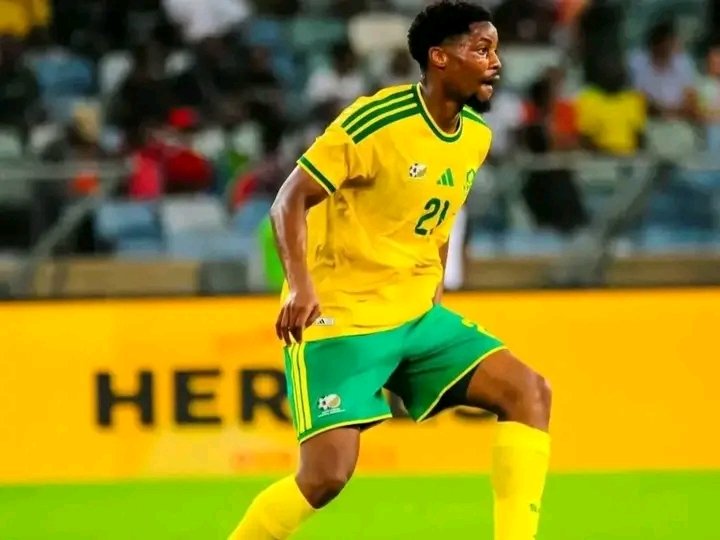
As South Africa continues its campaign at the 2026 FIFA World Cup, one player attracting significant attention is defender Ime Okon, a talented footballer whose decision to represent Bafana Bafana instead of Nigeria has sparked debate among football supporters across Africa.
For many Nigerian fans, the story is particularly intriguing because Okon possesses strong ties to both nations. Born in South Africa to a Nigerian father and a South African mother, the young defender grew up with two rich football cultures influencing his identity. While he remained eligible to play for either the Super Eagles of Nigeria or South Africa’s Bafana Bafana, he ultimately chose to commit his international future to the country of his birth.
Now, with South Africa competing on football’s biggest stage while Nigeria watches from afar, Okon has opened up about the factors that shaped one of the most important decisions of his career.

Speaking about his choice, the defender explained that the decision was not driven by a rejection of his Nigerian roots. Instead, it was based on where he was raised, where he learned the game and the football system that played a central role in his development.
According to Okon, South Africa provided the environment that nurtured his talent from a young age and helped transform him into a professional footballer. He described his decision as a natural one because his football journey was built within South African structures and institutions.
His comments have reignited conversations about dual-nationality footballers and the increasing competition among national teams to secure the services of talented players with multicultural backgrounds.
A Proud Nigerian Heritage
Despite choosing South Africa, Okon has never hidden his Nigerian heritage.
His father originates from Nigeria, a nation renowned for producing generations of football stars who have excelled both on the African continent and across Europe’s top leagues. From legendary figures such as Nwankwo Kanu and Jay-Jay Okocha to modern stars like Victor Osimhen, Nigeria’s football legacy remains one of the strongest in Africa.
Growing up, Okon was exposed to both Nigerian and South African cultures. Family influences ensured that he maintained a connection with his father’s homeland while simultaneously embracing life in South Africa.
This dual identity made his international future a subject of considerable interest among football observers. Both countries recognized his potential, and many believed he possessed the qualities needed to succeed at the highest level.
However, as his career progressed, South Africa gradually became the clear favourite to secure his commitment.
Rising Through South African Football
Unlike some dual-nationality players who develop abroad before choosing an African nation, Okon’s football education was firmly rooted in South Africa.
From grassroots football to youth development programmes, he progressed through local structures that helped refine his defensive abilities and tactical understanding.
Coaches quickly identified his potential due to his composure under pressure, strong positional awareness and ability to read the game.
Standing out as one of the most promising young defenders in the country, Okon built a reputation for consistency and maturity beyond his years.
His performances earned recognition from scouts and national team selectors, eventually opening the door to opportunities at higher levels of competition.
By the time discussions surrounding his international allegiance intensified, he had already established himself as one of South Africa’s emerging football prospects.
The Decision That Sparked Debate
Nationality choices in football often generate emotional reactions, particularly when countries with passionate fan bases are involved.
Nigeria has experienced similar situations in the past, with several players of Nigerian descent opting to represent other nations due to personal circumstances, birthplace or developmental pathways.
For Nigerian supporters, losing a talented prospect can be frustrating given the country’s rich football tradition and enormous talent pool.
Yet Okon insists his decision should not be viewed as a rejection of Nigeria.
Instead, he sees it as recognition of the nation that shaped his football identity.
The defender explained that South Africa invested in his development from an early stage and gave him opportunities to grow as both a player and an individual. In his view, representing Bafana Bafana was a way of honouring that journey.
A New Generation for Bafana Bafana
South Africa’s qualification for the 2026 FIFA World Cup marked a significant achievement for the country.
Under the leadership of coach Hugo Broos, Bafana Bafana has undergone a remarkable transformation, rebuilding a squad capable of competing against some of the world’s best teams.
Okon has become part of a new generation tasked with restoring South Africa’s standing in international football.
His inclusion reflects the confidence coaches have in his ability to anchor the team’s defence for years to come.
Football analysts have praised his calm approach, physical strength and tactical intelligence, qualities that are essential at the highest level of international competition.
With South Africa returning to the World Cup after years of absence, players like Okon symbolize the nation’s renewed ambitions.
Nigeria’s World Cup Absence Adds More Attention
The spotlight on Okon has become even brighter because Nigeria failed to qualify for the 2026 FIFA World Cup.
The Super Eagles’ absence shocked many football followers, considering the country’s reputation as one of Africa’s traditional powerhouses.
As South Africa secured qualification ahead of Nigeria, discussions surrounding Okon’s decision naturally intensified.
Many supporters wondered how different the situation might have been had the defender chosen the green and white colours of Nigeria.
Nevertheless, football careers are often shaped by personal experiences rather than public expectations.
For Okon, the decision was ultimately about loyalty to the environment that developed him rather than choosing one heritage over another.
Looking Toward the Future
At just the beginning of what promises to be a long career, Ime Okon represents the modern face of international football, where players often possess deep connections to more than one country.
His journey reflects the increasingly global nature of the sport and the complex decisions athletes must make regarding identity and representation.
While his Nigerian roots remain an important part of who he is, his football future is firmly aligned with South Africa.
As Bafana Bafana continues its quest for success on the world stage, Okon will hope to repay the faith shown in him and establish himself as one of Africa’s leading defenders.
For now, the young centre-back remains focused on writing his own chapter in football history, carrying both his Nigerian heritage and South African upbringing with pride as he pursues glory at the highest level of the game.




