



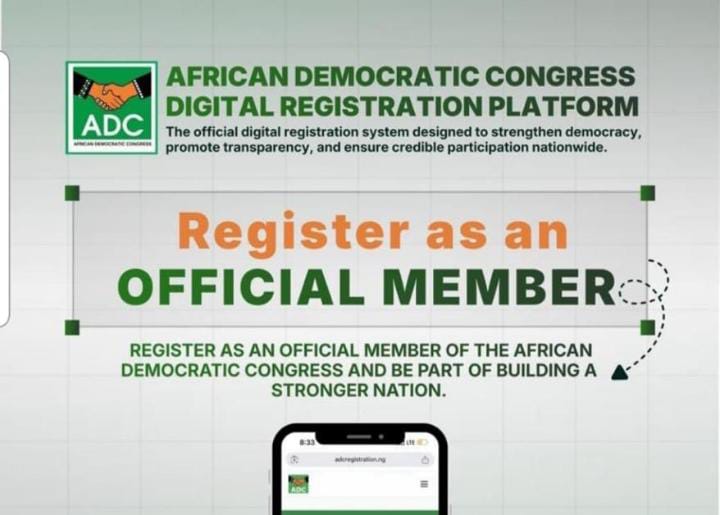
(DDM) – Nigeria’s opposition politics recorded a fresh development this week as the African Democratic Congress (ADC) officially deployed its online registration portal, opening digital membership enrollment to citizens across the country and in the Diaspora ahead of the 2027 general elections.
DDM gathered that the newly activated platform, https://adcregistration.ng, is designed to streamline party membership registration and expand grassroots mobilization through a centralized digital system accessible nationwide.
Party officials say the site is open to everyone willing to join what they describe as a growing coalition for a better Nigeria.
The launch comes at a politically strategic moment.

Nigeria is still navigating the aftershocks of the 2023 general elections, which reshaped opposition alignments and triggered renewed debates over party structures, internal democracy, and coalition politics.
By activating its digital portal early, the ADC appears to be positioning itself ahead of what many analysts believe will be an intense build-up to 2027.
Founded in 2005, the African Democratic Congress gained national prominence in 2018 when it emerged as a coalition-friendly platform during realignments ahead of the 2019 elections.
Since then, the party has projected itself as a reform-driven alternative to Nigeria’s dominant political forces, advocating governance reform, youth inclusion, and institutional restructuring.
The introduction of an online registration system marks a significant modernization step for the party.
Digital portals now serve more than symbolic purposes in Nigerian politics.
They function as tools for verified membership documentation, data-driven mobilization, internal coordination, and compliance with electoral regulations.
Political strategists note that building a structured digital database years before elections can enhance credibility and negotiating strength in future coalition talks.
The ADC’s messaging around the portal emphasizes inclusivity and national renewal.
By inviting Nigerians at home and abroad to register via https://adcregistration.ng the party is tapping into a broader sentiment among citizens seeking alternative political platforms amid economic challenges and governance debates.
However, the digital turn in Nigerian politics has not been without controversy.
Recent electoral cycles have sparked national conversations about technological transparency, verification processes, and institutional trust.
Any digital platform introduced by political actors therefore carries expectations of efficiency, cybersecurity safeguards, and accessibility for users across diverse regions.
For the ADC, success will likely depend on how effectively the portal handles traffic, verifies entries, and integrates membership data into broader organizational strategy.
Beyond technology, the bigger story is political timing.
Opening membership registration years before the next general election suggests that mobilization has already begun.
In Nigeria’s competitive political environment, early organization often translates into structural advantage.
Whether this move strengthens the ADC’s standing nationally remains to be seen.
What is clear, however, is that the party has formally signaled its readiness to expand its base and consolidate supporters digitally.
As the 2027 electoral horizon gradually approaches, online membership platforms like https://adcregistration.ng may become one of the first indicators of which political movements are building momentum and which are struggling to adapt to the digital age.




