Across Africa, clothing has always been more than a means of covering the body. Traditional fabrics and garments have served as powerful expressions of identity, social status, spirituality, authority and community values. In southeastern Nigeria, one of the most recognisable examples of this cultural connection is the Ìsí Àgú, an attire strongly associated with the Igbo people and widely recognised today as a symbol of prestige, strength and traditional authority.
Although the Ìsí Àgú is now commonly seen at weddings, cultural festivals, chieftaincy ceremonies, traditional gatherings and other important occasions, its significance goes far beyond fashion. The garment carries a history connected to ideas of leadership, courage, social hierarchy and the preservation of Igbo identity. Historical and cultural accounts describe it as prestigious Igbo apparel traditionally associated with titled men and important community occasions.
The name itself is one of the most interesting aspects of Ìsí Àgú. In Igbo, “agụ” refers to the leopard, while “ọdụm” refers to the lion. This distinction has generated considerable discussion because the modern fabric commonly called Ìsí Àgú is frequently decorated with the image of a lion rather than a leopard. Some cultural commentators argue that the original symbolism was connected to the leopard, while others explain that changes in the design and interpretation of the material over time contributed to the lion-headed patterns that dominate the modern version.
This difference is not simply a matter of vocabulary. It opens a window into the way cultures evolve and how meanings can change as languages, trade, fashion and external influences interact. The question of whether the original Ìsí Àgú should carry a leopard or lion motif remains debated among cultural commentators, historians and Igbo traditionalists. What is less disputed is the importance of the garment as an emblem of prestige and identity.
The leopard itself has a significant place in the traditional imagination of several Igbo communities. Historical research into Igbo political and cultural institutions shows that the animal could be associated with royalty, authority and traditional leadership. In Enugu Ezike, for example, historical documentation describes the leopard as being connected with the traditional ruler, while leopard skins were associated with the highest levels of traditional authority.
This connection between powerful animals and traditional leadership helps explain why animal imagery became important in ceremonial clothing. In societies where symbols communicated social position before the widespread use of modern identification systems, what a person wore could immediately tell observers something about the individual’s place in the community.
Traditionally, Ìsí Àgú was therefore not simply an everyday shirt. It was connected with occasions where status and authority mattered. Historical accounts state that the attire was traditionally presented to a man when he received a chieftaincy title. Wearing it could therefore communicate that the individual had attained a recognised position of honour within his community.
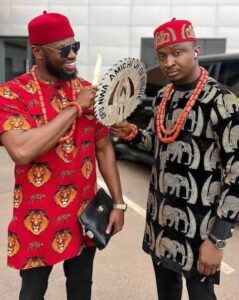
The traditional styling also contributed to its symbolism. The garment was commonly worn with trousers or wrappers and paired with traditional headwear, including the red cap associated with titled Igbo men. The combination of the patterned top, cap and other accessories created a complete ceremonial appearance that communicated dignity and authority.
Over time, however, Ìsí Àgú moved beyond the exclusive world of traditional titles. Its popularity expanded as Igbo communities increasingly incorporated it into weddings, cultural festivals, coronations, public ceremonies and other major celebrations. The garment became particularly visible during traditional marriages, where grooms, family members and guests frequently wear different interpretations of the fabric. The Guardian Nigeria has similarly documented its widespread use at weddings and chieftaincy-related occasions, noting that the material has evolved into different colours and styles.
For DDM News, the transformation of Ìsí Àgú demonstrates how traditional culture can survive by adapting to changing generations. What was once closely associated with titled men can now be seen across different social groups and in increasingly modern designs, without completely losing its connection to Igbo heritage.
Another important chapter in the story of Ìsí Àgú is its relationship with modern fashion. The traditional garment has gradually moved away from a single standard design. Contemporary designers now create short-sleeved and long-sleeved versions, fitted shirts, kaftans, senator-style outfits and other modern silhouettes from Ìsí Àgú fabric. Some versions incorporate embroidery, gold buttons, chains and other decorative elements, while others use the familiar motif in more understated ways.
The fabric itself has also become available in different colours and patterns. Although black remains strongly associated with the classic appearance, modern versions can be found in a variety of colours. This flexibility has helped the material remain relevant among younger generations who may want to express cultural identity without dressing exactly like previous generations.
The changing role of women is another important development. Earlier descriptions often presented Ìsí Àgú primarily as male attire, particularly because of its association with chieftaincy. In contemporary fashion, however, women have increasingly embraced the fabric, using it for dresses, blouses, skirts, jackets and other designs. The Guardian noted this transition from an outfit traditionally worn by men to a material increasingly used by women as well.
This evolution reflects a broader transformation in African fashion, where traditional materials are being redesigned to fit modern lifestyles. Instead of abandoning cultural clothing because it appears old-fashioned, designers are finding ways to reinterpret it for contemporary audiences.
The history of Ìsí Àgú is also connected to cultural exchange. Some discussions about the origins of the modern fabric suggest that its present form may have been influenced by European-style shirts, trade relationships and imported textiles. One cultural analysis proposes that the fabric could have developed partly through contact during the colonial-era trading period, while acknowledging that its precise origin remains debated.
This uncertainty is important because it reminds us that cultural history is rarely a simple straight line. Traditional societies interacted with neighbouring communities and foreign traders, adopted some influences, rejected others and transformed imported ideas into forms that eventually became part of their own cultural expression.
The modern Ìsí Àgú can therefore be understood as a product of both continuity and change. Its patterns, names and precise historical origins may be debated, but its cultural importance has continued to grow.
Today, wearing Ìsí Àgú can be a statement of belonging. At an Igbo traditional wedding, the fabric can immediately establish a visual connection between the wearer and the culture being celebrated. At a chieftaincy ceremony, it can reinforce the seriousness and dignity of the occasion. At cultural festivals and diaspora gatherings, it can serve as a visible reminder of ancestral heritage.
Its influence has also travelled beyond southeastern Nigeria. Members of the Igbo diaspora continue to wear traditional clothing during weddings, cultural festivals, naming ceremonies, New Yam celebrations and other gatherings outside Nigeria. Research on Igbo culture and migration has documented the continued use of traditional dress among Igbo communities abroad as an important way of maintaining cultural connections.
This international visibility has given Ìsí Àgú another role: it has become a cultural ambassador. Someone wearing the distinctive fabric in London, New York, Johannesburg, Accra or elsewhere can communicate their Nigerian and Igbo heritage without saying a word.
Yet the story of Ìsí Àgú is not simply about clothing. It is ultimately about memory.
Every pattern carries a conversation between generations. The older generation remembers the garment as something connected to title, honour and community hierarchy. The younger generation may see it as fashionable, stylish and proudly African. Both interpretations can exist at the same time.
The challenge for future generations will be preserving the history behind the design while allowing the fashion itself to evolve. As Ìsí Àgú becomes increasingly commercialised and redesigned, there is a growing need for cultural education so that people understand what the symbols represent rather than treating them merely as decorative patterns.
For DDM News, Ìsí Àgú remains one of the strongest examples of how African fashion can carry history, identity and modern creativity at the same time. From its traditional association with authority and prestige to its widespread presence at weddings, festivals and contemporary fashion events, the garment has travelled a remarkable journey.
Its story also reminds us that African fashion is not simply about colourful fabrics or attractive designs. Behind many traditional garments are stories of leadership, migration, trade, spirituality, family and community. Ìsí Àgú represents one of those stories.
Whether the motif is interpreted as the head of a leopard or the head of a lion, its enduring message remains connected to strength, pride, courage and identity. What began as a garment associated with status has become something much larger: a visible expression of Igbo heritage and an enduring symbol of African cultural pride.
As designers continue to reinvent the material and younger generations continue to embrace it, Ìsí Àgú is unlikely to disappear. Instead, its history will continue to be rewritten through every wedding, ceremony, festival and cultural gathering where another generation chooses to wear it.
And perhaps that is the greatest strength of Ìsí Àgú: it has survived not by remaining unchanged, but by changing while still carrying the memory of where it came from.