


BAMAKO, MALI — Malian music legend Salif Keita has cancelled his scheduled commercial performances in South Africa, citing recent xenophobic violence against African migrants in the country and describing his decision as a matter of conscience rather than a rejection of the South African people.
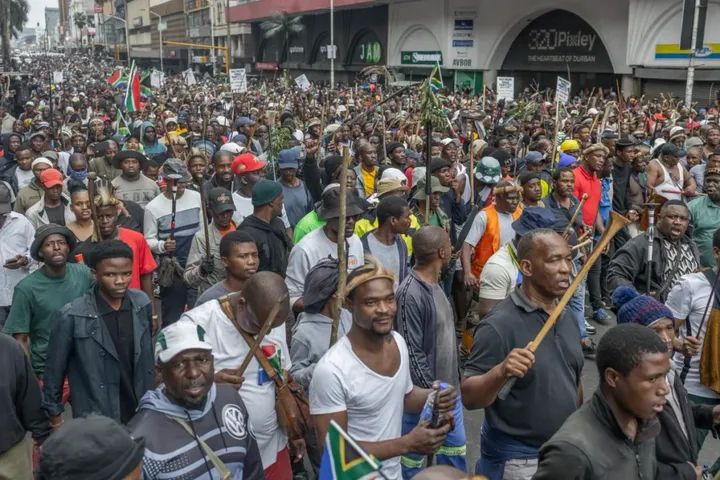
The 76-year-old singer, often referred to as the “Golden Voice of Africa,” announced the cancellation in an emotional open letter posted on his official Facebook page on Tuesday, which has since sparked widespread debate across the continent. His decision came in response to a series of anti-migrant protests and attacks that have rocked South Africa in recent months, with groups such as Operation Dudula and March and March leading aggressive anti-immigration campaigns that have resulted in multiple fatalities, widespread displacement, and emergency repatriations of citizens from several African countries including Nigeria, Ghana, Malawi, and Mozambique.
Keita explained that the reported hostility represents a painful departure from the values of unity and shared struggle he associates with South Africa’s liberation history. “To my beloved brothers and sisters in South Africa, and across the continent,” Keita wrote, “for over fifty years, Africa has not just been a place I visit — it is who I am. South Africa, in particular, has always welcomed me as a brother, not just an artist”.
The musician, who in 1988 performed at the Nelson Mandela 70th Birthday Tribute concert at Wembley Stadium to draw international attention to the anti-apartheid struggle, stressed that his decision was driven by conscience. “I cannot ignore the reports of xenophobic violence against our African brothers and sisters,” Keita stated. “When I see migrants attacked, I do not see ‘politics.’ I see people looking for work, safety and dignity. This does not match the South Africa I know — the South Africa that stood with Mali and the South Africa that Nelson Mandela built”.

The Malian artist acknowledged the frustrations of South Africans facing economic hardship but urged that such pain should not be turned against fellow Africans. “I understand the frustrations. But pain cannot become hatred toward our fellow Africans. Colonial borders separate us on a map, but they must never divide our humanity”.
His cancellation affects scheduled appearances, including the upcoming Manguang African Cultural Festival in the Free State, scheduled for September, after Keita had earlier this year been forced to withdraw from the Montreux Jazz Festival Franschhoek due to illness. However, Keita made it clear that he was not closing the door on South Africa entirely, drawing a significant distinction between commercial performances and community engagement.
“Please hear me clearly: This is not a rejection of you, the people. It is a rejection of hate,” Keita wrote. “To be clear — I am not closing the door on South Africa. I am closing the door on violence”. He left open the possibility of performing in non-commercial spaces, including townships and venues where music could encourage conversation and healing. “If there is a stage in a township, I will sing there. If a community needs to be heard, I will listen,” he said.
The musician’s protest comes amid rising concerns over xenophobic violence across South Africa. Recent months have seen major demonstrations and localized attacks in cities including Johannesburg, Pretoria, and Durban, with several African countries stepping in to coordinate emergency repatriations for thousands of their citizens. The violence has strained diplomatic relations with other African nations, with Nigerian singer Tyla recently withdrawing from a concert in Nigeria due to the diplomatic tensions.
Keita, who has a career spanning more than five decades and is known for his distinctive voice despite touring less frequently due to medical reasons, emphasized that his stance is directed at the violence and perceived hostility rather than at South Africans as a people. “I close the door on hate, but my heart remains open,” Keita concluded. “I step back in love and sorrow. But I will sing again when our shared humanity wins”. His comments have ignited debate about xenophobia, economic pressure, and the complex relationship between African nations, with many hoping his return to South African stages will happen when the country reflects the spirit of ubuntu once again.




