


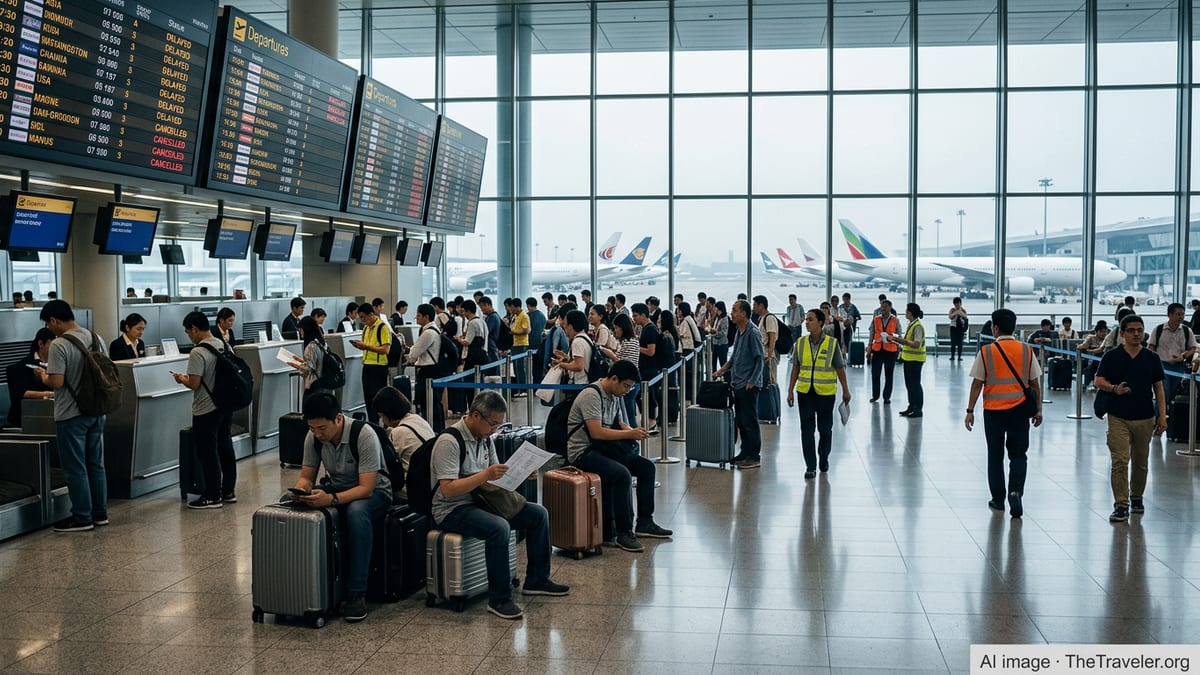
Airfares on major Asia–Europe routes have surged sharply following the closure of key Gulf aviation hubs amid the escalating U.S.–Israel conflict with Iran, as airlines slash capacity and passengers scramble for alternative routes.
Airline booking platforms on Tuesday showed limited seat availability and steep price increases on some of the region’s busiest long-haul corridors, particularly routes linking Australia, China and Southeast Asia with the United Kingdom and continental Europe.
Major Gulf transit hubs including Dubai International Airport, the world’s busiest international airport remained closed for a fourth consecutive day.
The airport typically handles more than 1,000 flights daily and serves as a critical connecting point for Europe-bound traffic operated by Gulf carriers such as Emirates and Qatar Airways.

The shutdown has significantly reduced seat capacity on high-demand routes like Australia–Europe, where Gulf airlines traditionally hold a large market share.
Australia’s Flight Centre Travel Group reported a 75% increase in customer calls to its stores and emergency assistance lines since the crisis began.
Global Managing Director Andrew Stark said teams were working around the clock to assist travelers affected by cancellations and reroutings.
According to Stark, many Australians are already rebooking flights to the UK and Europe via alternative hubs in China, Singapore and other parts of Asia, as well as through North America using transit points such as Houston.
Carriers operating non-stop Asia–Europe services are attempting to bypass closed Middle Eastern airspace by flying northern routes via the Caucasus and Afghanistan, or southern paths via Egypt, Saudi Arabia and Oman.
However, these detours extend flight times and increase fuel burn a costly adjustment at a time when oil prices have climbed sharply.
“Right now the whole of the Middle East is out of bounds, which is a high price for some airlines,” said Subhas Menon, director general of the Association of Asia Pacific Airlines.
He warned that sustained higher operating costs could undermine airline profitability and ultimately reduce global connectivity.
Reuters checks of airline websites on Tuesday showed few near-term seats available and sharply elevated fares.
Hong Kong-based Cathay Pacific displayed no economy-class availability on its Hong Kong–London route until March 11.
The lowest one-way fare available that day was HK$21,158 ($2,705), compared with more typical prices of around HK$5,054 later in the month.
From Sydney to London, Qantas showed no economy-class seats available via its usual Perth and Singapore routings until March 17, when a one-way ticket was listed at A$3,129 ($2,220).
NoEarlier departures required less conventional stopovers, including Los Angeles and Johannesburg, at significantly higher prices.
Thailand’s Thai Airways reported fully booked Europe-bound flights as travelers opted for direct services rather than transiting through the Middle East.
A search of its Bangkok–London route showed economy-class tickets sold out until late next week. A one-way fare on March 15 was priced at 71,190 baht ($2,265), easing to 27,045 baht by March 18.
Taiwan’s EVA Air said bookings on its Europe-bound services had surged as passengers sought alternatives to Gulf-based carriers.
On mainland China routes, fares have also climbed steeply. A return economy ticket from Beijing to London typically costs under 10,000 yuan ($1,452).
However, Air China showed only a business-class option for immediate departure on Wednesday, priced at 50,490 yuan one way.
Aviation consultancy Alton Aviation said airlines operating outside the affected region including Singapore Airlines and Turkish Airlines could see short-term gains as passengers shift bookings away from Gulf hubs.
Still, industry analysts caution that prolonged airspace closures would continue to distort global flight networks, increase insurance and operating costs, and keep ticket prices elevated.
With Middle Eastern air corridors still restricted and uncertainty surrounding the duration of the conflict, travelers across Asia and Europe face ongoing disruption and significantly higher fares in the days ahead.




