



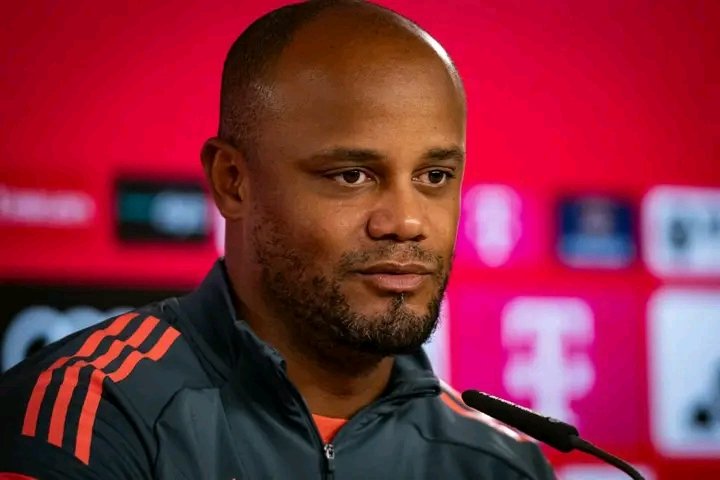
Vincent Kompany, the head coach of Bayern Munich and former Manchester City captain, has reflected on the profound influence Pep Guardiola had on his career, revealing that the Spanish manager was instrumental in convincing him that he could succeed as a football coach after retirement.
Kompany made the remarks while speaking ahead of Bayern Munich’s German Cup final fixture against Stuttgart, a high stakes encounter that comes at a significant moment in his managerial journey. His comments also coincide with growing global attention on Guardiola, who has confirmed that he will step down from his role at Manchester City at the end of the current season after a historic and trophy laden tenure.
The Belgian football legend, who enjoyed an illustrious playing career most notably at Manchester City between 2008 and 2019, captained the club through one of its most successful eras. He later worked directly under Guardiola between 2016 and 2019, a period he now describes as transformative not only for his understanding of football but also for his long term career direction.
According to Kompany, Guardiola’s approach to management went far beyond tactics and match preparation. He explained that the Spanish coach had a unique ability to inspire belief in players, making them see possibilities beyond their immediate roles on the pitch. It was during this period that Kompany began to seriously consider a future in coaching, a path he admits he had not fully envisioned during the early stages of his playing career.
Kompany stated that Guardiola’s confidence in him, combined with his detailed understanding of the game, made a lasting impression. He noted that even in moments when he was not a regular starter due to injuries or tactical decisions, he still felt valued as part of the squad and intellectually engaged in the team’s football philosophy. This environment, he said, helped him develop a deeper appreciation of leadership and strategy.
The Bayern Munich coach further explained that many outsiders often misinterpret Guardiola’s methods as purely tactical complexity, but in reality, his greatest strength lies in his human management skills and his relentless pursuit of improvement. Kompany emphasized that Guardiola constantly challenged players to think, adapt, and evolve, creating a culture of continuous development that left a lasting imprint on those who worked under him.
Reflecting on his personal journey, Kompany admitted that he was not always among Guardiola’s closest on field collaborators, especially in a dressing room filled with world class talent. However, he insisted that the mutual respect between them remained strong throughout their shared time at Manchester City. He added that Guardiola’s belief in his leadership qualities gave him confidence that extended well beyond his playing career.
After retiring from professional football in 2020, Kompany quickly transitioned into coaching, beginning with Belgian club Anderlecht, where he took on the dual role of player and manager before fully focusing on management. His early coaching style reflected the influence of Guardiola, particularly in his emphasis on possession based football, structured build up play, and high pressing systems.
His managerial reputation grew further during his time at Burnley in England, where he guided the club back to the Premier League and earned praise for implementing an attractive, modern style of football despite limited resources. This success ultimately paved the way for his appointment as Bayern Munich head coach in 2024, marking a major milestone in his coaching career.
At Bayern, Kompany has continued to evolve tactically while managing the high expectations that come with leading one of Europe’s most prestigious clubs. His leadership has been closely observed by analysts, many of whom see clear traces of Guardiola’s influence in his structured approach, disciplined defensive organization, and commitment to controlling matches through possession.
Guardiola, meanwhile, has often spoken positively about Kompany, previously describing him as one of the most intelligent and natural leaders he ever coached. Their relationship is widely regarded in football circles as one built on mutual respect, professional admiration, and shared football philosophy.
The timing of Kompany’s reflections carries additional significance, as Guardiola prepares to bring his Manchester City era to a close. During his time at the club, Guardiola transformed City into a dominant force in English and European football, winning multiple Premier League titles, domestic cups, and the UEFA Champions League. His departure marks the end of one of the most influential managerial periods in modern football history.
For Kompany, Guardiola’s exit represents not only the end of an era but also an opportunity to acknowledge the lasting impact the coach has had on a generation of players who have since moved into coaching roles across Europe. Many of these former players, like Kompany, continue to apply principles learned under Guardiola in their own managerial careers.
As Bayern Munich prepare for their crucial German Cup final against Stuttgart, Kompany’s comments add emotional depth to his current campaign. They also highlight the broader narrative of mentorship in football, where elite managers shape not only teams but also future leaders of the sport.
Kompany concluded by emphasizing that his time under Guardiola fundamentally changed his perception of football. He said it taught him discipline, patience, and the importance of constant learning, values that now guide his own coaching philosophy at Bayern Munich as he continues to build his managerial legacy.




