


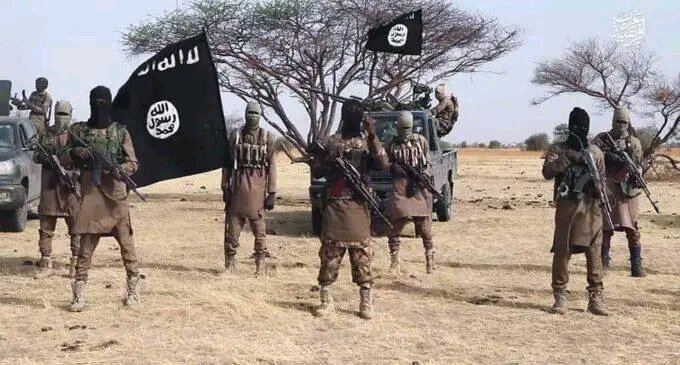
A major breakthrough has emerged in the ongoing fight against terrorism in Nigeria following revelations that a top commander of the Islamic State West Africa Province, widely known as ISWAP, had been under close surveillance by United States intelligence drones for nearly six months before he was eventually killed in a coordinated military strike.
The development has once again drawn international attention to the growing collaboration between Nigerian security forces and the United States in combating insurgency across the Lake Chad Basin and the wider northeastern region of Nigeria.
Security sources disclosed that the slain commander, identified as Abu Bilal al Mainuki, was considered one of the most dangerous and influential leaders within the extremist group. He was reportedly tracked through advanced aerial intelligence operations that monitored his movements, communication patterns, hideouts, and interactions with other senior insurgent figures operating within the region.

The operation that led to his death was reportedly executed through a joint intelligence sharing arrangement involving the Nigerian military and the United States Africa Command, also known as AFRICOM. Military analysts have described the mission as one of the most sophisticated counterterrorism operations carried out in recent months against terrorist networks operating in West Africa.
According to intelligence reports, surveillance drones monitored the commander’s activities across several remote territories within the Lake Chad region, an area notorious for insurgent camps, smuggling routes, and cross border militant activities. The region has remained one of the most volatile security flashpoints in Africa due to the prolonged activities of Boko Haram and ISWAP factions.
Sources familiar with the operation revealed that the prolonged monitoring was necessary to fully understand the commander’s network and identify key associates involved in planning attacks against both military personnel and civilians. Security officials reportedly wanted to ensure the operation would significantly weaken ISWAP’s operational capacity before launching the final strike.
Military insiders stated that the final assault was launched after intelligence confirmed the presence of several high ranking militants gathered at a strategic location believed to be used for operational planning. Precision targeting supported by aerial surveillance reportedly enabled troops to eliminate multiple insurgents during the raid.
The death of Abu Bilal al Mainuki is being viewed as a major symbolic and operational setback for ISWAP, which has continued to expand its influence in parts of northeastern Nigeria despite sustained military offensives over the years.
Counterterrorism experts believe the operation demonstrates the increasing importance of technology driven warfare in modern security operations. The use of drones for long term intelligence gathering has become a critical component in identifying insurgent hideouts, monitoring movement patterns, and preventing planned attacks before they occur.
Security analysts also noted that insurgent groups operating within the Sahel and Lake Chad Basin have become more sophisticated in recent years, often relying on remote terrain, encrypted communication, and mobile camps to evade detection. However, sustained aerial monitoring and intelligence coordination are gradually narrowing the operational space available to such groups.
The Nigerian military has intensified its campaign against terrorist elements in the northeastern part of the country following renewed government commitments to restore stability and protect vulnerable communities affected by years of insurgency.
Residents in parts of Borno State have continued to express hope that recent military gains will reduce attacks on villages, highways, and farming communities that have suffered repeated assaults from insurgents over the past decade.
Humanitarian agencies estimate that millions of people have been displaced across the Lake Chad region due to persistent violence linked to Boko Haram and ISWAP activities. Thousands of lives have also been lost since the insurgency began, creating one of Africa’s most devastating humanitarian crises.
Observers say international collaboration remains essential in confronting transnational terrorist threats, especially as extremist groups increasingly exploit porous borders and weak governance structures across parts of West Africa and the Sahel region.
The latest operation is also expected to strengthen military intelligence partnerships between Nigeria and allied countries committed to counterterrorism operations in Africa. Experts argue that intelligence sharing, surveillance technology, and coordinated military planning are becoming indispensable tools in addressing modern security challenges.
While the elimination of high profile insurgent leaders often disrupts terrorist operations temporarily, security experts caution that long term success will require sustained military pressure alongside economic development, community engagement, and rehabilitation programmes aimed at preventing radicalisation.
As Nigeria continues its battle against insurgency, the successful operation against Abu Bilal al Mainuki may represent another important step in weakening extremist networks that have threatened national security and regional stability for years.




