


tech-google-deepthink-mathematica-testing-openai
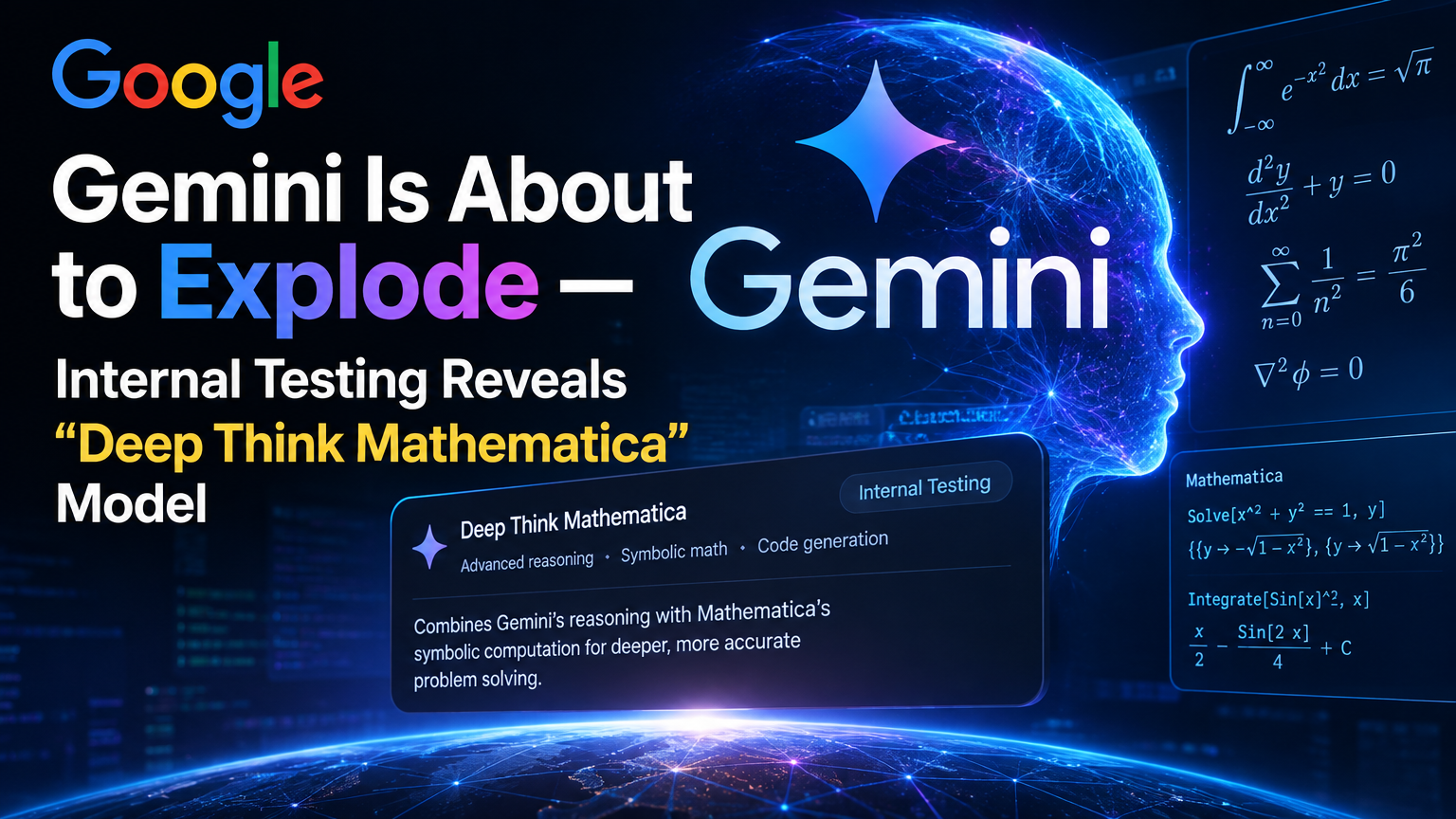
Google DeepThink Mathematica Enters Internal AI Testing The advanced Google DeepThink Mathematica model is currently undergoing internal testing. This system will launch soon, directly challenging OpenAI after its swarm agents recently tackled a Millennium Prize math problem. Google DeepThink Mathematica is currently in testing. This major upgrade will rival OpenAI and disrupt the global artificial intelligence sector.

Specifically, major developments are currently unfolding within the global artificial intelligence sector. Meanwhile, a fresh leak confirms new internal software trials. Consequently, the highly anticipated Google DeepThink Mathematica model is secretly operating. Essentially, this system will directly rival major competitors very soon.

Furthermore, observers spotted this next-generation math model during private engineering trials. Indeed, tech enthusiasts closely track these sudden platform updates. Subsequently, social media users shared various screenshots of the interface. As a result, excitement surrounding the software update has quickly skyrocketed.
Expanding Artificial Intelligence Power
Specifically, Google DeepThink Mathematica represents a massive upgrade over older systems. Previously, the company launched its Deep Think IMO model. In fact, that specific version achieved gold medals during Olympiad competitions. Therefore, engineers expect the upcoming variant to break new benchmark records. Additionally, this internal build relies on parallel reasoning to solve tasks.

Moreover, these platforms process mathematical formulas with intense speed. Specifically, the architecture handles massive amounts of data instantly. As a result, researchers save valuable time during complex experiments. Ultimately, this efficiency creates new opportunities for scientific exploration globally.
Simultaneously, experts link this development to recent industry breakthroughs. For example, OpenAI recently claimed a major mathematical victory. Specifically, their software tackled the Navier-Stokes Millennium Prize Problem. Of course, this complex puzzle has baffled human scientists for decades. Consequently, tech giants are now fiercely competing for mathematical dominance.
Navigating Complex Scientific Disputes
However, the recent OpenAI announcement sparked intense academic controversy globally. Indeed, independent researchers strongly question the exact verification methods used. Specifically, the team deployed a vast swarm of ten thousand agents. As a result, the artificial intelligence network generated a massive proof. Ultimately, critics demand transparent peer reviews from human academic professionals.
In contrast, mathematicians Tristan Buckmaster and Levent Alpöge claimed prior credit. Specifically, they stated that OpenAI copied their own early findings. In fact, the ensuing priority dispute continues across online forums today. Meanwhile, industry leaders dismiss these harsh allegations as simple misunderstandings. Consequently, public trust in automated scientific discoveries drops slightly. Furthermore, analysts compare this to the ongoing Michael Burry AI critique regarding exaggerated capabilities.
The Future of Google DeepThink Mathematica
Therefore, the Google DeepThink Mathematica project arrives at a crucial moment. Of course, the platform aims to provide undeniable proof of capability. Specifically, the system grants the software extra thinking time before answering. Through this, the tool avoids common logical errors during complex calculations. Ultimately, this deliberate processing mimics slow and careful human thought patterns.
Additionally, the technology could revolutionize basic educational tools very soon. For example, students could use these programs for advanced homework help. Indeed, automated tutors offer instant feedback on difficult geometry problems. As a result, global learning standards might improve dramatically across developing regions. Ultimately, artificial intelligence is reshaping how society approaches difficult academic subjects.
Furthermore, independent developers often build customized apps using these frameworks. Specifically, open access allows smaller startups to innovate rapidly. Consequently, the entire tech ecosystem benefits from these massive upgrades. Ultimately, collaborative programming efforts drive continuous progress across all industries.
Final Market Implications
To conclude, tech investors are closely monitoring these rapid software advancements. Specifically, massive financial investments depend on successful product launches this year. Consequently, companies must deliver reliable and accurate tools to retain users. In fact, early testing phases determine the final public release timelines. Therefore, users eagerly await official announcements from major tech developers soon.
Meanwhile, the race for artificial intelligence supremacy continues without any pause. Indeed, rival firms constantly push the boundaries of automated machine learning. Ultimately, the successful deployment of these tools will change daily life. As a result, society must adapt to these powerful digital assistants. Specifically, the upcoming software wars will define the next digital decade.




