


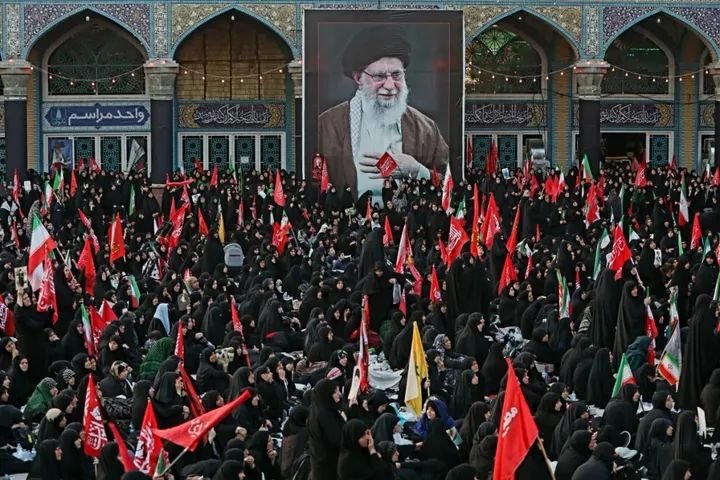
NAJAF, Iraq — The body of Iran’s late Supreme Leader Ayatollah Ali Khamenei has arrived in Iraq as part of a historic multi-day funeral procession that will take the remains through the Shia holy cities of Najaf and Karbala before his final burial in the northeastern Iranian city of Mashhad.
Khamenei, who led Iran for decades, was killed alongside four family members in a U.S. and Israeli strike in Tehran on February 28. His son, Mojtaba Khamenei, was subsequently selected as Iran’s new supreme leader by the Assembly of Experts in March.
The transfer of Khamenei’s body to Iraq marks a significant moment in the funeral proceedings, reflecting the deep religious and cultural ties between the two nations. Iraq, like Iran, is predominantly Shia Muslim and is home to several of the most sacred shrines in Shia Islam, including the Imam Ali Shrine in Najaf and the Imam Hussein Shrine in Karbala. The decision to include Iraq in the funeral rites underscores the late leader’s stature across the region and the importance of these holy sites in Shia tradition.
The funeral ceremonies in Iraq will follow a series of events in Iran that began on July 4 with a two-day farewell ceremony at the Imam Khomeini’s Mosalla prayer hall in Tehran. The Tehran events drew hundreds of thousands of mourners from across the country and were followed by a major funeral procession on Monday. On Tuesday, a ceremony was held in the central Iranian city of Qom, another major centre of Shia religious scholarship.

According to the funeral schedule, Khamenei’s body will be transferred to Iraq on Wednesday for further rites in Najaf and Karbala. While the Iraqi government had not officially confirmed specific details of the ceremonies at the time of reporting, Iranian officials had earlier indicated that more than 30 countries, as well as religious leaders from over 90 countries, had expressed readiness to attend the funeral ceremonies. Iranian Foreign Minister Seyed Abbas Araghchi had also visited Iraq to help coordinate the ceremonies there.
Following the events in Iraq, Khamenei’s body will be returned to Iran and laid to rest in Mashhad on Thursday, July 9, which the Iranian government has declared a day of national mourning. The final burial site is expected to draw massive crowds from across Iran and the region.
The funeral ceremonies have been described by Iranian officials as a “historic and very important” event for the Iranian people. The Iranian government has announced public closures in Tehran from Saturday to Tuesday to accommodate the ceremonies. The international response has been significant, with officials from over 100 countries expected to attend various events.
The funeral processions mark the final chapter for a leader who played a dominant role in Iranian and regional politics for decades. The events in Iraq, which will see Khamenei’s body carried through the streets of Najaf and Karbala, are expected to draw large crowds of mourners, reflecting the enduring influence of the late supreme leader across the Shia world.




