


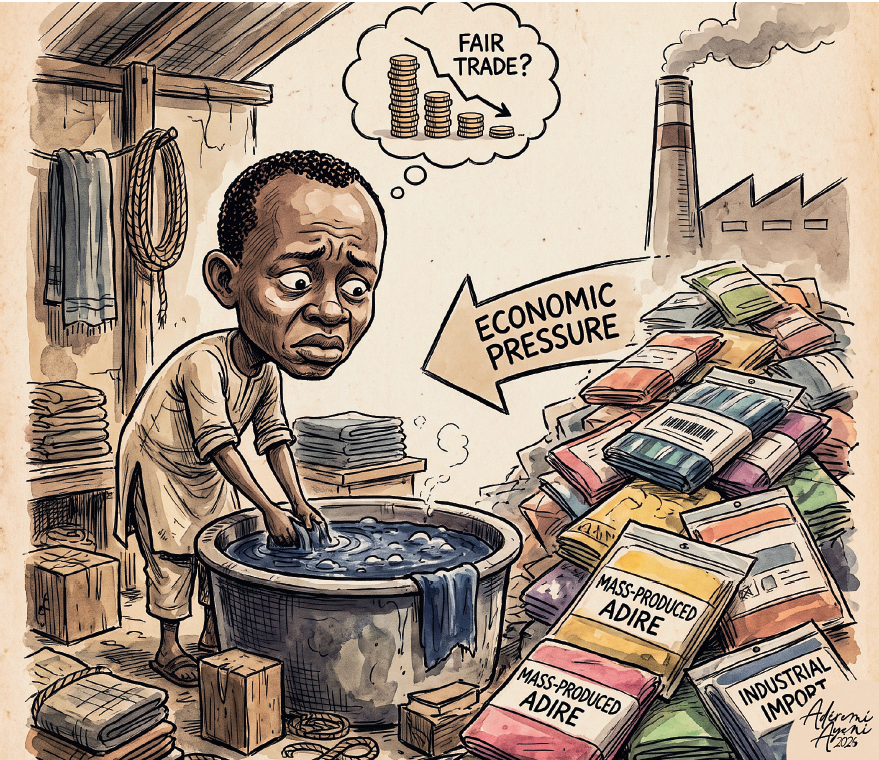
China’s growing involvement in the production and sale of Adire-style fabrics has sparked fresh concerns about the protection of Nigeria’s cultural products and the need for stronger trade policies.
Adire, a traditional Yoruba textile known for its distinctive patterns and dyeing techniques, has moved beyond its historical roots to become an important part of Nigeria’s fashion industry and cultural identity.
However, the increasing availability of foreign-made fabrics designed to look like Nigerian Adire is raising questions about how effectively the country protects its cultural heritage in an increasingly competitive global market.
The concern is not simply about where a particular fabric is manufactured.

It is about ownership, economic value, cultural identity and the ability of Nigerian producers to benefit from products that originate from the country’s own traditions. As Nigerian fashion continues to gain international attention, local cultural designs are becoming commercially attractive, creating opportunities for manufacturers outside the country to reproduce similar patterns and sell them at competitive prices.
Chinese manufacturers have become major players in global textile production because of their ability to produce large quantities of fabrics at relatively competitive prices.
This capacity allows designs inspired by African prints and traditional Nigerian aesthetics to reach markets quickly and in large volumes.
While international trade can create opportunities for consumers and businesses, it can also place traditional local producers under pressure when imported alternatives are cheaper and more widely available.
For Nigerian Adire producers, the challenge can be particularly difficult.
Authentic Adire is traditionally associated with hand-dyeing processes, locally developed patterns and techniques passed down through generations.
Production can require significant time, skill and labour, making it difficult for small-scale artisans to compete directly with mass-produced alternatives manufactured in large industrial facilities.
When cheaper imitations enter the market, consumers may choose based on price rather than authenticity.
A customer who wants an Adire-inspired outfit may not always know whether the fabric was produced by a Nigerian artisan or manufactured elsewhere.
Over time, this can weaken the commercial value of authentic Adire and reduce the income available to the people whose skills have preserved the craft.
The issue therefore highlights a broader weakness in Nigeria’s approach to cultural products.
Nigeria has numerous traditional goods with commercial potential, ranging from textiles and fashion to crafts, artwork, food products and indigenous designs.
Yet cultural identity does not automatically translate into economic ownership.
Without effective policies, intellectual property protection, geographical identification and trade measures, foreign producers can reproduce aspects of Nigerian cultural products and compete with local businesses.
This is where trade policy becomes important.
A well-designed trade framework can help Nigeria protect culturally significant products without unnecessarily restricting legitimate international commerce.
The goal should not be to prevent foreign manufacturers from producing African-inspired designs altogether, but to establish clear rules that distinguish authentic Nigerian products from foreign imitations and protect consumers from misleading claims.
One possible approach is stronger geographical indication protection.
Geographical indications are used in different parts of the world to connect particular products with specific locations and production traditions.
Such protection could potentially help establish clearer recognition for culturally significant Nigerian products where appropriate.
If consumers understand what qualifies as authentic Nigerian Adire, producers who meet those standards could gain greater commercial recognition.
Nigeria also needs to strengthen intellectual property awareness among artisans and small businesses.
Many local producers have unique patterns, logos, brand names and design concepts but may not understand how to protect them.
Government agencies, industry associations and creative-sector organisations could provide easier access to information and affordable registration systems.
DDM News notes that the debate surrounding foreign-made Adire should also be viewed through the larger question of Nigeria’s creative economy.
Fashion and textiles are no longer merely cultural expressions; they are commercial industries capable of creating employment, generating exports and attracting international investment.
Protecting Nigerian cultural products can therefore become part of a broader economic strategy.
The government could also support local textile manufacturers by improving access to finance, technology, electricity and modern production equipment.
One reason imported fabrics remain competitive is the difference in production costs.
If Nigerian manufacturers face expensive energy, transportation and financing costs, simply restricting imports will not solve the underlying problem.
Local producers must be given the capacity to compete on quality, price, reliability and scale.
There is also a role for consumers. Nigerians who value cultural authenticity can support artisans and local textile businesses by asking questions about where fabrics are produced and choosing genuine Nigerian products when possible.
This can create market demand for authentic goods and encourage producers to maintain traditional techniques while developing modern designs.
At the same time, Nigerian Adire should not remain trapped in its traditional market.
The country has an opportunity to turn the textile into a stronger international brand.
Nigerian designers are already using Adire in contemporary dresses, shirts, trousers, jackets and accessories.
With proper branding, certification and export support, Adire could become a recognisable Nigerian cultural product in international fashion markets.
The challenge is that global recognition without adequate protection can produce an unintended outcome.
The more popular a Nigerian cultural product becomes, the greater the incentive for other manufacturers to reproduce it.
Nigeria therefore needs to move beyond celebrating its cultural heritage and begin treating cultural products as valuable economic assets.
A stronger trade policy could include clearer labelling requirements, stronger enforcement against counterfeit branding, support for local textile producers and better coordination between trade, culture, intellectual property and creative-industry institutions.
Such measures would allow Nigeria to participate in international trade while ensuring that local producers are not unfairly disadvantaged.
The issue also raises an important question about what happens when culture becomes a global commodity.
Cultural exchange is not inherently negative. Nigerian fashion itself draws inspiration from different cultures and global trends.
The concern arises when traditional Nigerian products are commercially reproduced without adequate recognition of their origins, while the original producers struggle to compete in their own market.
DDM News reports that the growing debate over Adire should therefore serve as a warning and an opportunity.
Nigeria has the cultural resources to build a powerful creative economy, but cultural wealth must be matched with economic protection, modern production systems and strategic trade policies.
Adire represents more than a piece of fabric. It carries history, craftsmanship, identity and the economic potential of generations of Nigerian artisans.
If Nigeria wants its cultural products to compete globally, it must protect them with the same seriousness given to other valuable economic assets.
The appearance of Adire-inspired fabrics from China should not simply be treated as a dispute over imported textiles.
It should encourage a broader national conversation about how Nigeria can protect, commercialise and export its cultural heritage.
With the right policies, authentic Adire can remain firmly connected to its Nigerian roots while becoming an even stronger product in the global fashion market.




