


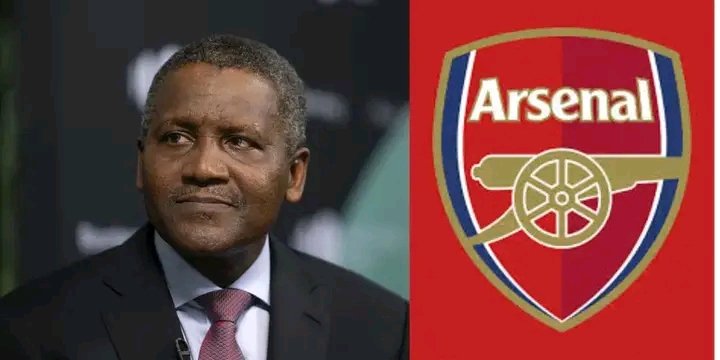
LAGOS, NIGERIA — Africa’s richest businessman, Aliko Dangote, has explained why he eventually decided against pursuing his long-discussed ambition of buying English Premier League club Arsenal.
Dangote, who had repeatedly expressed interest in acquiring the North London club over the years, said changing business realities and the rising valuation of the club influenced his decision to step away from the idea.
The billionaire businessman disclosed that the opportunity to purchase Arsenal became increasingly difficult as the club’s value continued to rise significantly.
According to him, there was a period when buying the club appeared financially realistic, particularly before major commercial growth and ownership restructuring increased its market worth.

Dangote stated that his focus later shifted toward completing the multibillion-dollar Dangote Refinery project, which demanded enormous financial commitment and strategic attention.
He explained that constructing and stabilizing the refinery became a national and corporate priority that required full concentration.
The businessman noted that the refinery project consumed substantial resources and became one of the most ambitious industrial investments ever undertaken in Africa.
Observers say Dangote’s previous interest in Arsenal generated excitement among many Nigerian football fans who hoped an African businessman would eventually own one of Europe’s biggest clubs.
The billionaire had publicly spoken in past interviews about his admiration for Arsenal and his long-term ambition to acquire the club after completing the refinery project.
At different times, Dangote suggested he could consider buying the club once the refinery became fully operational and financially stable.
However, he now says the economics surrounding football club ownership have changed considerably.
Analysts note that the commercial value of elite European football clubs has surged sharply in recent years due to broadcasting rights, sponsorships, global fan engagement, and international investments.
Arsenal has also witnessed renewed growth both commercially and competitively following recent strong performances in the English Premier League and European competitions.
Sports business experts believe the increased valuation of major football clubs has made acquisitions far more expensive than they were a decade ago.
Dangote nevertheless maintained his admiration for Arsenal and acknowledged his continued support for the club despite abandoning takeover ambitions.
The Nigerian billionaire is widely recognized for investments spanning cement, sugar, salt, fertilizer, petrochemicals, and oil refining.
His refinery project, located in Lagos, has remained one of the most discussed industrial developments in Nigeria due to expectations surrounding fuel supply, energy security, and economic impact.
Political and economic observers believe Dangote’s decision reflects a broader trend where African billionaires increasingly prioritize infrastructure and industrial investments over luxury international acquisitions.
Football fans across social media reacted differently to the revelation, with some expressing disappointment while others praised Dangote for focusing on projects considered more beneficial to Nigeria’s economy.
The Arsenal ownership structure has remained stable in recent years under the Kroenke family, who maintain majority control of the club.
Attention now shifts to Dangote’s expanding business empire and the continued operational growth of the refinery project, which many believe could significantly reshape Nigeria’s energy sector.




