


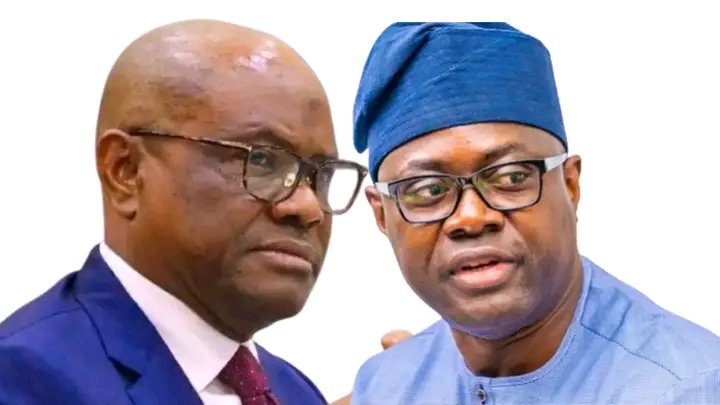
The Minister of the Federal Capital Territory, Nyesom Wike, has strongly dismissed reports suggesting an emerging political alliance between Oyo State Governor, Seyi Makinde, and the Allied Peoples’ Movement, describing the alleged arrangement as deceptive and politically misleading.
Wike, who spoke in reaction to growing speculation within Nigeria’s opposition circles, accused the purported coalition of lacking legitimacy and internal party approval. He insisted that any political collaboration not recognised by the formal structures of the Peoples Democratic Party cannot be considered valid or binding on the party.
He further described the alleged alliance as a “political 419,” a phrase commonly used in Nigeria to refer to fraudulent activity, arguing that the development was designed to misinform party members and the wider public ahead of the 2027 general elections.

The controversy is the latest flashpoint in the ongoing tension within the Peoples Democratic Party, which has continued to struggle with internal disagreements over leadership authority, coalition strategy, and control of party structures at various levels.
Political observers say the latest exchange highlights the widening rift between key power blocs within the PDP, particularly between those aligned with Wike and supporters of Governor Makinde. The disagreement reflects deeper structural challenges facing the party as it attempts to reposition itself ahead of the next national elections.
According to political insiders, discussions around possible alliances and political partnerships have intensified within opposition circles as parties begin early preparations for the 2027 elections. However, these discussions have also exposed competing interests and differing visions on how best to challenge the ruling All Progressives Congress.
Wike maintained that the PDP must first address its internal crisis before engaging in any external political negotiations. He argued that unresolved leadership disputes and parallel structures within the party undermine its credibility and weaken its chances of presenting a united front.
He warned that attempts to create parallel political arrangements outside recognised party institutions could further deepen divisions within the opposition and complicate ongoing reconciliation efforts. His comments are seen as part of a broader push by his political bloc to assert control over key decision making processes within the party.
On the other hand, supporters of Governor Makinde have continued to advocate for broader consultation and coalition building, arguing that opposition unity may be necessary to strengthen the party’s electoral competitiveness in 2027. They maintain that strategic alliances across political groups could help consolidate support ahead of the elections.
Despite these differing positions, both sides acknowledge that the PDP is currently facing one of its most significant internal challenges since the return of democratic rule in 1999. The absence of a unified direction has led to repeated public disagreements among top party figures, further fueling uncertainty within its ranks.
Analysts note that the latest remarks by Wike could further heighten tensions within the party, especially as efforts to reconcile competing factions remain ongoing but fragile. They caution that unresolved disputes could affect the party’s organisational strength and electoral readiness.
The PDP’s internal struggle has also become a central topic in Nigeria’s broader political discourse, as opposition parties continue to explore potential realignments and coalition strategies ahead of the next general elections. These developments are increasingly shaping early political calculations across the country.
As preparations for 2027 gradually gain momentum, political stakeholders expect more confrontations and negotiations within and outside major parties. The evolving situation within the PDP is therefore being closely watched as a key indicator of how opposition politics may unfold in the coming years.
For now, Wike’s sharp rejection of the alleged Makinde–APM alliance has added fresh tension to an already divided political environment, reinforcing concerns about unity, trust, and direction within one of Nigeria’s most influential opposition parties.




