


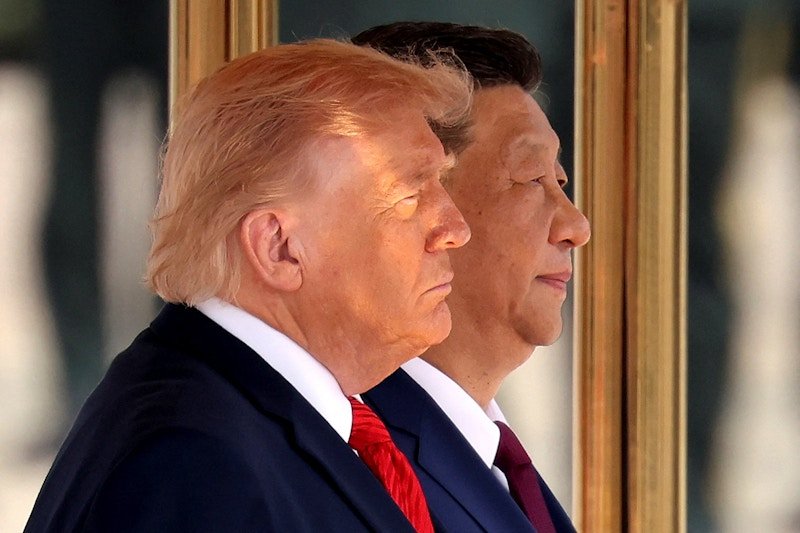
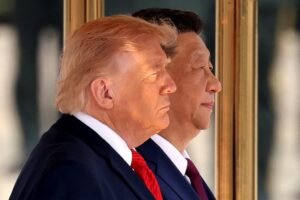
United States President Donald Trump and Chinese President Xi Jinping wrapped up the first day of talks in Beijing on Thursday, with both leaders focusing on growing tensions over Taiwan, the Iran conflict, trade, and global energy security.
The meeting, held at Beijing’s Great Hall of the People, marked Trump’s first visit to China since returning to office and the first by a sitting US president since his 2017 trip.
During more than two hours of closed-door discussions, Xi warned that mishandling the Taiwan issue could push relations between both countries toward “conflict,” according to China’s official summary of the meeting.

Taiwan remains the most sensitive issue in China-US relations. Beijing considers the self-ruled island part of its territory and has repeatedly vowed to reunify with it, by force if necessary.
The United States, while officially recognising Beijing’s position, maintains close unofficial ties with Taiwan and continues to supply defensive weapons to the island.
Although the White House summary of the talks did not initially mention Taiwan, US Secretary of State Marco Rubio later confirmed that the issue came up during discussions.
“US policy on Taiwan is unchanged,” Rubio said in an interview with NBC.
“They always raise it, we make our position clear, and we move on.”
He added that Washington would oppose any attempt to change Taiwan’s status by force.
Another major issue during the summit was the ongoing Iran conflict and its impact on global oil supplies.
According to the White House, Trump and Xi agreed that the Strait of Hormuz “must remain open” to ensure the free flow of energy supplies.
The strategic waterway has faced major disruptions since fighting involving Iran escalated earlier this year.
China is heavily dependent on Middle Eastern oil, with more than half of its seaborne crude imports passing through the strait.
The White House also said Xi expressed interest in increasing purchases of American oil to reduce China’s dependence on Middle Eastern supply routes, though Beijing’s official statement did not mention the claim.
Rubio later clarified that Trump raised concerns about Iran’s nuclear programme during the talks but did not ask China for direct assistance.
“We’re not asking for China’s help,” Rubio said. “But it’s important both countries agree the Strait of Hormuz should not be militarised.”
Trade negotiations also featured prominently during the summit.
Xi reportedly told Trump that recent discussions between officials from both countries had made progress, following years of economic tensions and tariffs that strained relations between Washington and Beijing.
The two leaders also agreed to pursue what Chinese officials described as a “constructive and strategically stable relationship” over the next three years.
Earlier in the week, delegations led by US Treasury Secretary Scott Bessent and Chinese Vice Premier He Lifeng met in South Korea ahead of the Beijing summit.
Several top American business executives accompanied Trump on the trip, including Apple CEO Tim Cook, Nvidia chief Jensen Huang, and Tesla and SpaceX boss Elon Musk.
Speaking at a meeting with the executives, Chinese Premier Li Qiang encouraged American companies to deepen their investments in China and help strengthen ties between both nations.
Trump told Xi the business leaders had travelled to Beijing to “pay respects” and expand commercial opportunities.
Aside from formal talks, Trump and Xi also toured Beijing’s historic Temple of Heaven before attending a lavish state banquet at the Great Hall of the People.
At the dinner, Xi described the China-US relationship as “the most important bilateral relationship in the world.”
“We must make it work and never mess it up,” the Chinese leader said.
Trump called the day’s discussions “extremely positive and productive” and formally invited Xi and his wife to visit the White House later this year.
The summit continues on Friday with additional bilateral meetings before Trump departs Beijing.




