


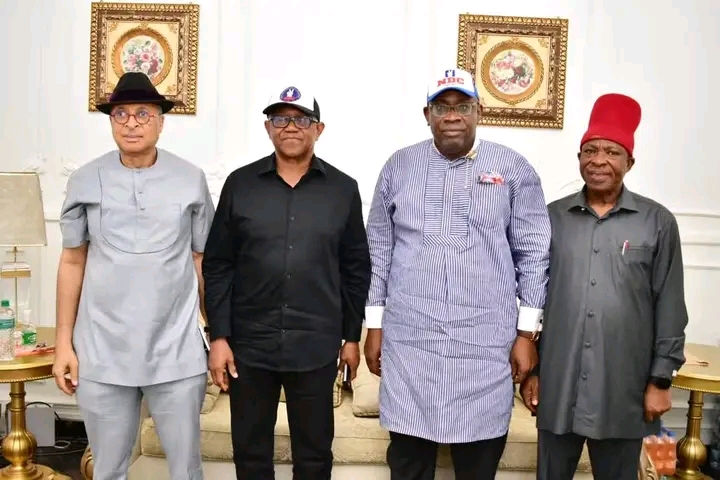
A major internal dispute within the Nigeria Democratic Congress has been officially resolved following a closed-door reconciliation meeting involving key party leaders, including presidential candidate Peter Obi and senior party figure Senator Seriake Dickson.
The meeting, which brought together top stakeholders of the emerging political platform, was convened to address recent disagreements that had threatened unity within the party following tensions linked to its internal primaries and leadership structure.
Speaking after the discussions, Dickson confirmed that all contentious issues had been thoroughly addressed and resolved in the interest of party unity and long-term stability. He described the engagement as frank, constructive and guided by a shared commitment to strengthening the party’s national outlook.

According to him, the leadership took time to review the concerns raised by various factions within the party, particularly those relating to the conduct of the primaries, allocation of responsibilities and internal communication gaps that had created friction among stakeholders.
He explained that after extensive deliberations, all parties reached a consensus to move forward with renewed unity, placing collective political goals above individual grievances.
The development is seen as a significant step for the Nigeria Democratic Congress, which has recently been undergoing rapid expansion and attracting influential political figures from different regions of the country.
Political analysts note that emerging political parties often experience internal disagreements as they transition from formation stages to full national structures. However, the ability to resolve such disputes quickly is often viewed as a critical test of leadership maturity and organisational strength.
Senator Dickson emphasised that the party remains focused on building a strong and credible alternative political platform capable of competing effectively in Nigeria’s evolving democratic space. He added that unity among leaders is essential if the party hopes to achieve its long-term objectives.
He further disclosed that part of the agreement reached during the meeting includes improved coordination among party organs, clearer guidelines for future primary elections and strengthened mechanisms for conflict resolution within the party structure.
The reconciliation also reportedly includes renewed commitments to internal discipline, ensuring that members resolve disputes through established party channels rather than through public disagreements that could damage the party’s image.
Peter Obi’s participation in the meeting has drawn particular attention, given his prominence in national politics and his influence within opposition circles. His involvement underscores ongoing efforts to stabilise emerging political alliances and maintain cohesion among key stakeholders.
Observers say Obi’s presence at the reconciliation meeting signals his continued engagement in efforts to build consensus within opposition politics ahead of future elections. His political standing has made him a central figure in discussions around coalition building and party alignment across Nigeria’s political landscape.
Sources within the party indicate that recent tensions were largely driven by disagreements over internal processes and expectations following the primaries. Some stakeholders had expressed concerns about fairness, communication and the implementation of party guidelines.
However, the leadership has now agreed to address these concerns through structured reforms aimed at improving transparency and trust within the organisation.
The reconciliation meeting also reportedly focused on strengthening internal communication channels to ensure that all party members are adequately informed and involved in key decision-making processes.
Party insiders believe that the resolution of the crisis will help restore confidence among members and supporters who had become concerned about the stability of the party in recent weeks.
Political commentators argue that internal cohesion will be crucial for the Nigeria Democratic Congress as it seeks to position itself as a viable alternative in Nigeria’s competitive political environment.
They note that in a political system where established parties dominate, emerging platforms must maintain strong internal unity to build credibility and attract broader public support.
The meeting is therefore being viewed as a strategic turning point for the party, marking a shift from internal disagreements to renewed focus on organisation building, grassroots mobilisation and policy development.
Senator Dickson called on all members of the party to remain committed to its collective vision and to avoid actions that could undermine internal unity. He stressed that personal interests must be subordinated to the broader goal of building a strong democratic institution.
He also reaffirmed the party’s commitment to democratic principles, internal inclusiveness and respect for diverse opinions within its structure.
With the crisis now resolved, attention is expected to shift to how effectively the party can implement the agreed reforms and maintain unity as it prepares for future political contests.
Analysts say the durability of the reconciliation will depend on sustained communication, fair internal processes and consistent leadership engagement at all levels of the party structure.
For now, the leadership appears confident that the agreement reached will hold and provide a solid foundation for the party’s future activities.
The resolution marks a critical moment for the Nigeria Democratic Congress as it seeks to consolidate its presence and strengthen its organisational framework in Nigeria’s dynamic political environment.
As preparations continue for future elections, the party’s ability to maintain unity following this reconciliation will likely play a key role in determining its political relevance and long-term success.




