


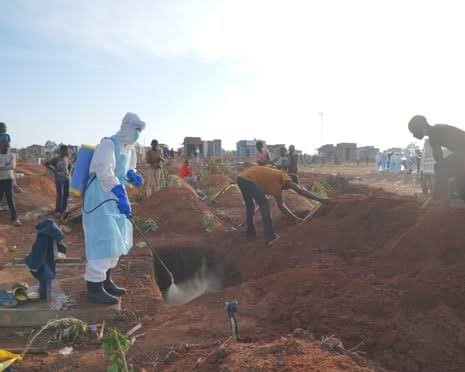
The ongoing Ebola outbreak in the Democratic Republic of the Congo (DRC) has become the deadliest in the country’s history, after the number of reported deaths rose to 2,325.
According to the latest government health data, the outbreak has recorded 4,945 confirmed cases, including 101 new cases reported within the previous 24 hours. The death toll has now surpassed the 2,299 fatalities recorded during the country’s 2018–2020 Ebola outbreak.
The development has intensified concerns among health authorities and international organisations as efforts continue to contain one of the fastest-growing Ebola outbreaks ever recorded.
Outbreak caused by rare Ebola strain
The current outbreak is being driven by the Bundibugyo strain of Ebola, a relatively rare species of the virus.

The outbreak was officially declared in May 2026 after cases were detected in northeastern DRC. Since then, transmission has expanded across six provinces, with Ituri Province accounting for the largest share of reported infections and deaths.
The World Health Organization has warned that the outbreak is occurring in a difficult environment marked by insecurity, population movement, limited healthcare infrastructure and challenges in reaching affected communities.
Rising fatalities raise concern
The latest figures show how quickly the outbreak has progressed.
Reuters reported that the case-fatality ratio has risen from about 20 per cent in early June to approximately 46 per cent. Health experts say the increase is linked largely to delays in detecting infections and getting patients into appropriate medical care, rather than evidence that the virus itself has become more lethal.
The high number of infections being identified outside established contact-tracing networks has also complicated efforts to contain transmission.
No approved vaccine or treatment for the strain
One of the major challenges facing health authorities is the absence of an approved vaccine or specific treatment for the Bundibugyo strain.
The WHO says work is ongoing to evaluate promising vaccine and treatment candidates. However, these products remain under investigation and are not yet approved specifically for this strain.
Health authorities are therefore relying heavily on early detection, isolation, supportive medical care, contact tracing, infection prevention and community cooperation to slow transmission.
Healthcare system under pressure
The response is also being affected by limited healthcare resources and insecurity in some affected areas.
Health workers have faced difficult working conditions, while poor infrastructure and population displacement have made it harder to identify people who may have been exposed to the virus. In some communities, misinformation and distrust have further complicated public-health efforts.
Ituri remains the epicentre of the outbreak, with the province accounting for more than 3,400 confirmed cases according to the latest reports.
Uganda continues monitoring
The outbreak has also raised concerns about possible cross-border transmission because of the movement of people between the DRC and neighbouring countries.
Uganda previously recorded cases linked to the outbreak, but authorities were able to limit the spread, with two deaths reported there. Health officials continue to maintain surveillance and preparedness measures because of the possibility of imported infections.
Public urged to take precautions
Ebola is transmitted primarily through direct contact with the blood or other bodily fluids of infected people and through contaminated materials.
Health authorities continue to urge people in affected communities to report suspected cases quickly, cooperate with medical teams and avoid contact with the bodily fluids of people who are sick or have died from suspected Ebola.
Early diagnosis and appropriate medical care can improve the chances of survival and reduce the risk of further transmission.
The latest figures underscore the scale of the challenge facing the DRC. With 2,325 deaths and 4,945 confirmed cases, health authorities and international partners are under increasing pressure to strengthen surveillance, expand access to treatment and prevent the outbreak from spreading further.
The situation remains closely monitored as health officials work to bring the rapidly expanding outbreak under control.




