


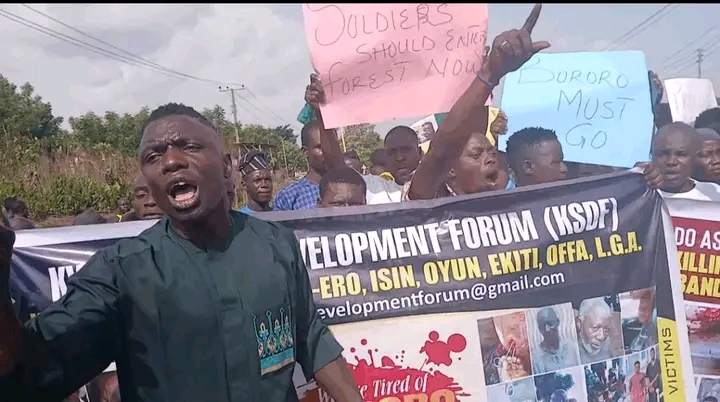
ILORIN, NIGERIA — Residents of Kwara South have staged widespread protests over worsening insecurity in the region, calling on government authorities to take immediate and decisive action to address escalating cases of killings, kidnappings, and mass displacement.
The protests began on Tuesday, April 21, 2026, at approximately 10:00 a.m., across several communities including Omu-Aran, Offa, and parts of Oke-Ero and Ekiti Local Government Areas, where hundreds of demonstrators took to the streets to express frustration over what they described as a prolonged security crisis.
Protesters, comprising youths, women, and community leaders, blocked major roads and carried placards with inscriptions highlighting their grievances, including demands for protection, justice for victims, and urgent government intervention. Many chanted slogans condemning the persistent attacks and calling for accountability from security agencies.
Residents alleged that armed groups have repeatedly invaded villages, carrying out abductions and violent attacks, often at night, with little or no resistance. Some community members claimed that kidnappers now operate with increasing boldness, targeting farmers, traders, and commuters along rural roads.

Local leaders who addressed the crowds said the situation has severely disrupted economic activities, particularly farming, which is the main source of livelihood in the area. They explained that many farmers have abandoned their farmlands due to fear of attacks, leading to reduced agricultural output and rising food insecurity.
Eyewitness accounts from affected communities described how families have been forced to pay heavy ransoms to secure the release of kidnapped relatives, further deepening poverty and hardship. In some cases, victims were reportedly killed despite ransom payments, intensifying anger among residents.
Community representatives also raised concerns over the displacement of villagers, with several households relocating to safer towns or urban centres to escape the violence. This has placed additional pressure on host communities and strained already limited resources.
The protesters demanded the immediate deployment of more security personnel, including military and paramilitary forces, to identified flashpoints. They also called for the establishment of permanent security checkpoints and improved surveillance to deter criminal activities.
In response, local government officials acknowledged the gravity of the situation and assured residents that steps are being taken to reinforce security architecture in the region. They indicated that collaboration with federal security agencies has been strengthened to improve intelligence gathering and rapid response.
Security experts say the rising insecurity in Kwara South reflects a broader pattern of rural banditry and kidnapping spreading into previously less-affected areas. They stress that addressing the crisis will require a combination of force, intelligence, and community engagement.
Civil society groups have also weighed in, urging authorities to adopt a comprehensive approach that includes addressing underlying issues such as unemployment, poverty, and weak local security structures.
As protests continue, residents insist they will sustain peaceful demonstrations until concrete and visible actions are taken to restore safety, protect livelihoods, and rebuild confidence in the government’s ability to secure lives and property in Kwara South.




